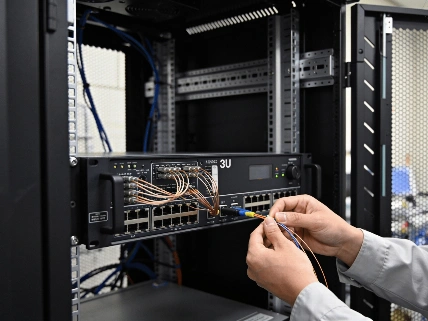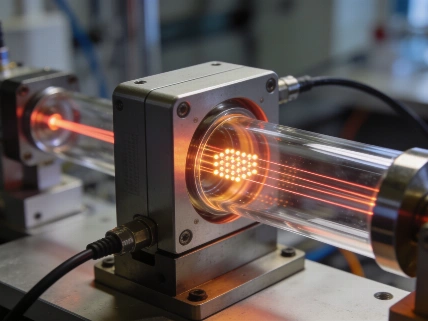
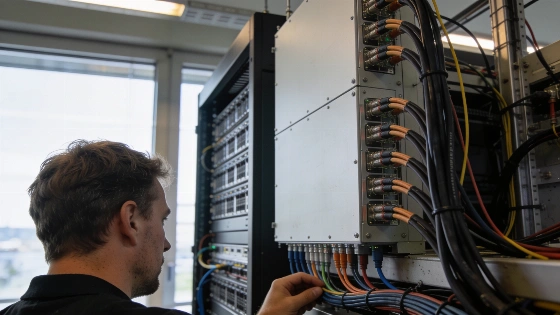
Swiss startup Qambria has raised CHF 2 million to develop vendor-neutral software that links quantum processors with high-performance computing systems and handles real-time control tasks.
Qambria AG has raised CHF 2.0 million, equivalent to $2.4 million in the funding announcement, to build the classical control layer it says future fault-tolerant quantum systems will need. The Zurich company is not manufacturing a quantum processor; it is developing software intended to connect quantum processing units directly to standard high-performance computing nodes.
The company's central premise is technically sound: a quantum processor would operate as a specialized accelerator rather than replace conventional computing infrastructure. That architecture leaves classical systems responsible for scheduling workloads, supplying data and processing measurement results quickly enough to keep quantum hardware operating effectively.
Qambria says existing systems often rely on improvised general-purpose classical hardware for these tasks. Its proposed vendor- and modality-neutral engine is designed to coordinate different quantum hardware approaches while supporting real-time data feeding and quantum error-correction decoding at sub-microsecond timescales.
In a fault-tolerant architecture, the classical layer is part of a feedback loop. Measurement results are converted into syndrome data, a decoder estimates the most likely error pattern, and the control system uses that information to determine the next operation or correction. The relevant timing is therefore not simply the speed of an isolated processor; it includes measurement, data transfer, decoding, decision-making and signal delivery.
That description is a technology objective rather than a published performance demonstration. The available independent announcement provides no measured decoder latency, error rate, processor configuration, operating temperature, qubit count or independent benchmark. Those omissions matter because the control requirements of superconducting, trapped-ion and photonic systems can differ substantially even when they share the same broad need for fast classical processing.
Research programs associated with institutions such as MIT and CERN commonly treat quantum hardware, control electronics and classical computation as coupled engineering layers rather than as interchangeable measures of progress. The distinction is also reflected in peer-reviewed quantum-error-correction work, including Nature's surface-code study, where logical performance depends on the behavior of an integrated error-correction system, not merely on the number of physical qubits.
The CHF 2.0 million pre-seed round is valued at $2.4 million in the announcement. Syntropy led the financing through its Frontier Investment Track, with participation from Qbeat Ventures, Kensho VC, BC Growth Equity and QAI Ventures.
Qambria was co-founded by CEO Dominik Ulmer and CTO Dr. Jens Krüger. Its business model is based on licensing intellectual property rather than building dedicated control hardware, allowing quantum hardware manufacturers, HPC system integrators and enterprise data centers to embed the control and orchestration stack into existing classical infrastructure.
The licensing approach limits the company's direct hardware footprint, but it does not remove the engineering challenge. A useful control layer must operate reliably across changing hardware interfaces, calibration conditions and error models. It must also coordinate classical computation with quantum measurement quickly enough that decoding does not become the slowest element in the system.
Because the product is described as modality-neutral, its practical value will depend on the interfaces it exposes and on how much device-specific adaptation remains necessary beneath the software layer. A common orchestration engine could simplify deployment, but neutrality alone does not demonstrate that identical timing, calibration or decoding behavior can be achieved across distinct processor technologies.
Quantum error correction uses measurements of error syndromes to infer whether an encoded quantum state has been disturbed. A decoder then processes those syndromes and supplies information needed for corrective operations or control decisions. The decoder can therefore be essential to fault-tolerant operation without being, by itself, evidence that a fault-tolerant computer exists.
Qambria's emphasis on sub-microsecond decoding identifies a real systems problem, but the announcement does not establish a logical qubit, a completed error-correction cycle or a reduction in logical error rates. It also does not report a code, a physical-qubit overhead, a decoder architecture or a demonstration on quantum hardware. The claim should therefore be read as a commercialization target for infrastructure rather than as a reported advance in quantum processor performance.
This distinction is increasingly important as quantum companies move from isolated hardware demonstrations toward integrated systems. Earlier coverage of a trapped-ion project similarly showed how processor architecture and classical control must be considered together rather than reduced to a raw qubit count.
The same caution applies to comparisons with large scientific-computing environments, including those associated with CERN. High-performance computing can provide scheduling, storage and numerical processing, but it does not automatically supply the low-latency control path required by a particular quantum device. The engineering question is whether the complete hardware-software stack can meet its timing and reliability requirements under defined operating conditions.
The financing gives Qambria resources to commercialize its platform, but investment is not technical validation. The available public account does not identify a deployed customer, a completed integration, a peer-reviewed paper or independent testing. It also does not show whether the proposed engine has operated across multiple quantum modalities or whether its licensing model has been tested in a production data center.
For potential users, the decisive evidence will be concrete: sustained decoder latency, reproducible behavior under changing workloads, compatibility with real control electronics and a clear accounting of classical preprocessing and postprocessing. A sub-microsecond target may be meaningful in one architecture and insufficient in another, depending on measurement cadence, communication pathways and the time available before the next control decision.
Qambria is addressing an underreported part of quantum computing: the conventional computing infrastructure surrounding the quantum device. That makes the company's direction more credible than claims that quantum processors will simply displace HPC systems. Yet the funding announcement supports a business and engineering program, not a demonstrated fault-tolerant capability.
Only one independent public account was identified for the financing, and no separate company press release, regulatory filing or investor statement was found to corroborate the deal details. The strongest current conclusion is therefore limited: Qambria has identified a necessary systems layer and attracted early capital to develop it; whether that layer can meet real hardware demands will depend on measurements the company has not yet disclosed.
In quantum computing, a physical qubit is an individual controllable quantum system, while a logical qubit encodes information across multiple physical qubits so errors can be detected and corrected. A fast classical decoder can help process the syndrome data from that code, but speed alone does not lower the logical error rate. It becomes part of a useful fault-tolerant architecture only when the complete system demonstrates reliable correction under defined operating conditions, and Qambria's announcement does not yet provide that evidence.