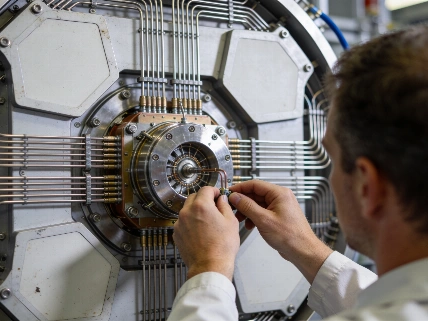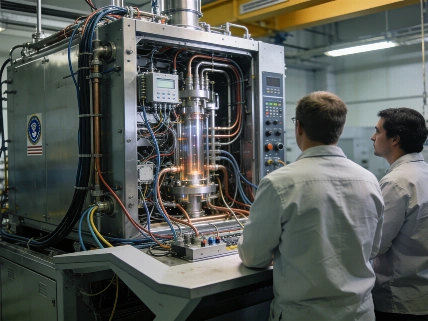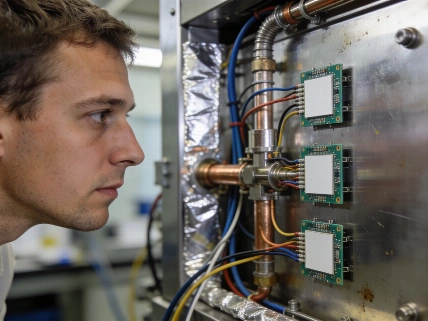
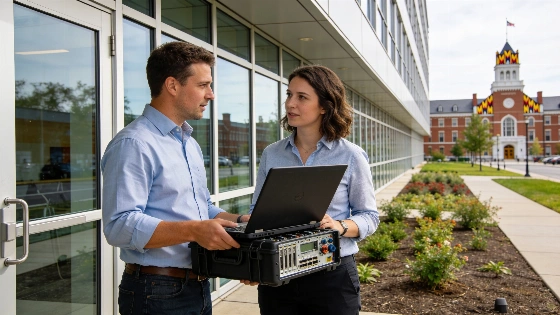
Riverlane has set up its US headquarters in Maryland's Discovery District to speed up real-time quantum error correction projects and work more closely with quantum hardware makers and academic researchers.
Riverlane has chosen Maryland's Discovery District for its US headquarters, placing its quantum error correction (QEC) work in the middle of a major American research cluster. The new site, just steps from the University of Maryland, will handle executive operations, lab development, and direct work with hardware partners. The goal is to move real-time QEC from theory into practice across several quantum computing platforms, as the field tries to move beyond noisy qubits toward more reliable, large-scale systems. The area's quantum research network includes the NSF Quantum Leap Challenge Institute for Robust Quantum Simulation-a $37.5 million, five-year project led by the University of Maryland, Duke, and Princeton-which draws both academic and commercial quantum research to the region.
Deltaflow and real-time decoding
Riverlane's main product is Deltaflow, a QEC platform that combines its own hardware decoders, QEC chips, and a compiler to enable real-time syndrome decoding. Deltaflow is built to work with a range of quantum hardware, including superconducting, trapped-ion, neutral-atom, and silicon spin-qubit devices. Riverlane says Deltaflow is already in use with more than 60% of the world's quantum hardware companies and national supercomputing centers, as the industry looks for ways to lower error rates that limit practical quantum computing. In September 2026, Riverlane announced a partnership with FPGA maker Altera to develop more flexible control and error-correction systems, using Altera's field-programmable gate arrays to speed up real-time decoding and cut latency in QEC workflows.
The Maryland office will also include facilities for customer integration, letting hardware developers and end users work directly with Riverlane's team. The company's Deltakit software development kit is meant to make QEC integration easier for partners. Being in the Discovery District puts Riverlane close to the Joint Center for Quantum Information and Computer Science (JQI), the US Army Research Laboratory, and hardware companies like IonQ and Microsoft. Maryland's Capital of Quantum initiative, which aims for $1 billion in quantum investment by 2030, adds to the region's focus on quantum technology. The clustering of quantum companies in the Discovery District is similar to innovation hubs at places like MIT and Stanford, where close ties to academic research and federal funding help move technology from lab to market.
Research partnerships and workforce development
Riverlane's expansion goes beyond hardware. The company has started a partnership with the University of Maryland focused on workforce training, student fellowships, and joint research on real-time decoding algorithms. This effort is meant to address the shortage of engineers and physicists with hands-on QEC experience, which has slowed progress toward scalable quantum computing. The partnership gives students direct access to Deltaflow hardware and software, connecting academic research with industry needs. The University of Maryland's role in quantum research, recognized by the National Science Foundation and covered in Nature, makes it a key partner for Riverlane's US plans.
Riverlane now has sites in Cambridge (UK), Boston, and Delft, and has raised over $120 million, including an $85 million Series C round. The US expansion builds on work with hardware partners like IQM and Quantum Motion, and is backed by state infrastructure investment. The announcement comes during the 2026 Quantum World Congress in Maryland, highlighting the competition among quantum technology companies to show progress on error-corrected computing. Maryland Governor Wes Moore has publicly supported the project, pointing to the state's resources, research strength, and workforce as reasons for growth in quantum science.
Technical and operational context
Riverlane's Maryland operations focus on real-time decoding and QEC chip development. The Deltaflow platform is designed to process error syndromes quickly enough for active correction, a technical challenge for both hardware and software teams. Using FPGA-based decoders and custom QEC chips is meant to reduce latency and handle the high data rates of modern quantum processors. While Riverlane reports broad industry use, the real impact will depend on whether these systems can consistently lower logical error rates across different hardware and in real-world conditions. Journals like Science and Nature have called for more rigorous benchmarking and open data in quantum error correction research, highlighting the need for reproducible results.
Maryland's Capital of Quantum initiative provides policy and funding support for this expansion, with a goal of $1 billion in quantum investment by 2030. The Discovery District's location near federal research agencies and hardware companies creates a dense network for collaboration, but also raises expectations for technical proof and reproducibility. As the industry moves from lab demos to commercial use, delivering real-time, hardware-agnostic QEC remains a major engineering challenge. The presence of companies like IonQ, Microsoft, and Riverlane in the area is similar to the collaborative research environments at CERN and NASA, where interdisciplinary teams drive rapid progress in experimental science.
Recent investment in the quantum sector has focused on connecting classical and quantum workflows, as seen in recent funding rounds for hybrid simulation platforms. Riverlane's approach, which centers on real-time error correction hardware and direct integration with leading quantum processors, reflects the view that error rates-not just qubit counts-will set the pace for practical quantum computing.
Limits and open questions
Despite Riverlane's expansion and the technical goals of Deltaflow, the company has not published detailed performance benchmarks or independent validation of logical error rates achieved in hardware. The success of real-time decoding depends on both the speed and accuracy of syndrome processing, as well as the quality and stability of the physical qubits. Working with different hardware types adds complexity, since each has its own error patterns and control needs. Moving from demonstration to sustained, reproducible logical error suppression is still the main challenge for all QEC developers, and Riverlane's progress will be judged by its ability to show verified improvements in real systems.
Riverlane's Maryland headquarters is a major investment in the US quantum sector, but the real test will be whether its QEC hardware can deliver the error reduction needed for fault-tolerant computing across different platforms. The company's focus on workforce development and academic partnerships is promising, but the field will keep demanding clear technical evidence and reproducible results before claims of scalable quantum computing are accepted.
Quantum error correction is a set of methods for detecting and fixing errors in quantum information caused by noise, decoherence, and imperfect control. Unlike classical error correction, which can copy and compare bits, quantum error correction must protect fragile superpositions and entanglement without directly measuring the encoded state. This is usually done by spreading logical qubits across several physical qubits and measuring error syndromes-patterns that show errors without destroying the quantum information. Real-time decoding means processing these syndromes quickly enough to correct errors before they spread, which is needed for practical fault-tolerant quantum computing. The effectiveness of a QEC system is measured by its ability to lower the logical error rate below the point where making the code bigger leads to better reliability, a milestone that remains a key focus for research and engineering teams worldwide.