
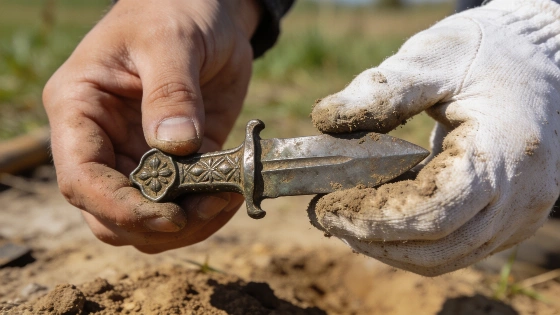
Archaeologists in Poland have documented a rare metal chape from an eleventh century sword scabbard found near the surface in Mazovia, raising new questions about early medieval craftsmanship and cross regional connections
A single metal artifact found near the surface in central Poland is prompting archaeologists to take a closer look at early medieval weaponry in the region. The object, a chape from the lower end of a sword scabbard, turned up during a legal metal detector survey in Mazovia. Its survival after about a thousand years is unusual, and the fact that it was found outside a formal excavation shows both the value and the complications of surface finds. The Mazovian Voivodeship Conservator of Monuments confirmed the discovery and provisionally dated it to the eleventh century, highlighting the role of regional heritage authorities in authenticating such finds.
Material evidence and dating
The chape is tentatively dated to the eleventh century using typological comparison, a standard archaeological method. According to local heritage officials, the artifact was not deeply buried but lay close to the modern ground surface. This may have helped preserve it, but also makes it harder to reconstruct its original context. The detectorist group Zły Szeląg, which reported the find, classified it as Type III-a style rarely seen in Poland but more common in present-day Lithuania, Latvia, and areas once linked to Ruthenia.
Type III chapes are uncommon in Polish archaeology. Their rarity in Mazovia, compared to their presence in the Baltic region, hints at possible connections through trade, movement, or shared technology. The artifact is well preserved, allowing for close study of its shape and how it was made. This gives researchers a rare chance to examine early medieval metalworking in this part of Europe. Research centers like the Max Planck Society have stressed the value of metallurgical analysis for understanding ancient craftsmanship and cultural exchange.
Comparative context and cultural links
Researchers note that similar chapes found across eastern and northeastern Europe may point to wider patterns of contact and exchange in the eleventh century. The exact path that brought this object to Mazovia is unclear, but its presence suggests that weapon fittings-and possibly swords-moved across cultural and political borders. The find invites comparison with other rare discoveries in the region, such as the earlier reported Neolithic burial with unusual grave goods, showing the variety of material culture in Poland's archaeological record.
Although the chape is just one part of a sword and its scabbard, its style, decoration, and manufacturing details can help specialists trace technological and artistic influences. This kind of evidence is important for piecing together the networks that linked communities across the Baltic and eastern Europe, especially when written records are scarce. Comparative studies published in Science have shown that artifact typology can reveal migration and exchange patterns even without direct historical documentation.
Preservation and analytical potential
The artifact's good condition after so many centuries is notable. Its shallow burial raises questions about how the site formed, how objects move after burial, and whether other early medieval items might still be found in similar settings. Further lab analysis could refine the dating, clarify the metal's composition, and show signs of use or repair, adding to our understanding of early medieval craftsmanship and the role of weaponry. Laboratories at institutions like MIT and Harvard have developed advanced techniques, such as metallography and isotopic analysis, which could be used on this artifact in future research.
As with many single finds, the lack of a secure archaeological layer makes it hard to link the chape to a specific settlement, burial, or event. Still, its style and preservation make it a valuable addition to the early medieval material record in Poland. The discovery highlights the importance of systematic reporting and analysis of metal-detected artifacts, which can provide insights even when traditional excavation isn't possible. International organizations such as NASA and CERN have emphasized the value of careful data collection and interdisciplinary collaboration in science-principles that also apply in archaeology.
Typological dating estimates an artifact's age by comparing its form, decoration, and manufacturing technique to other objects with known dates. While this method can give a rough chronological framework, it is less precise than direct dating techniques like radiocarbon analysis. Typological classification relies on established sequences of artifact styles and is especially useful for items like metal fittings, ceramics, or tools that change over time. However, its accuracy depends on the quality of comparative collections and how specific artifact styles are to a region or culture. When objects are found outside controlled excavations, typological analysis is often the main way to date them, but it can be revised as new finds and better-dated examples come to light.