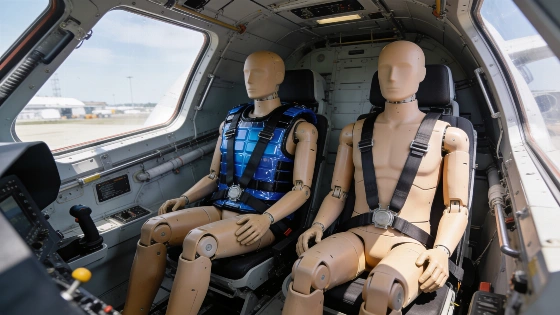
A hydrogen-rich plastic vest tested aboard NASA's Artemis I mission has demonstrated significant shielding against solar radiation, offering a potential solution for astronaut protection on future lunar and Mars expeditions
As NASA prepares for longer crewed missions beyond low Earth orbit, the challenge of protecting astronauts from unpredictable solar radiation remains a central concern. A recent study has evaluated a wearable radiation-shielding vest, tested during the Artemis I mission, that could help reduce exposure to hazardous solar particle events during lunar and interplanetary travel.
Targeted Shielding for Deep Space
Unlike the Apollo era, when missions to the Moon were brief and solar activity was less of a limiting factor, Artemis aims to support longer stays and eventual Mars expeditions. The primary threat comes from solar particle events-bursts of high-energy protons and heavier ions from the Sun that can penetrate spacecraft hulls and increase cancer risk for astronauts. While shielding an entire spacecraft with thick protective material is impractical due to mass constraints, personal protective equipment offers a more feasible approach.
The AstroRad vest, developed by StemRad with support from the Israel Space Agency and Lockheed Martin, is constructed from a high-density plastic rich in hydrogen. Hydrogen atoms are effective at slowing and absorbing incoming charged particles, and unlike lead, do not produce secondary radiation when struck by neutrons. The vest's design uses thousands of interlocking plastic rods, forming a flexible garment weighing approximately 26 kilograms. Its thickness varies to provide greater protection to organs most sensitive to radiation, such as bone marrow and reproductive tissues.
Artemis I Phantom Experiment
To assess the vest's effectiveness, researchers placed it on one of two anthropomorphic phantoms-Zohar and Helga-aboard the uncrewed Orion spacecraft during Artemis I's 26-day mission in late 2022. Both phantoms were modeled after adult females, reflecting the higher radiation sensitivity of certain female organs. Each contained over 5,600 radiation sensors embedded in tissue-equivalent plastics to record dose distribution throughout the mission.
Although Artemis I did not encounter a major solar particle event during its flight to lunar orbit and back, the phantoms traversed the inner Van Allen radiation belt, providing a relevant test of shielding performance. By analyzing the recorded data and modeling historical solar storms, the team estimated that the AstroRad vest could have reduced radiation dose by up to 60% during a significant solar event, such as the August 1972 storm. This level of protection could spare astronauts the equivalent of several months of deep-space exposure, potentially narrowing the risk gap between male and female crew members.
Operational Use and Practical Limits
The AstroRad vest is not intended for continuous wear. Instead, it is designed as an emergency countermeasure, to be donned during periods of elevated radiation risk-typically hours to days-when a solar particle event is detected or forecast. Tests on the International Space Station have shown that astronauts can tolerate wearing the vest for extended periods, including while sleeping, without significant discomfort.
Importantly, the vest allows astronauts to remain mobile and continue mission-critical tasks outside of a dedicated storm shelter. Its protective effect is comparable to that of the Orion spacecraft's onboard shelter, but with the added flexibility of movement. The research team is also exploring the feasibility of manufacturing radiation shielding components in space, including 3D-printing vest elements from recycled polyethylene aboard the ISS.
Future Prospects and Remaining Questions
The findings, published in Science Advances, suggest that targeted personal shielding could become a key element of crew safety protocols for Artemis and future Mars missions. However, the vest's performance during an actual, intense solar particle event remains untested in space. The effectiveness of in-situ manufactured shielding, as well as the integration of wearable protection with spacecraft-based shelters, will require further study as mission durations and distances increase.
As NASA and its partners refine strategies for deep space exploration, the balance between mass, mobility, and radiation protection will remain a central engineering and biomedical challenge. The AstroRad vest represents a promising step, but its ultimate role will depend on operational experience and the unpredictable behavior of the Sun.
While the focus of this study is astronaut safety, advances in solar observation and tracking technology also play a crucial role in mission planning. For example, recent developments in solar tracking mounts, such as those described in our coverage of automated solar telescope mounts, help researchers monitor solar activity and anticipate hazardous events that could affect both crewed and robotic missions.
Understanding the complex interplay between solar radiation, spacecraft shielding, and human physiology will be essential as exploration moves beyond the relative safety of low Earth orbit. Ongoing research and operational testing will determine how wearable shielding fits into the broader suite of countermeasures for deep space travel.
Radiation shielding in space relies on both material science and mission architecture. Hydrogen-rich plastics are favored for their ability to slow and absorb charged particles without generating harmful secondary radiation, unlike heavier elements such as lead. The effectiveness of any shield depends on its thickness, composition, and placement relative to sensitive organs. In practice, shielding is always a trade-off between mass, mobility, and the specific radiation environment encountered. Personal protective equipment, such as the AstroRad vest, complements spacecraft-based shelters and operational protocols, but cannot eliminate all risk. Accurate modeling of solar particle events and real-time monitoring remain critical for timely deployment of protective measures.