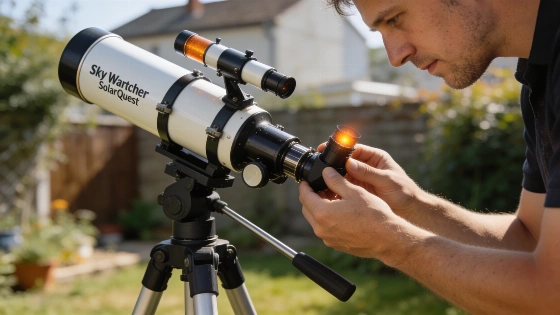
The Sky-Watcher SolarQuest mount uses GPS and a solar sensor to automatically locate and track the Sun, offering a streamlined solution for small solar telescopes and eclipse viewing with minimal manual adjustment
Locating and tracking the Sun with a telescope is more challenging than it appears, especially when using solar filters that dim the view and reduce the Sun to a small, bright disc against a dark background. The Sky-Watcher SolarQuest mount is designed to address this problem by automating the process of finding and following the Sun, making solar observing more accessible for both beginners and experienced eclipse chasers.
Instrument Design and Capabilities
The SolarQuest mount head is compact and lightweight, weighing just 1.3 kg, and is compatible with standard 45 mm Vixen-style dovetail plates. It can be mounted on a tripod with a 3/8-inch screw, and the optional aluminum tripod adds stability while keeping the total setup under 4.1 kg. The mount supports a maximum payload of 4 kg, making it suitable for small solar telescopes, including white-light-filtered refractors and dedicated H-alpha instruments.
Controls are intentionally minimal: a power button and an eight-way sliding switch for manual adjustments. The mount is powered by eight AA batteries or an external 12V DC supply, though the reliance on AA batteries is a notable drawback for travel and extended use. The system is designed for simplicity, with no menus or alignment routines required.
Key specifications include a resolution of 0.625 arcseconds, slewing speeds up to 1200x sidereal rate, and dual-axis alt-azimuth tracking. The tripod, when used, offers adjustable height and features such as a bubble level and accessory tray to aid setup and stability.
Automated Solar Tracking in Practice
To operate the SolarQuest, users level the tripod, point the telescope roughly toward the Sun, and activate the mount. The built-in GPS determines the observer's location and time, while the mount calculates the Sun's position in the sky. A photodiode-based solar sensor then searches for the solar disc and locks on, typically achieving alignment within a minute under clear conditions.
During testing, the mount consistently located the Sun even when it was low on the horizon, such as during early morning observations. Fine adjustments can be made using the manual controls, which respond smoothly and allow precise centering. Once aligned, the mount tracks the Sun automatically, keeping it in the field of view for extended periods with only occasional minor corrections needed.
The SolarQuest's tracking accuracy is sufficient for visual observing and short-duration imaging, including eclipse events. However, as an alt-azimuth mount, it does not compensate for field rotation, which can limit its utility for long-exposure solar imaging or time-lapse sequences.
Limitations and Practical Considerations
The main limitations of the SolarQuest are its payload capacity and power system. The 4 kg payload restricts use to compact telescopes and excludes larger or heavier instruments. The battery compartment requires eight AA batteries, and the compartment door is easily misplaced. While external 12V power is supported, no cable is included, and the reliance on disposable batteries is increasingly outdated given the prevalence of rechargeable lithium-ion solutions.
Despite these drawbacks, the mount's portability and ease of use make it attractive for travel and field observing. The system is particularly well-suited for eclipse chasers and those seeking a straightforward, reliable way to observe the Sun without frequent manual adjustments. The included instructions are minimal, but the mount's operation is intuitive once assembled.
For those interested in broader astronomical observing, it is important to note that the SolarQuest is specialized for solar tracking and does not support nighttime Go-To functionality. Alternatives such as star trackers with solar modes or equatorial mounts may offer greater flexibility for users with more diverse observing needs.
Testing and Context in Solar Astronomy
The SolarQuest mount was evaluated over a two-week period with both a Celestron Regal M2 spotting scope (equipped with a solar filter) and a Sky-Watcher Heliostar 76 mm H-alpha solar telescope. The system performed reliably in both configurations, enabling rapid setup and consistent solar tracking. Imaging the Sun in H-alpha with a planetary camera produced stable results, with the mount maintaining alignment throughout typical observing sessions.
Dedicated solar tracking mounts remain rare, and the SolarQuest fills a niche for those prioritizing simplicity and portability. For comparison, some star trackers can be configured to follow the Sun, and equatorial mounts-when properly aligned-can support longer-duration solar imaging. The SolarQuest's focus on ease of use and rapid deployment distinguishes it from these more complex alternatives.
Recent advances in solar observing technology have paralleled developments in other areas of astronomy, such as the use of space telescopes to study rare stellar phenomena. For example, astronomers have used the Hubble Space Telescope to observe high-velocity gas ejections from a helium nova in the Milky Way, as detailed in this report on Hubble's observations of V445 Puppis. While the SolarQuest operates on a much smaller scale, both cases illustrate the importance of specialized instruments in advancing our understanding of dynamic solar and stellar processes.
For users seeking a dedicated, user-friendly solar tracking solution for small telescopes, the Sky-Watcher SolarQuest mount offers a practical balance of automation, portability, and accuracy, with clear trade-offs in payload and power options.
Solar tracking mounts like the SolarQuest rely on a combination of GPS positioning, timekeeping, and photodiode-based sensors to determine the Sun's location in the sky. The mount calculates the Sun's altitude and azimuth based on the observer's coordinates and current time, then uses its sensor to refine the pointing and lock onto the solar disc. This approach eliminates the need for manual alignment and shadow-aiming, reducing setup time and improving the reliability of solar observations. However, alt-azimuth mounts do not correct for field rotation, which can affect long-duration imaging. Understanding these operational principles helps observers select the right equipment for their scientific or recreational solar astronomy goals.