A new experiment using ultra-cold rubidium atoms has measured how gravity affects quantum waves, providing the first direct test of Einstein's equivalence principle in the quantum regime
For the first time, physicists have measured how gravity influences the quantum wave of a falling atom, directly testing a core prediction of general relativity at the smallest accessible scale. The result does not establish a quantum theory of gravity, but it marks a concrete advance in probing where Einstein's theory and quantum mechanics intersect-and where they may ultimately diverge.
Testing Gravity with Quantum Waves
The experiment, led by a team at Ben-Gurion University of the Negev, set out to examine whether the equivalence principle-a foundation of general relativity-remains valid when applied to quantum systems. The equivalence principle states that all objects, regardless of their mass or composition, should fall identically in a gravitational field if no other forces act. While this has been confirmed for macroscopic objects, its validity for quantum particles, which can exist in superpositions and behave as waves, has remained untested in direct laboratory conditions.
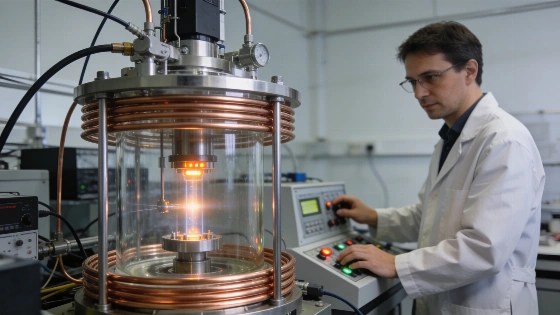
To address this, researchers used a device called a Quantum Galileo Interferometer. They cooled a cloud of rubidium atoms to near absolute zero and placed them in a quantum superposition, allowing each atom to follow two distinct paths simultaneously. One path was held stationary by a magnetic field, while the other was allowed to fall freely under gravity. After a controlled interval, the two quantum waves were recombined, and the resulting interference pattern was measured to detect any phase shift caused by gravity's effect on the falling wave.
Experimental Details and Results
The team's apparatus relied on an atom chip to generate precise magnetic fields and microwave pulses, enabling the preparation and manipulation of the rubidium atoms. The experiment was conducted at temperatures just above absolute zero, where thermal motion is minimized and quantum effects dominate. The falling atoms experienced Earth's gravitational acceleration of approximately 9.8 meters per second squared, while the stationary atoms remained suspended by the chip's magnetic field.
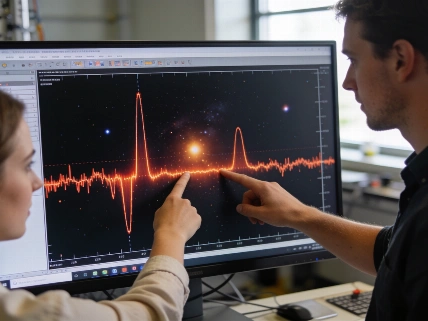
By analyzing the interference between the two quantum paths, the researchers measured the phase difference induced by gravity. This phase shift is a direct signature of how gravity acts on the quantum wave function of the atom. The result represents the first time that the phase of a quantum wave has been measured in free fall, providing a new window into the interplay between gravity and quantum mechanics. The findings were published in the peer-reviewed journal Science Advances on September 2, 2026.
Limits and Implications
While the experiment confirms that the equivalence principle holds for quantum waves of rubidium atoms under the tested conditions, it does not demonstrate quantum gravity itself. The result shows that, within current experimental sensitivity, gravity acts on quantum systems as predicted by general relativity. However, the experiment does not probe the regime where gravity itself must be quantized, nor does it reveal any deviation from established theory.
Physicists have long sought a unified theory that reconciles general relativity with quantum mechanics, but direct evidence for quantum gravity remains elusive. This experiment narrows the gap by extending precision tests of gravity into the quantum domain, but it leaves open the question of whether new phenomena will emerge at smaller scales or higher energies. As with recent reported earlier advances in astrophysical measurement, the result demonstrates the power of laboratory experiments to constrain fundamental physics, even as the search for a deeper theory continues.
What Remains Unknown
The current measurement is limited by the sensitivity of the interferometer and the mass and energy scale of the atoms involved. No violation of the equivalence principle was detected, but the experiment cannot rule out deviations at scales beyond its reach. Future experiments with higher precision, different atomic species, or more extreme gravitational environments may be able to probe deeper into the quantum-gravity interface. For now, the evidence supports the continued validity of Einstein's principle for quantum systems, but the ultimate nature of gravity at the quantum level remains unsettled.
Understanding the equivalence principle is central to both general relativity and experimental gravity. In classical physics, the principle asserts that gravitational and inertial mass are indistinguishable, leading to the prediction that all objects fall at the same rate in a gravitational field. In quantum mechanics, particles can exist in superpositions and are described by wave functions, raising the question of whether gravity acts identically on all quantum states. Interferometry with ultra-cold atoms allows researchers to measure phase shifts caused by gravity with extraordinary precision, providing a direct test of this foundational principle in the quantum regime.