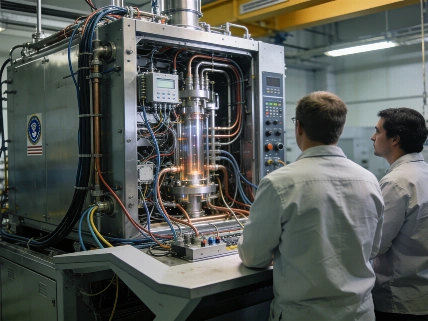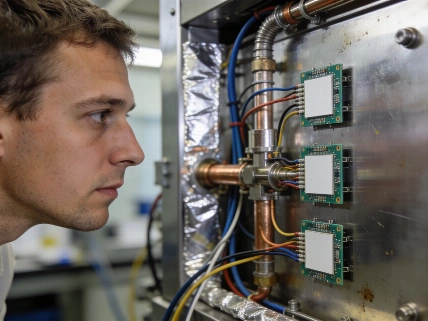
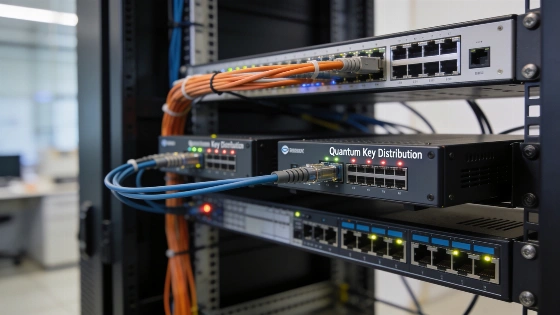
Q-SAFE Solutions has introduced a quantum-safe communications platform built in the EU-27, combining quantum key distribution and post-quantum cryptography for telecom, infrastructure, and government networks-no dedicated dark fiber required.
European network operators can now deploy a quantum-safe communications platform over their existing production fiber, without needing dedicated dark fiber lines. Q-SAFE Solutions GmbH, a German company specializing in quantum communications, has released a system aimed at the operational and regulatory needs of telecom providers, infrastructure operators, and government agencies across the EU-27. The platform brings together quantum key distribution (QKD) hardware, post-quantum cryptography (PQC), and centralized hybrid key management to support secure key exchange and distribution at scale.
This development comes as Europe moves to adopt quantum-safe technologies in real-world networks. Research centers like CERN and the Max Planck Society have contributed to the science behind quantum communication protocols. Toshiba Europe has already shown that quantum-safe data transmission can work over international distances using existing telecom infrastructure, confirming that these solutions do not require dedicated dark fiber. Recent Nature publications on quantum network field trials reflect this shift toward integrating quantum-safe systems into operational networks.
Hybrid key generation and distribution
The Q-SAFE platform uses a hybrid key agreement method, combining entropy from physics-based QKD with standardized post-quantum key encapsulation mechanisms (KEMs). This is designed to protect against both current and future threats, including "harvest now, decrypt later" attacks, where attackers collect encrypted data now to decrypt it with future quantum computers. Keys from the hybrid protocol are distributed to existing network encryptors and applications using standardized ETSI GS QKD 004 and ETSI GS QKD 014 interfaces, making it possible to integrate with EU- and NATO-approved cryptographic devices.
The system is built for unattended, automated operation by regular network staff and is managed through standard Operations Support Systems (OSS), Network Management Systems (NMS), and Software-Defined Networking (SDN) interfaces. This removes the need for on-site quantum specialists, which is important for moving beyond lab environments. ETSI, the European Telecommunications Standards Institute, continues to publish standardized APIs for quantum key management, supporting integration with telecom equipment.
Deployment architecture and standards
Q-SAFE's architecture works over production lit fiber, multiplexed with conventional IT and operational technology traffic. The platform can be set up in point-to-point, star, or trusted relay mesh topologies, so operators can focus on protecting high-value links-like inter-datacenter backbones and cross-border connections-before expanding to national networks. The system meets European EuroQCI procurement requirements, positioning it for use in the continent's developing quantum communication infrastructure.
Technical details emphasize layered defense, with hybrid key agreement and fiber transport designed to run alongside legacy traffic. The management layer integrates with carrier operations and certified encryptors, focusing on operational compatibility and regulatory compliance. This approach matches recent European Commission initiatives and the scenarios described by Toshiba, where quantum-safe multiplexing is achieved "without dedicated fibres" on existing infrastructure.
Operational independence and policy alignment
Q-SAFE Solutions says its platform is developed, integrated, and quality-tested entirely in Germany, with no foreign state involvement. This is meant to align with EU goals for technological sovereignty, as member states look to secure critical infrastructure against quantum threats. The company plans to demonstrate live systems at the European Commission's QCI Days 2026 conference in Padua, Italy, scheduled for September 28-30.
While Q-SAFE's announcement focuses on a fully integrated platform, the European quantum networking field remains competitive and technically varied. Other projects, such as those reported earlier, are building multi-node quantum secure networks using different protocols and architectures. The sector continues to test interoperability, scalability, and deployment across mixed infrastructure. Research groups at MIT and Stanford are also studying the scalability and error management of quantum-safe networks, adding to the global knowledge base.
Technical evidence and remaining challenges
Q-SAFE's platform runs over existing production fiber, multiplexed with legacy data traffic, and does not require dedicated dark fiber. Keys are generated using a hybrid QKD-PQC protocol and distributed via standardized interfaces to certified encryptors. The system is designed for unattended operation, managed through OSS, NMS, and SDN, and supports point-to-point, star, and trusted relay mesh topologies. The company claims compliance with ETSI GS QKD 004 and 014 standards, but independent technical evaluation and long-term operational data have not yet been published. The upcoming demonstration at QCI Days 2026 will allow further review of performance, integration, and interoperability.
Several engineering and operational questions remain. The effectiveness of hybrid key management in large, mixed networks will depend on real-world error rates, key refresh intervals, and the resilience of both QKD and PQC components under operational stress. Not needing dedicated dark fiber lowers deployment barriers, but multiplexing quantum and classical traffic brings new challenges in channel isolation, loss, and noise management. Relying on standardized interfaces and certified devices is a practical step, but the real test will be sustained, reproducible performance in production. Ongoing studies published in Science continue to examine the robustness of quantum-safe protocols under real-world conditions.
Quantum key distribution (QKD) is a protocol for generating and distributing cryptographic keys using quantum states, usually photons, sent over optical fiber. QKD's security depends on quantum mechanics: any attempt to intercept or measure the quantum states disturbs them, revealing eavesdropping. But QKD alone does not cover all practical security needs, so hybrid systems combine QKD with post-quantum cryptography (PQC)-algorithms designed to resist quantum computer attacks but run on conventional hardware. Hybrid key management aims to provide layered defense, but its effectiveness depends on the quality of both quantum and classical components, the physical infrastructure, and operational procedures. As quantum networks move from lab prototypes to operational systems, the interaction between quantum protocols, classical cryptography, and engineering constraints will determine their practical security and usefulness.