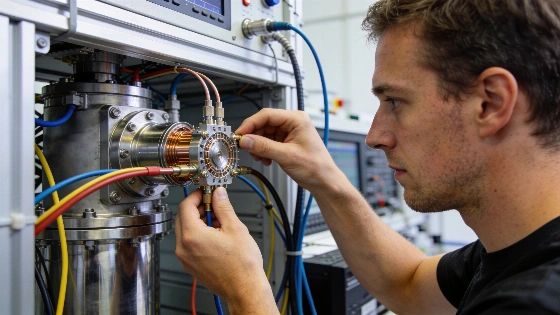
QC Ware has demonstrated a hybrid quantum-classical workflow for molecular energy calculations, integrating its Promethium platform with IBM's 156-qubit Heron superconducting quantum processor to analyze a complex metalloenzyme system
QC Ware has reported a technical demonstration of a hybrid quantum-classical computational chemistry workflow, combining its Promethium platform with IBM Quantum's Heron superconducting processor. The experiment focused on calculating the electrostatic interaction energy of nitric oxide reductase, a metalloenzyme relevant to catalysis and drug discovery, by integrating GPU-accelerated classical modeling with quantum subspace measurements performed on a 156-qubit device.
Hybrid Workflow Integration
The workflow used Promethium's GPU-native architecture to perform electronic structure calculations, generating molecular models and energy estimates at speeds up to 20 times faster than some legacy classical software, according to the company. Quantum measurements were then executed on IBM's Heron processor, targeting specific quantum subspaces and Hamiltonian terms relevant to the molecular system. This approach allowed the team to partition the computational workload, using classical resources for the most demanding modeling steps and quantum hardware for selected measurement tasks.
Experimental Details and Limitations
The demonstration targeted the electrostatic interaction energy, a property used to rank candidate compounds and assess catalytic sites. The Heron processor, featuring 156 superconducting qubits, was used for quantum measurement, but the experiment remains a technical proof-of-concept rather than a commercial product. QC Ware emphasized that the hybrid execution capability is not yet available as a standard feature and that the integration was designed to test architectural compatibility and workflow feasibility rather than to deliver a practical quantum advantage.
Performance and Classical Comparison
Promethium's GPU acceleration enabled the classical portion of the workflow to complete in hours rather than weeks, based on the company's internal benchmarks. However, the quantum component was limited to specific measurement tasks that are currently tractable for available hardware. The overall workflow did not demonstrate a computational advantage over state-of-the-art classical methods for this molecular system, but it provided a testbed for future algorithm development as quantum hardware improves. Similar efforts to integrate quantum and classical resources for chemistry applications have been reported elsewhere, including initiatives such as the hybrid testbed project at the Pittsburgh Supercomputing Center.
Next Steps and Engineering Challenges
QC Ware, led by Dr. Kin-Joe Sham, plans to extend Promethium's classical GPU capabilities and develop new hybrid algorithms that could transition to larger-scale quantum processors as hardware fidelity improves. Key engineering challenges remain, including increasing quantum gate fidelity, reducing noise, and scaling up the number of useful qubits. The company has not announced a timeline for commercial deployment of the hybrid workflow, and independent replication or peer-reviewed publication of the results has not yet been reported.
Hybrid quantum-classical workflows aim to combine the strengths of classical and quantum computing by assigning different parts of a computational problem to the most suitable hardware. In quantum chemistry, this often means using classical processors for large-scale modeling and quantum processors for tasks that are difficult to simulate classically, such as certain correlated electron interactions. The effectiveness of this approach depends on the quality of the quantum hardware, the efficiency of the integration, and the ability to verify results against classical benchmarks. As quantum processors improve, hybrid workflows may become increasingly relevant for scientific and industrial applications, but current demonstrations remain limited by hardware noise, error rates, and the scale of accessible problems.