QuiX Quantum has appointed Sendai-based TEI-C as its exclusive Japanese distributor, giving universities, research institutes and industry local access to Alquor 2.0 photonic processors and PACU control systems.
QuiX Quantum has handed Japan a single commercial gateway to its photonic quantum hardware. On September 24, 2026, the Dutch startup appointed Sendai-based Tohoku Electronic Industrial Co., Ltd., known as TEI-C, as the exclusive distributor for its integrated photonic processing systems across the country.
TEI-C will handle Japanese-language commercial engagement, technical seminars and first-line support. The arrangement targets universities, research institutes and industrial users working with linear optics for quantum simulation, boson sampling and quantum key distribution rather than claiming that any of those applications has already reached practical quantum advantage.
TEI-C is described as an R&D and technology distributor, making its role broader than simply reselling equipment. Its local position could help Japanese laboratories evaluate photonic hardware, coordinate installation and communicate technical requirements without relying exclusively on overseas commercial teams.
The partnership is a market-access decision rather than a performance result. That distinction matters when compared with an earlier deployment report that described a planned university installation; here the immediate development is an exclusive distribution channel for hardware already offered by QuiX Quantum.
QuiX Quantum describes the agreement as an effort to strengthen its commercial presence in one of Asia's strategically important quantum-technology markets. The announcement therefore signals regional expansion and service infrastructure, not a new experimental demonstration or a claim of quantum advantage.
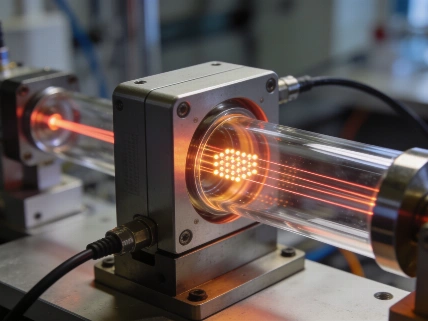
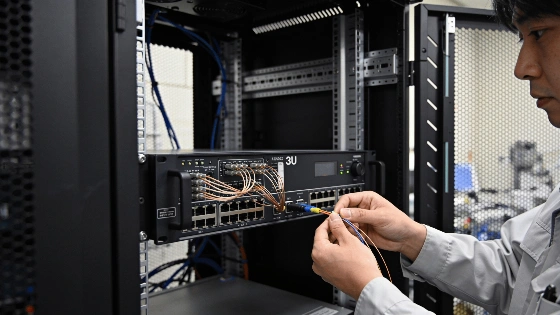
The central product is Alquor 2.0, a programmable quantum photonic processor built in a 3U rack-mountable form factor. It is offered in 8-mode, 20-mode and 32-mode optical configurations and uses a silicon nitride, Si3N4, TriPleX(TM) photonic integrated-circuit platform. QuiX Quantum reports average amplitude fidelity above 90 percent and insertion loss below 4 decibels.
Those specifications describe an integrated optical processor intended to replace optical-table setups with a standardized rack-based system. The hardware also exposes a Python API, allowing users to automate workflows rather than manually reconfigure a laboratory interferometer for every experiment. The supplied information does not establish a universal gate-based quantum computer, a fault-tolerant processor or a demonstrated advantage over classical computing.
Photonic processors manipulate optical degrees of freedom such as spatial modes, path information and phase. In bosonic approaches, photons can be prepared, interfered and measured to implement specialized computational protocols, but losses and imperfect detection can rapidly affect the useful signal. A peer-reviewed Nature photonics study illustrates how programmable photonic architectures can be evaluated experimentally, while also showing why processor capability must be separated from claims about general-purpose quantum computing.
The distinction between a mode count and a logical-qubit count is central. An optical mode is a physical degree of freedom; a logical qubit is an error-protected computational unit whose reliability must improve as error-correction resources are added. Work across institutions such as MIT has helped establish the broader engineering context for integrated quantum photonics, but those general advances do not constitute an independent performance measurement of Alquor 2.0.
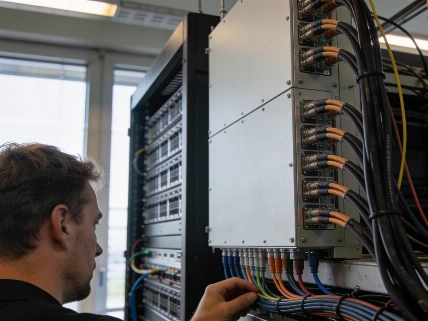
The second product is the Photonic Assembly Control Unit, or PACU. It is a standardized instrumentation layer designed to drive as many as 1,000 low-speed thermo-optic phase shifters inside high-performance computing environments. The unit also provides 32 high-speed RF and optical connectors for feed-forward, alongside board-to-board interconnects intended to support hot-swappable mean time to repair.
PACU uses a standardized 3U 19-inch rack chassis and supports native Ethernet and USB connections for HPC integration. These features address the unglamorous part of photonic quantum systems: controlling many optical elements, coordinating fast signals and maintaining hardware without relying on a permanently assembled optical table. They do not by themselves show how many quantum operations a complete system can execute reliably or how performance changes as the number of modes increases.
The numerical profile is specific but narrow. Alquor 2.0 comes in 8, 20 and 32 optical modes, reports average amplitude fidelity above 90 percent and insertion loss below 4 dB; PACU controls up to 1,000 low-speed thermo-optic modulators and includes 32 high-speed RF and optical connectors. No operating temperature, wavelength, photon-source specification, detector efficiency, circuit depth, runtime, error rate or classical benchmark is provided in the announcement.
Large research infrastructures such as CERN routinely demonstrate why control electronics, calibration and maintainability matter as much as the central detector or processor. For photonic quantum systems, PACU represents this instrumentation layer: it may make complex experiments easier to assemble and service, but its listed connector and control capacities are not equivalent to a measured computational throughput.
Japan's policy setting gives the agreement a clear commercial rationale. National quantum initiatives target 10 million quantum technology users and ¥50 trillion in economic output by 2030, with ¥100 billion in supplementary national funding. Those targets are policy ambitions, not measurements of QuiX Quantum hardware, and the distribution agreement does not show that the national goals will be met.
For users, TEI-C's role could reduce the practical friction of obtaining photonic equipment, arranging technical instruction and securing first-line support in Japanese. The arrangement also places responsibility for local engagement with a company founded in 1968 and specialized in advanced optical and scientific instruments. Yet access to a processor is only one layer of a quantum workflow: sources, detectors, calibration, software, loss management and validation still determine what experiments can produce.
Photonic quantum computing encodes information in optical modes and relies on precise control of light, but a mode count is not equivalent to a count of logical qubits. A logical qubit requires error-correcting resources and a demonstrated reduction in logical error as those resources grow. The supplied announcement reports neither logical qubits nor error-correction performance, so the defensible reading is that QuiX Quantum and TEI-C are expanding access to integrated photonic instrumentation rather than announcing a fault-tolerant machine.
That makes the agreement meaningful in a narrower and more credible way. It shifts QuiX Quantum's hardware from a company-centered offering toward a supported national distribution route, while giving Japanese research and industrial groups a defined contact for systems that are difficult to evaluate from product descriptions alone. The next test is not the size of the announcement but whether local users can reproduce measurements, characterize optical loss and fidelity under their own workloads, and connect the hardware to validated scientific tasks. On the evidence provided, this is a serious infrastructure and access step for photonic quantum research, not proof that photonic quantum computing has solved scalability or usefulness.
In this context, "photonic processor" should not be read as shorthand for a complete quantum computer. Optical modes are controllable degrees of freedom, while useful computation also depends on state preparation, interference, measurement, loss, feed-forward and often error correction. The Alquor 2.0 and PACU specifications show an effort to package and control those components in rack hardware, but the announcement supplies no application benchmark or independent comparison. That boundary is precisely why TEI-C's distribution role matters: it may make testing easier, while leaving the scientific and engineering case for practical quantum advantage open.
NASA's experience with highly integrated scientific instruments offers a useful general analogy: standardized hardware can improve deployment and reproducibility, but a platform's scientific value still depends on calibration, operating conditions and validated measurements. The same principle applies here. TEI-C can widen access to QuiX Quantum's equipment in Japan, while independent laboratory characterization will determine how the systems perform in real experiments.