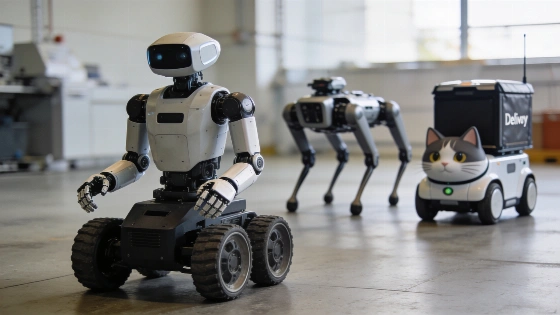
At its Amsterdam summit, PUDU Robotics displayed its full robot lineup and set out a plan to use shared AI technology across different machines, as it seeks to expand in Europe and explore the US market
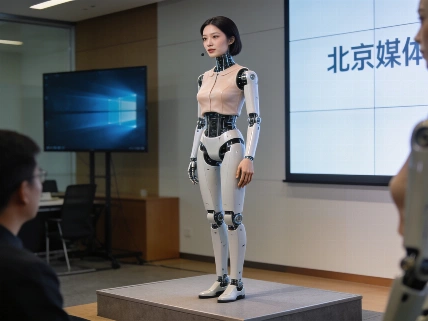
A wheeled semi-humanoid standing 5.4 feet (1.65 meters) tall is designed to run for more than eight hours on a battery exceeding one kilowatt-hour. PUDU Robotics displayed the D7 alongside its other robot lines at its European Partner Summit in Amsterdam.
The Shenzhen-based company also introduced its "One Brain, Multiple Embodiments" strategy. Founder and CEO Felix Zhang said PUDU plans to use the same artificial intelligence (AI) technology across its products, arguing that robots need to become smarter, easier to deploy and cheaper to reach wider adoption. "With our 'One Brain, Multiple Embodiments' strategy, we are building a shared technological foundation across different robot forms - from specialized service robots to semi-humanoid and humanoid robots," Zhang said.
PUDU describes the architecture as spanning specialized, semi-humanoid and humanoid robots, with embodied navigation, manipulation and interaction as its core capabilities. Its broader technical description also includes motion control and multi-robot coordination. The company's product portfolio encompasses service delivery, commercial cleaning, industrial delivery, general embodied AI and commercial lawn care, among other applications, according to a PUDU company description carried by ISSA.
The plan connects machines built for very different jobs. That broader effort to link AI with physical machines also appears in coverage of Amazon's Physical AI Toolchain; PUDU's announcement focuses on sharing technology across its own robot forms.
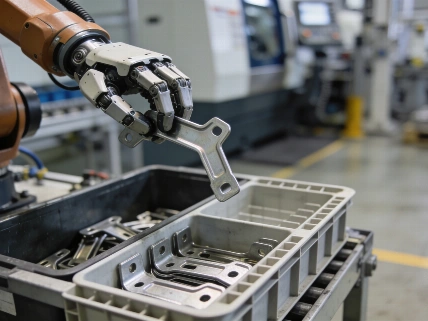
The D7 uses human-like arms to handle objects and wheels to move in any direction. It has 30 degrees of freedom, or up to 50 with a dexterous hand attachment, and its arms can lift up to 22 pounds. PUDU first introduced the robot in September 2024. The company says it can transport and sort objects, as well as use elevators in workplaces such as offices and factories.
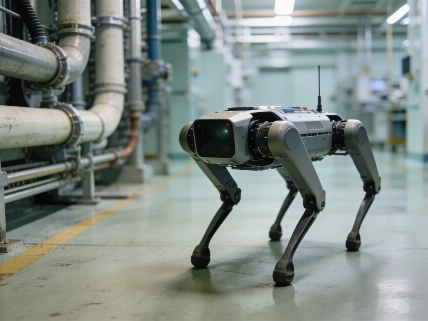
PUDU also showed its D5 and D5-W quadrupeds. Both have an Nvidia Jetson Orin AGX processor and an RK3588 chip, with two LiDAR sensors and four fisheye cameras for navigation. The company says their computing performance reaches 275 trillion operations per second. It says the robots can climb slopes of up to 45 degrees and carry between 44 and 66 pounds (20 to 30 kilograms) while walking.
The service lineup included BellaBot Pro, a cat-like delivery robot whose screen displays playful facial expressions. Designed for restaurants and other commercial spaces, it delivers food and interacts with customers. The CC1 PRO handles floor cleaning, with sweeping, scrubbing, vacuuming and mopping functions.
For industrial sites, PUDU presented the MP2000, which can carry pallets weighing up to 4,409 pounds (2,000 kilograms). The company says it can insert its forks into a pallet in 20 seconds. Its outdoor range includes the GT series for businesses and TOMO S series for homeowners; the latter is designed for lawn care and is PUDU's first consumer robotics product. PUDU's TOMO S product description specifies Triple-Sense Navigation, combining 360-degree LiDAR, AI vision and network RTK for claimed centimeter-level positioning without a local RTK reference station.
PUDU says it has shipped more than 130,000 robots and operates in more than 85 countries and regions. In Europe, the company reports a presence in more than 20 countries. Its European headquarters in Neuss, Germany, officially opened on October 30, 2026, with the company describing the regional base as a way to strengthen local teams, service capabilities and partner relationships.
Europe is a priority for the strategy. Bella Sun, PUDU Robotics VP and GM for Europe, told Interesting Engineering (IE): "We see huge potential in the European market. The direction is pretty clear. Customers across Europe are becoming more open to robotics technology."
Zhang said the company aims to support human workers rather than replace them. Addressing restrictions affecting Chinese robotics products in the US, he said: "The FCC regulation is only for new products, meaning all of our existing products can be sold in the US." He added: "[But] I want our robots working everywhere in the world."