Pratt & Whitney has completed a digital design review of its Valox 1500 engine, a propulsion system intended for autonomous military aircraft, moving the program closer to ground testing and raising questions about cost, mission life, and rapid development
Pratt & Whitney has announced the completion of a key digital design review for its Valox 1500 engine, a propulsion system developed for the next generation of autonomous and semi-autonomous military aircraft. The company reports that this milestone clears the way for ground testing, but the engine remains in the prototype phase and has not yet been evaluated in operational conditions. The Valox 1500 is part of the broader Valox engine family, which is being designed to support a range of uncrewed defense platforms, including collaborative aircraft and expendable effectors. The program reflects a shift in U.S. defense priorities toward lower-cost, rapidly developed autonomous systems, but the evidence for real-world performance remains limited to internal digital assessments.
According to Pratt & Whitney, the design review was conducted entirely in a digital engineering environment, allowing engineers to simulate and evaluate the engine's architecture before manufacturing physical hardware. The company claims that this approach reduces development time and production costs, but no independent verification of these savings has been published. The Valox 1500 is engineered around a reduced mission life, in contrast to traditional fighter engines designed for decades of service. This design choice is intended to simplify development for platforms that do not require extended durability, but it also raises questions about long-term reliability and maintenance in operational settings.
Digital Engineering and Manufacturing
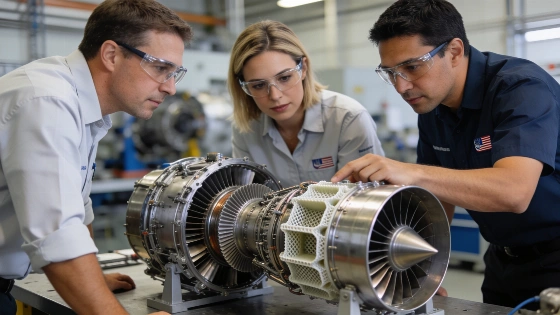
The Valox program relies heavily on digital engineering tools and additive manufacturing techniques. Engineers used collaborative digital environments to identify potential design issues and refine components prior to hardware fabrication. Additive manufacturing, or 3D printing, is being used to produce complex engine parts, which the company says can accelerate production and allow for rapid design changes. However, the transition from digital models to physical prototypes often reveals unanticipated challenges, and the company has not yet reported results from ground or flight testing.
Pratt & Whitney states that the Valox engine family is designed to deliver between 2.2 and 8.0 kilonewtons (500 to 1,800 pounds) of thrust, making it adaptable for a range of autonomous aircraft classes. This scalability is intended to allow manufacturers to use the same core technology across multiple platforms, but the practical implications for integration, certification, and mission performance remain untested. The company has not disclosed detailed technical specifications, test protocols, or independent evaluation data for the Valox 1500 at this stage.
Program Status and Oversight
The Valox 1500 program has received more than $10 million in U.S. Air Force funding as of late 2025, supporting continued design maturation and preparation for hardware testing. While this contract signals institutional interest, it does not constitute operational approval or deployment. The next major milestone will be ground testing, which is expected to generate the first physical performance data and provide an opportunity to compare digital predictions with real-world results. Until then, claims about cost, speed, and mission suitability remain provisional.
Unlike conventional military engine programs, the Valox family was conceived with digital engineering as a central feature. This approach is consistent with broader trends in aerospace and defense, where digital twins and simulation environments are increasingly used to accelerate development. However, the effectiveness of these methods depends on the accuracy of the underlying models and the fidelity of simulation to operational conditions. The company has not released information about independent audits, safety assessments, or regulatory review of the Valox 1500 design process.
Limitations and Open Questions
Key limitations of the Valox 1500 program include the absence of published ground or flight test data, lack of independent verification, and uncertainty about how the engine will perform under the stresses of real-world military operations. The decision to design for a reduced mission life may lower costs and speed up production, but it also introduces new risks related to reliability, maintenance, and lifecycle management. The extent of human oversight required during testing and eventual deployment has not been detailed, nor have the safety protocols for integration with autonomous or semi-autonomous aircraft.
As the U.S. military expands its interest in collaborative autonomous systems, propulsion remains a critical bottleneck for rapid fielding and operational flexibility. The Valox 1500 represents an attempt to address these challenges through digital engineering and modular design, but its actual impact will depend on the results of forthcoming ground tests and subsequent operational evaluations. Until those results are available, the program's claims about speed, cost, and adaptability should be interpreted as targets rather than established outcomes.
Digital engineering refers to the use of advanced modeling, simulation, and collaborative design tools to develop complex systems before physical prototypes are built. In aerospace and defense, this approach can reduce development time and allow for rapid iteration, but it also depends on the accuracy of digital models and the ability to capture real-world variables. Additive manufacturing, often called 3D printing, enables the production of intricate parts that would be difficult or impossible to fabricate using traditional methods. While these technologies offer potential advantages, their effectiveness must be validated through rigorous physical testing and independent evaluation before claims about performance and reliability can be confirmed.