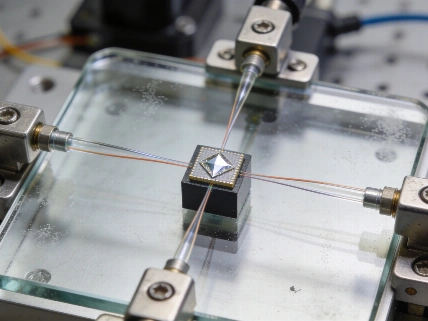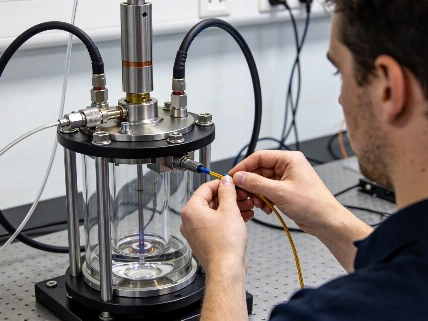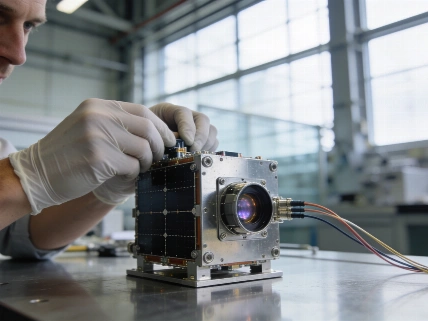
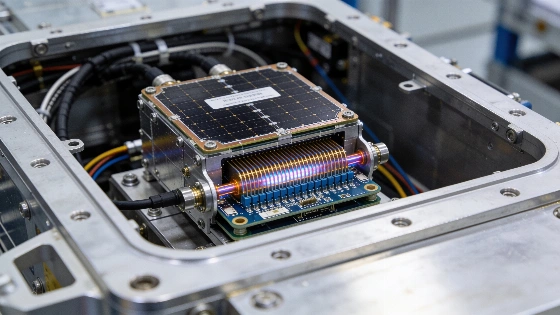
A space-qualified optical frequency comb developed by QuantX Labs has been activated and verified in low Earth orbit, demonstrating key engineering benchmarks for future optical atomic clock payloads in space
QuantX Labs, a deep-tech company based in South Australia, has reported the successful in-orbit commissioning of its space-qualified optical frequency comb. The device was launched into low Earth orbit on March 30, 2026, aboard Exotrail's spacevan(TM) orbital transfer vehicle as part of SpaceX's Transporter-16 rideshare mission. According to the company, this marks the first time an optical frequency comb has been deployed and operated in the space environment, with support from the Australian Space Agency's Moon to Mars Demonstrator Program.
An optical frequency comb is a photonic device that generates a spectrum of equally spaced optical frequencies, enabling precise conversion between optical and radio-frequency (RF) signals. This technology is foundational for optical atomic clocks, which achieve higher frequency stability than traditional microwave-based clocks. In laboratory settings, frequency combs are used to bridge the gap between optical transitions-oscillating at hundreds of terahertz-and the electronic systems that count and process timing signals. Deploying such a device in orbit introduces new engineering challenges, including mechanical vibration during launch, thermal cycling, vacuum operation, and exposure to radiation.
QuantX Labs reports that the in-orbit activation of the frequency comb confirmed several critical engineering parameters. The device's optical alignment and precision components survived launch-induced vibration and mechanical shock. Once in orbit, the comb demonstrated stable operation under vacuum and radiation conditions, maintaining thermal and electrical stability. The mission also verified the integration of Australian quantum hardware with international satellite platforms, establishing communication and control interfaces required for future quantum-enabled payloads.
Engineering Benchmarks and Measurement Conditions
The optical frequency comb was subjected to launch loads, including high-frequency vibration and acceleration, followed by deployment into the thermal and vacuum environment of low Earth orbit. The company states that the device maintained optical alignment and frequency stability throughout these transitions. While detailed performance metrics such as frequency stability, phase noise, or output power have not been independently published, the successful commissioning demonstrates that the core photonic subsystem can operate in the relevant space environment. The comb's output provides a stable RF reference derived from optical transitions, a prerequisite for next-generation space-based atomic clocks.
This demonstration is a subsystem milestone for QuantX Labs' planned TEMPO space optical atomic clock payload. The company is currently completing environmental testing of the full TEMPO Proto-Flight Model, with a target deployment date in 2027. If realized, this would represent the first fully operational optical atomic clock in orbit, with potential applications in satellite navigation, secure communications, and deep-space timing. However, the present result is limited to the frequency comb subsystem; the full atomic clock payload has not yet been launched or validated in space.
Scientific and Technological Implications
Current global navigation satellite systems, such as GPS, rely on microwave atomic clocks, which are limited in timing precision and can be vulnerable to jamming or spoofing. Optical atomic clocks, enabled by frequency combs, offer an order-of-magnitude improvement in frequency stability and timing accuracy. In principle, this could enhance the resilience and precision of satellite-based navigation and communication systems. The successful operation of a frequency comb in orbit is a necessary step toward realizing these benefits, but further engineering and validation are required before a complete optical atomic clock can be deployed and operated as part of a satellite constellation.
Independent verification of the comb's long-term stability, radiation tolerance, and integration with atomic reference systems will be essential for future missions. The current demonstration establishes flight heritage for the photonic subsystem, but does not yet address the full system-level challenges of operating an optical atomic clock in space, such as atomic state preparation, laser cooling, and long-term frequency calibration. The company's roadmap anticipates these steps, but technical details and peer-reviewed performance data remain to be published.
Optical frequency combs are based on mode-locked lasers that generate a series of discrete, equally spaced frequencies across the optical spectrum. By stabilizing both the repetition rate and the carrier-envelope offset frequency, the comb acts as a precise ruler for measuring optical frequencies and converting them to RF signals. In the context of atomic clocks, this enables the translation of ultra-stable optical transitions-such as those in strontium or ytterbium atoms-into electronic signals that can be counted and distributed. The stability and accuracy of the comb are critical for preserving the timing precision of the underlying atomic reference, especially in the challenging environment of space.