

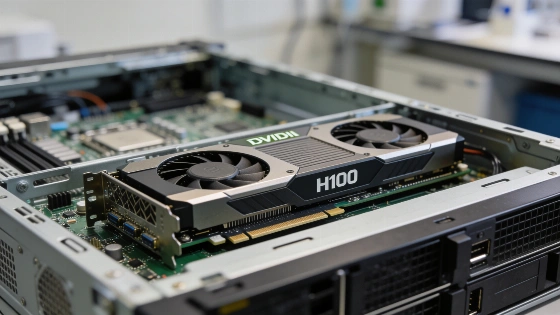
Riverlane says an NVIDIA H100 reduced a surface-code decoder training cycle from three minutes on one CPU core to 2.8 seconds, speeding recalibration before quantum experiments
Qubit behavior can drift between calibration and an experiment, leaving a quantum error-correction decoder with weights that no longer match the device. Riverlane and NVIDIA report a GPU-based method for recalibrating those weights much faster, although the benchmark does not show that quantum errors themselves fell.
Seconds instead of minutes
In the collaboration's test, Riverlane adapted its Local Clustering Decoder (LCD) to run in parallel on an NVIDIA H100 GPU. A surface-code training cycle that took three minutes on a single CPU core took 2.8 seconds on the GPU. The H100 processed more than 4 million surface-code error syndromes per second, compared with about 59,000 on the CPU: roughly a 68-fold throughput increase.
That is a large reduction in the time needed for this calibration process. It is not a measurement of quantum processor speed, nor does it establish that the GPU performed the decoder's correction task during a live quantum computation. The reported use is recalibration before an experiment, so the faster processing could make more frequent updates practical.
Weights can go stale
Quantum error correction (QEC) uses measurements of error syndromes to help identify faults affecting encoded information. A decoder interprets those measurement patterns using estimates of how likely different physical errors are. If qubit frequencies shift or gate performance changes, the estimates can become inaccurate and the decoder may make poorer decisions.
Riverlane describes the GPU process as a way to process large batches of experimental syndrome data and update a physical noise model without manual tuning. That addresses a real operating challenge: a decoder calibrated against yesterday's device behavior may not be well matched to today's. But the reported benchmark is about recalibration speed. The supplied material gives no before-and-after logical error rate showing how much the updated model improves encoded qubit performance.
The Cambridge-based company also announced a strategic minority equity investment from NVIDIA. The investment's value was not specified; NVIDIA's wider UK computing commitment is stated as $250 million. The Cambridge setting also features in earlier quantum coverage of a planned IonQ centre, a separate development that does not establish a technical link between the projects.
What remains untested
The announcement does not specify the quantum processor architecture or the number of qubits represented in the benchmark. It also does not report decoder latency during live operation, the calibration data volume, or a comparison across multiple devices. Those details matter because a fast training cycle alone cannot show whether recalibration is reliable across hardware or improves the logical information the system is meant to protect.
Nor does a GPU calibration result demonstrate fault-tolerant computing. A practical error-correction system must keep pace with measurements from the quantum processor and apply appropriate corrections under operating conditions. This collaboration reports faster preparation of decoder parameters; the available figures do not establish that the full QPU-GPU feedback loop was tested in real time or that a useful quantum computation ran with improved protection.
A syndrome is a pattern of measurement outcomes used to detect signs of physical errors; it is not a direct readout of the encoded logical state. A decoder uses that pattern and a noise model to infer which error is most likely and what response is appropriate. Recalibrating the model can help keep those inferences aligned with changing hardware, but the benchmark here measures how quickly the model-training process runs, not the final accuracy of error correction.







