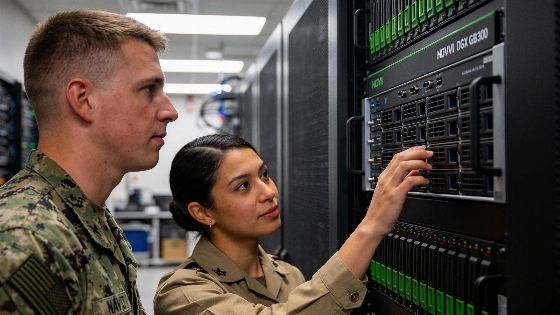
NVIDIA has provided its DGX GB300 AI supercomputer to the Naval Postgraduate School in California, aiming to support advanced research and education for military leaders in high-performance computing and artificial intelligence
NVIDIA has delivered its DGX GB300 artificial intelligence supercomputer to the Naval Postgraduate School (NPS) in Monterey, California, as part of a collaborative research agreement signed in December 2024. The system is intended to expand the institution's capacity for research and education in machine learning, data analysis, and operational decision support for military applications. The DGX GB300 is not a standalone data center but is integrated into NPS's existing high-performance computing infrastructure, allowing researchers and students to access increased computational resources for complex AI workloads.
DGX GB300 Expands NPS Computing Capacity
The DGX GB300 combines 36 NVIDIA Grace CPUs with 72 NVIDIA Blackwell Ultra GPUs, providing a platform for large-scale parallel processing. This configuration is designed to accelerate the training of machine learning models and the analysis of large datasets, supporting research into pattern recognition, simulation, and operational planning. According to NVIDIA, the system's architecture enables faculty and students to tackle problems that previously exceeded the school's computational limits, including the development and evaluation of advanced AI models for defense-related scenarios.
Historically, NPS has played a role in the adoption of advanced computing for military research, acquiring its first electronic digital computer in 1953 and the Control Data Corp. 1604 supercomputer in 1960. The arrival of the DGX GB300 continues this tradition, but with a focus on contemporary AI and machine learning methods. The system is intended to support both foundational research and applied projects, with an emphasis on accelerating the transformation of data into actionable insights for naval operations. The school's leadership has stated that the new computing capability will help researchers identify operational patterns, evaluate alternatives, and generate insights more rapidly than before.
AI Infrastructure for Military Decision Support
The integration of the DGX GB300 comes at a time when military organizations are seeking to leverage AI for faster and more reliable decision-making in increasingly complex operational environments. The NPS initiative is part of a broader trend in which defense institutions are investing in high-performance computing to maintain decision superiority. This approach is consistent with recent large-scale infrastructure projects in the AI sector, such as the construction of hyperscale data centers for model development and deployment, including efforts like OpenAI's planned data center campus in Georgia.
Operational Benefits Remain Unproven
While the DGX GB300's technical specifications represent a significant increase in available computing power for NPS, the system's real-world impact will depend on how effectively it is integrated into research workflows and educational programs. The school has not disclosed specific benchmarks or performance metrics for the new system, and independent evaluation of its operational benefits remains pending. As with other high-performance AI infrastructure, the effectiveness of the DGX GB300 will be shaped by the quality of training data, the design of research projects, and the degree of human oversight in both development and deployment.
Computing Power Alone Does Not Ensure Reliable AI
Understanding the distinction between high-performance computing and artificial intelligence is essential in this context. While supercomputers like the DGX GB300 provide the raw computational capacity needed to train and run large-scale machine learning models, the reliability and safety of AI systems depend on the quality of data, the robustness of algorithms, and the presence of meaningful human oversight. In military and defense settings, these factors are critical for ensuring that automated systems support, rather than undermine, operational decision-making and accountability.