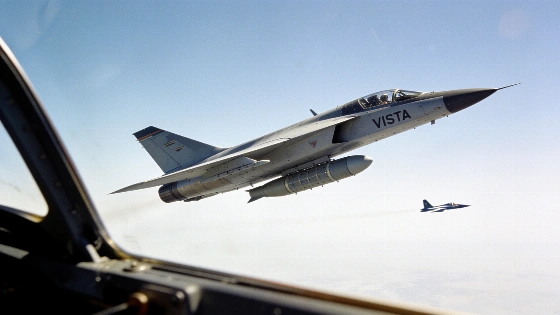
Lockheed Martin and the U.S. Air Force Test Pilot School have tested an AI agent that autonomously flew the X-62A VISTA fighter using real-time infrared sensor data to intercept a live aircraft, marking a step toward operational airborne autonomy
Lockheed Martin and the U.S. Air Force Test Pilot School have completed a series of flight tests in which an artificial intelligence agent autonomously controlled the X-62A Variable In-flight Simulation Test Aircraft (VISTA) to intercept another aircraft using live sensor data. The demonstration, conducted over eight sorties and involving 27 autonomous intercept attempts, represents one of the most direct tests to date of closed-loop airborne autonomy in a real-world environment. Unlike previous AI flight demonstrations that often relied on simulated data or pre-scripted scenarios, this campaign required the AI to process operational sensor inputs and make tactical decisions in real time.
AI-Controlled Intercepts Using Live Sensor Data
The test system integrated the Legion Pod, an infrared search and track sensor, to detect and track a live T-38 aircraft during flight. The sensor's data was fed directly to the onboard AI agent, which then controlled the X-62A's maneuvers to achieve tactical intercept positions. This approach exposed the AI to the same type of uncertain, noisy, and time-sensitive information encountered by human pilots in operational settings.
According to Lockheed Martin, the integration of the AI agent, software validation, and ground testing was completed in approximately three months, a timeline the company attributes to its “Supermassive” AI development framework, which is designed to accelerate the transition from development to flight testing.
During the campaign, the AI agent was responsible for interpreting classified infrared sensor data and executing combat-relevant maneuvers without human intervention during the intercept phase. However, the system remains a research prototype, and all flights were conducted under controlled test conditions with human oversight. The company has not disclosed detailed failure rates or the frequency of human intervention required during the tests. The demonstration does not establish that the AI agent can reliably handle the full range of operational scenarios or unexpected events that may arise in live combat environments.
X-62A VISTA as a Flying AI Laboratory
The X-62A VISTA has become a central platform for the U.S. Air Force Test Pilot School's research into autonomous aviation, serving as a flying laboratory for evaluating AI technologies before they are considered for operational aircraft.
Lockheed Martin reports that the upcoming Mission Systems Upgrade for the X-62A will enable tighter integration between onboard sensors, combat systems, and multiple AI agents, supporting more complex autonomous behaviors and networked operations. The aircraft's open software and hardware architecture is intended to allow rapid integration of new technologies without requiring major redesigns.
Operational Potential and Unresolved Safety Questions
Handing selected tasks to AI agents could reduce pilot workload during complex missions, allowing human aircrews to focus on higher-level tactical decisions while the software manages time-critical actions. However, the transition from research demonstration to operational deployment will require further evidence of reliability, safety, and effective human oversight.
The demonstration remains part of a test program, and the technology is not yet fielded in operational military aircraft. The integration of AI into airborne systems raises ongoing questions about meaningful human control, accountability, and the verification of autonomous decision-making in high-stakes environments.
Recent advances in AI-driven control systems for physical platforms have also prompted developments in related fields, such as energy management for AI infrastructure. For example, new battery technologies are being introduced to address the power and thermal demands of AI data centers, as seen in recent efforts to improve grid resilience for AI operations. These parallel developments highlight the broader ecosystem of technical challenges involved in scaling AI from laboratory prototypes to real-world deployment.
The Difference Between Automation and Autonomy
Understanding the distinction between automation and autonomy is essential in evaluating these demonstrations. Automation refers to systems that follow predefined rules or scripts, often requiring human supervision or intervention for unexpected situations. Autonomy, by contrast, involves the ability to interpret sensor data, make context-dependent decisions, and adapt to changing environments without direct human input.
In high-risk domains such as military aviation, the threshold for reliable autonomy is especially high, and meaningful human control remains a central requirement for safety and accountability. The X-62A tests illustrate both the technical progress and the unresolved challenges in moving from automated assistance to robust, trustworthy autonomous systems.