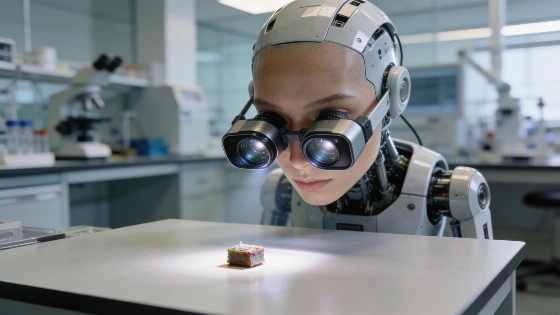
A research team at York University has introduced a convergent binocular stereo algorithm that enables humanoid robots to estimate depth and object orientation more like humans, with tested improvements on a challenging benchmark dataset
Researchers at York University in Toronto have developed a computer vision algorithm designed to improve how humanoid robots estimate depth and recognize objects in three-dimensional space. The system, called convergent binocular stereo (CBS), enables robots with two forward-facing cameras to process visual information in a way that more closely resembles human depth perception. Unlike conventional stereo vision, which typically uses parallel cameras and focuses on horizontal image differences, CBS allows robotic cameras to converge on a single point, capturing both horizontal and vertical disparities. This approach is intended to enhance the robot's ability to judge distances, interpret object orientation, and navigate cluttered or ambiguous environments.
The CBS algorithm operates by first aligning both cameras on a specific 3D target, then analyzing the geometric relationship between the resulting images. It constructs a five-level Gaussian pyramid to examine the images at multiple resolutions, beginning with coarse features and refining matches at higher resolutions. At each level, the system detects and matches SIFT (Scale-Invariant Feature Transform) features, applies epipolar constraints to estimate disparities, and uses Gabor filters to analyze texture and edge information. This multi-stage process produces detailed horizontal and vertical disparity maps, which are then converted into 3D depth estimates. The method is designed to capture additional information about surface slant and object pose, aiming for a more humanlike visual processing pipeline.
Benchmark Evaluation
To assess the algorithm's performance, the research team created the Convergent Binocular Stereo-BenchMark dataset (CBS-BM), which includes 49 scenes ranging from ordinary tabletop arrangements to environments with repeated patterns, featureless surfaces, and objects with significant self-occlusion. Each scene provides both parallel and convergent image pairs, allowing for direct comparison with established stereo vision methods and several deep-learning-based systems. CBS demonstrated lower mean horizontal disparity and depth errors across the full dataset compared to parallel stereo approaches. Its most significant advantage appeared in scenes with repeated patterns, where conventional systems often struggle to match visually similar features. In these cases, CBS reduced mean depth error by approximately 0.8 meters and horizontal disparity error by about 100 pixels relative to the next-best method.
Despite these improvements, the CBS approach has notable limitations. Its accuracy declines for objects at greater distances, and it relies on precise camera calibration and motor positioning. The current implementation requires roughly 69 seconds to process a scene on an AMD Ryzen 7 7700X processor, indicating that further optimization would be necessary for real-time applications. The developers emphasize that CBS is not intended to replace parallel stereo vision in all robotic systems, but rather to provide a foundation for humanoid robots that require coordinated eye movement and depth estimation similar to human vision.
Context and Limitations
The CBS algorithm represents a research-stage advance rather than a commercial deployment. Its evaluation was conducted in controlled laboratory conditions using a custom benchmark dataset, and independent replication of results has not yet been reported. The system's reliance on convergent camera movement means it is best suited to robots with articulated heads or eyes, rather than fixed stereo rigs. While the approach brings robotic vision closer to biological models, it does not confer general human-level perception or judgment. The research highlights the ongoing challenge of translating laboratory advances in robot perception into robust, real-world performance, especially in environments with unpredictable lighting, movement, or occlusion.
Interest in improving humanoid robot perception has grown alongside demonstrations of robots in industrial, service, and public environments. For example, recent industry showcases have highlighted the technical progress and deployment challenges faced by humanoid and quadruped robots in aviation and security roles, as seen in demonstrations by Chinese robotics firms. Advances in depth perception algorithms such as CBS may contribute to more reliable navigation and manipulation in these settings, but practical deployment will depend on further engineering, safety validation, and integration with broader robot control systems.
Depth perception in robots relies on extracting spatial information from sensor data, typically using stereo vision, structured light, or time-of-flight sensors. Stereo vision algorithms estimate depth by comparing differences between two images captured from slightly different viewpoints. Human vision uses convergent eye movement and both horizontal and vertical disparities to judge distance and object orientation. Most robotic systems have historically used parallel cameras, limiting their ability to replicate these cues. The CBS approach attempts to bridge this gap by enabling robots to use convergent camera movement and multi-resolution feature matching, but its effectiveness remains bounded by calibration, processing speed, and the complexity of real-world environments.