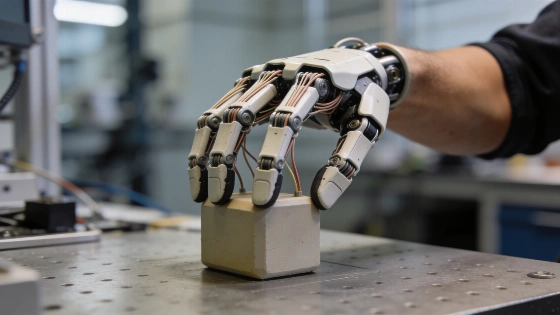
Clone Robotics has shown a remotely controlled Torso 3 hand while targeting November 2026 for Torso 4, a redesigned platform aimed at stationary two-arm workplace tasks.
Clone Robotics is betting its next humanoid platform on workplace tasks that use both arms, but the evidence released so far comes from an older hand operated by a person. In its official announcement, the company identified November 2026 as the launch target for Torso 4 after a six-month redesign. It did not provide an exact date, price, customer-delivery schedule, or independent performance results. The timetable is therefore a product target rather than a demonstrated workplace capability.
The distinction is central. The October 1 video is explicitly labeled "Teleoperation of the Hand of Torso 3," meaning that a human directs the movements remotely. It does not show autonomous manipulation and does not establish how Torso 4 will perform. In robotics evaluation, autonomy is not inferred from a moving mechanism alone: researchers must specify the task, permitted human intervention, test conditions, number of trials, and criteria for success.
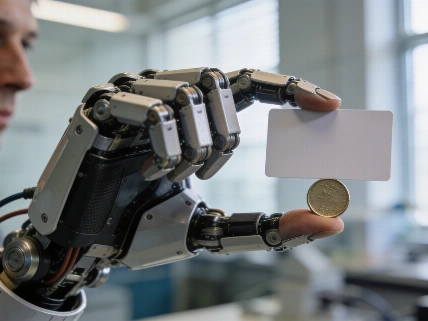
Clone Robotics describes the footage as "Teleoperation of the Hand of Torso 3." The hand uses five fingers pulled by artificial muscles and tendons in an arrangement intended to follow human anatomy. Such a design may support a broad range of grasps, but the clip provides no measured success rate, trial count, confidence interval, latency measurement, or evidence about performance across different objects and environments. It demonstrates motion under human control, not a statistically characterized manipulation system.
The company later said the hand was built in April 2026 and was the last of its legacy designs. Clone says it has since redesigned the entire system from the ground up with hardware intended to be easier to simulate and control while retaining its aim of human-level capabilities. Those are engineering priorities and company claims, not results from an independent evaluation. No peer-reviewed study, laboratory report, named lead researcher, or repeatable benchmark for the redesigned Torso 4 has been presented in the available materials.
Teleoperation also changes what a demonstration can establish. A remote operator can supply decisions about movement timing, object handling, force adjustment, and recovery from mistakes. Without information about the communication link, control latency, operator workload, or intervention frequency, a viewer cannot separate the hand's mechanical ability from the human controller's contribution. A rigorous study would normally report, for example, the proportion of successful trials, failures by task type, the number of operator interventions per attempt, and uncertainty around the measured estimates.
These distinctions align with established practice in robotics research. Work associated with MIT robotics research and studies published in Nature commonly separate hardware demonstrations from controlled evaluations, where predefined tasks and repeatable measurements make competing systems easier to compare. That framework does not imply that Torso 4 will fail; it shows why a short teleoperation clip cannot establish autonomy, reliability, or production readiness.
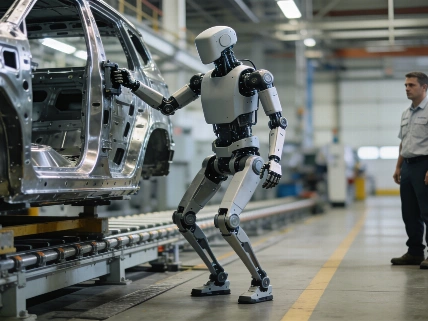
Torso 4 is being positioned for stationary bimanual work in enterprises. In practical terms, that means tasks performed in one place with two arms rather than a general demonstration of a humanoid moving through an unstructured environment. The narrower target could make control and simulation more manageable, but Clone has not identified a specific workplace task that Torso 4 has completed autonomously.
The company has also not stated how much human assistance the new platform will require. That missing detail matters more than a launch month. A system that performs a task only through continuous teleoperation is a different product from one that executes a complete task independently under supervisory control. The available material does not establish which category Torso 4 will occupy.
The timeline is concise: the demonstrated hand dates from April 2026, the video appeared on October 1, and Torso 4 is targeted for November 2026. The redesign therefore follows six months of work according to Clone. The hand has five fingers, but no numerical performance data are reported for its manipulation. There are also no published measurements of autonomy, task-success rate, repeated-trial performance, operator-intervention requirements, cost, or delivery terms.
Clone's anatomical approach contrasts with Boston Dynamics' four-finger hands for Atlas. Boston Dynamics has chosen to omit a fifth finger to limit cost, size, and possible failure points, while Clone continues to pursue a more humanlike arrangement. The comparison is useful because finger count alone does not determine practical dexterity. Control quality, simulation performance, reliability, force sensing, calibration, and recovery from errors are more decisive.
That same issue appears in an earlier hand analysis of Atlas. Different mechanical designs can still face the same engineering requirement: the system must produce repeatable actions under conditions that matter to the user rather than merely display a convincing movement in a short clip. For a meaningful comparison, evaluations would need matched tasks, consistent objects and environments, prespecified success criteria, and enough repetitions to distinguish robust performance from an isolated success.
Clone's announcement is therefore best read as two separate claims. One is supported by video: a human remotely operated a Torso 3 robotic hand. The other is prospective: a redesigned Torso 4 platform is intended for stationary two-arm enterprise work and is scheduled for launch in November 2026. The first does not validate the second.
Teleoperation is a control arrangement in which a human sends movement commands to a machine rather than leaving the machine to choose its own actions. It can demonstrate actuator response, tendon coordination, and mechanical range of motion, but it does not measure autonomy. Until Torso 4 is shown completing defined tasks with reported human interventions, repeated trials, and uncertainty estimates, the strongest evidence remains a demonstration of legacy hardware, not proof of an autonomous workplace robot. That makes the November target an important evaluation point, but not yet a verified industrial deployment.