NEURA Robotics says its model pairs 3D vision with tactile input, while also processing audio alongside language and robot-state data. A planned 11-minute laundry demonstration will test that approach on a humanoid, but the company has published no comparative results
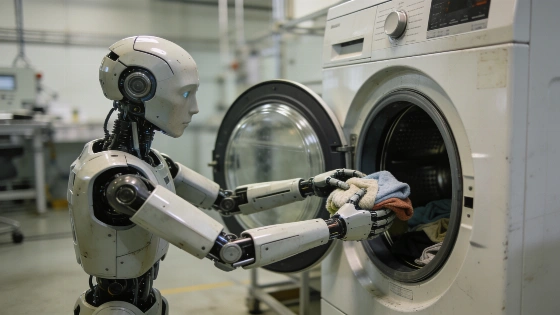
At NVIDIA GTC Berlin, NEURA Robotics plans an 11-minute laundry sequence for its 4NE1 humanoid. The run will start with sorting clothes and loading a washing machine, move through closing and reopening it, then unload the laundry before transferring it to a dryer. The company describes the planned run as autonomous, with no human intervention. NEURA announced Neuron AI on October 14, 2026, and scheduled the demonstration for October 20-22 at Station-Berlin, Hall 3, booth 3031. This is a planned demonstration, not a reported test result.
The announced sequence does not include a complete washing and drying cycle. NEURA has published no success rate or trial count, and no failure record or comparison with another system. Those omissions make it impossible to judge repeatability or reliability from the announcement alone.
The software behind the planned demonstration is Neuron AI, which NEURA describes as a Perception-Language-Action (PLA) foundation model for robots. The company says the model combines 3D vision with touch, while also processing audio, robot-state data, language and memory to produce physical actions. NEURA says the model supports multiple robot platforms; its official Neuron AI page lists five embodiments.
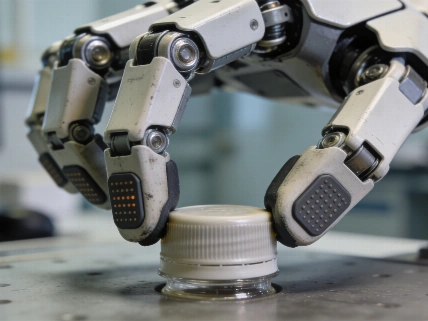
That combination could let a robot use contact and sound as clues during manipulation. NEURA cites force changes that indicate a screw has engaged, along with a click suggesting a latch has closed. These are intended capabilities, not independently verified results. The company has released no comparative benchmarks to show whether touch improves performance over vision-based control, or whether audio and memory do.
Memory is intended to preserve information about earlier events and objects that have moved out of view. That could help across a sequence of actions, but the announcement does not explain how memory is represented or how long information persists. It also gives no account of how errors are detected. Without those details and repeatable tests, the feature description does not establish dependable task planning.
NEURA says the model supports five robot embodiments: the 4NE-1 Gen 3 and Gen 4 humanoids, a wheeled 4NE-1 platform, plus two other bimanual platforms. The company's product information says inference runs locally on the robot, without a cloud connection. Local processing can avoid reliance on continuous remote computing, but the announcement offers no hardware specifications or measures of latency and reliability.
The numerical evidence currently available is limited. The planned demonstration runs for 11 minutes and is scheduled for October 20-22 at NVIDIA GTC Berlin; the model is described as supporting five embodiments. NEURA has reported no measured result for Time-to-Skill, its stated measure of how long it takes to teach a task before a robot performs it reliably.
Training combines real-world robot experience with simulated variations, as well as human demonstrations recorded using sensor-equipped suits. NEURA Gyms is the company's name for infrastructure that supports data collection, training and benchmarking. The company also identifies industrial data partnerships with Schaeffler and Bosch, but has disclosed neither dataset composition nor independent evaluation results.
Customers are meant to fine-tune capabilities through Neuraverse and distribute them across fleets. They can keep trained skills private or share them. A separate earlier tooling report described infrastructure for generating data, training models and deploying robots; that kind of platform is distinct from evidence that a robot can reliably complete a task.
The gap matters in physical automation. A robot can make a plausible movement while misjudging contact, losing track of an object or reaching a state its controller cannot recover from. The announcement gives no account of human monitoring or emergency stops, nor does it describe recovery procedures or how unsuccessful attempts will be handled during the Berlin demonstration. It also does not establish routine deployment in homes or workplaces.
Sensor fusion combines measurements from different devices to form a more useful estimate of a robot's surroundings. Cameras, force sensors and microphones capture different properties, and their readings can be incomplete or noisy. A model using several inputs still needs testing across varied objects and conditions; combining sensors alone does not demonstrate reliable control.