
A NASA technical bulletin warns that flawed casting can leave Aluminum 2219 vulnerable to corrosion and uneven mechanical performance unless manufacturers apply validated homogenization and multidirectional deformation.
A manufacturing defect formed before an aerospace component takes shape can survive every later heat-treatment and forging step. NASA's Technical Bulletin TB 26-07 says improper casting and forging of Aluminum 2219 can leave the alloy with microstructural damage that reduces its response to anodic surface treatments and increases corrosion susceptibility.
Aluminum 2219 is an age-hardenable aluminum-copper alloy developed by Aluminum Company of America in 1954 for service up to about 600 °F. Its combination of weldability, workability, cryogenic performance and strength across low and high temperatures has made it useful in launch and space vehicles, including space-shuttle fuel tanks and human-rated pressurized modules. The alloy's relatively high copper content also makes segregation and copper-rich intermetallic clustering important concerns during solidification, as summarized in ASM International materials guidance.
The risk begins during production of large ingots by conventional direct-chill casting. Uneven grain sizes, macrosegregation of alloying elements, and bands or clusters of copper-rich intermetallic phases can form before the material is forged or rolled. Those features can produce low ductility, low strength and non-uniform properties across the finished product.
Mechanical deformation, solution treatment, quenching and aging can reduce some damage, but they cannot reliably erase every discontinuity. Interdendritic segregation, large copper-rich particles and sharply different grain sizes may be effectively unrecoverable once embedded in a large ingot. This is a broader aerospace-materials principle: later thermomechanical processing cannot be assumed to restore uniform properties after severe casting-scale defects have formed.
NASA's guidance places homogenization immediately after casting because the process changes chemical distribution before intensive mechanical processing begins. During heating, copper atoms diffuse away from highly concentrated interdendritic boundary regions and become more evenly distributed through the aluminum matrix. Residual phases can dissolve into the matrix while overall elemental segregation falls.
Direct-chill casting is a standard route for producing large aluminum ingots, but inadequate homogenization can leave chemical segregation and coarse intermetallic particles that later processing cannot fully remove. The TMS discussion of aluminum homogenization emphasizes the same processing logic: diffusion during a carefully controlled thermal cycle is needed to reduce the compositional gradients created during solidification.
The treatment cannot be reduced to one universal recipe. Ingot cross-section thickness affects how heat moves through the material, while the melting point, eutectic phase, grain size and copper content influence the time and temperature needed for dissolution. NASA recommends verifying effectiveness with micrographs or analytical measurements such as differential scanning calorimetry and X-ray diffraction.
One study cited in the bulletin used 535 °C for 10 hours during homogenization. That figure is evidence of a reported processing condition rather than a blanket specification for every casting size. The bulletin instead recommends that manufacturers optimize the thermal cycle for the geometry and composition of each ingot.
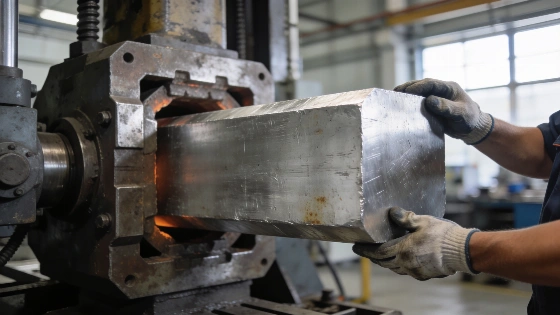
Homogenization prepares the material, but deformation supplies a second essential control. Upset forging and rolling can break up coarse particles, redistribute Al2Cu and other intermetallic phases, promote recrystallization and generate new grains. Multidirectional deformation is particularly important because it works the material through more than one axis rather than preserving a single dominant direction of strain.
The bulletin cites a study combining multidirectional forging at 510 °C with warm rolling at 240 °C before solution treatment and aging. In that example, the area fraction of coarse Al2Cu particles fell from 5.5% to 1.0%, while average grain size declined from 230 micrometers to 58.6 micrometers. The uniformly distributed θ' phase increased by 118%, and the reported microstructural changes were associated with improved strength, elongation and fracture properties.
Those results describe a processing study rather than a guarantee that every Aluminum 2219 component will achieve the same values. The available summary does not establish a universal sample size, p-value or confidence interval for all 2219 products, so the reported percentages should be treated as study-specific measurements. The central mechanism is nevertheless clear: the sequence of thermal homogenization followed by controlled deformation determines how effectively coarse phases are dissolved, fractured and redistributed.
NASA recommends that homogenization after conventional direct-chill casting be written directly into procurement specifications for Aluminum 2219. Verification should include evidence from before-and-after micrographs and may also use DSC or XRD measurements. Initial microscopy can reveal whether the ingot began with a microstructure suitable for further processing, while analytical measurements can help confirm that undesirable phase transformations and segregation have been addressed.
This emphasis matters most for larger castings, where uniform heating and removal of internal segregation become more difficult. A supplier that reports only the final temper or mechanical test result may not reveal whether the starting ingot contained defects that later processing could not repair. For aerospace programs, process records and microstructural acceptance criteria therefore complement conventional tensile, fracture and corrosion testing.
Issued on 24 September 2026 as DOC ID 20260008373, TB 26-07 is a technical manufacturing warning rather than a report of a new spacecraft or flight event. Its value lies in turning a materials lesson into an auditable production requirement: inspect the ingot, optimize the homogenization cycle and confirm the resulting structure before relying on downstream forging and aging.
Homogenization works through diffusion, the temperature-driven movement of atoms from regions of higher concentration toward more even distribution. That process takes time and depends on distance, which is why a large ingot cannot be treated as though its entire cross-section responds instantly. The evidence presented by NASA supports a firm engineering conclusion: for Aluminum 2219 used in demanding aerospace structures, homogenization and multidirectional deformation are not optional finishing touches but core controls for obtaining predictable material performance.