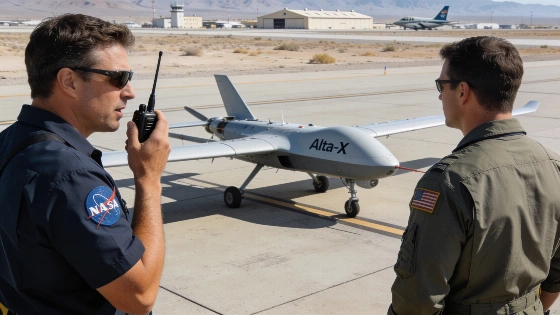
NASA's Dale Reed Subscale Flight Research Laboratory is testing the SPLICE guidance system on the Alta-X drone to improve hazard detection and precision landings for future Moon and Mars missions.
At NASA's Armstrong Flight Research Center in California, engineers and pilots are putting a new spacecraft landing system through its paces. The Safe and Precise Landing - Integrated Capabilities Evolution (SPLICE) experiment, developed at Johnson Space Center, is being tested on the Alta-X drone. The team behind these tests draws on years of hands-on aviation and engineering experience. Their work is part of NASA's ongoing effort to improve landing technology for future Moon and Mars missions, a topic recently covered in Nature.
SPLICE combines advanced guidance and navigation algorithms to help spacecraft find safe landing spots and avoid hazards during descent. At Armstrong, the Alta-X drone acts as a flying testbed, letting engineers simulate difficult landing scenarios in a controlled setting. On August 27, 2026, the team worked with Edwards Air Force Base air traffic control to run a flight near the research center. This test showed SPLICE's ability to process real-time data and respond to hazards as they appear. NASA documented the flight, and other outlets reported on it, confirming the focus on real-time hazard detection and precision landing for future missions.
Using subscale drones like Alta-X gives NASA a faster, less expensive way to try out new landing technologies before sending them to the Moon or Mars. The Armstrong lab's approach lets researchers quickly adjust both hardware and software based on flight results. This method lowers risk and cost compared to testing on full-size spacecraft. Other research centers, including MIT and the European Space Agency (ESA), use similar strategies to mature new technology.
The Armstrong subscale flight lab is led by chief engineer Derek Abramson, chief pilot Justin Hall, and drone pilot Justin Link. Abramson's background includes Navy avionics and engineering support for aircraft like the EA-6B, F-18, B-1, and CV-22 Osprey. Hall is known for his skill with model and remotely piloted aircraft, which led to his role at NASA. Link grew up around aviation and brings hands-on fabrication skills to the lab, helping design and build custom research vehicles.
The team works together to integrate new aerospace technology with their fleet of subscale aircraft, design flight experiments, and analyze results to guide future mission planning. Many of them continue to build and fly experimental aircraft outside of work, keeping their connection to the practical side of flight. This mix of professional and personal experience shapes the lab's culture and supports quick innovation.
SPLICE is designed to tackle a key challenge in planetary exploration: landing safely in unpredictable terrain. By mounting SPLICE on the Alta-X drone, NASA can test hazard detection and precision landing in realistic conditions. The August 2026 test flight required coordination with air traffic control at Edwards Air Force Base, showing the complexity involved even in small-scale experiments. The lab's approach allows for quick changes to support new mission ideas, covering both lunar and Martian landing scenarios. This way of working matches best practices in experimental aeronautics, as seen in research from the Max Planck Society and journals like Science.
Subscale testing at Armstrong adds to NASA's broader work on landing technology. Using remotely piloted and autonomous aircraft lets the agency test guidance systems, navigation software, and hazard avoidance without the high cost or risk of full-scale missions. This approach is similar to other NASA projects, such as expanding deep space communications infrastructure reported earlier, which also rely on step-by-step, evidence-based development.
As NASA prepares for more complex landings on the Moon and Mars, testing and refining landing systems at the subscale level becomes more important. The Armstrong team's work with SPLICE on the Alta-X drone offers a practical way to reduce uncertainty and improve mission safety. By validating guidance and hazard avoidance in real flight conditions, the lab helps make sure future spacecraft can land precisely on challenging surfaces.
The Armstrong subscale flight lab's mix of technical skill, operational discipline, and hands-on testing shows how important practical experience is for mission-critical innovation. Their ongoing work to test and improve landing systems will directly shape the capabilities of upcoming Moon and Mars missions, laying the groundwork for safer exploration.
Precision landing on other worlds requires real-time navigation, hazard detection, and adaptive control. Systems like SPLICE use onboard sensors and algorithms to scan terrain during descent, pick safe landing zones, and adjust the spacecraft's path as needed. Subscale flight tests let engineers see how these systems perform in changing conditions, spot limitations, and make improvements before full-scale missions. This step-by-step process is key to reducing risk and making future planetary landings more reliable.