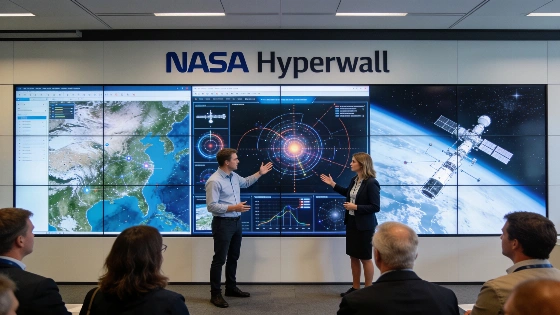
NASA will present a series of Hyperwall science talks at IGARSS 2026, featuring mission updates and instrument demonstrations from Earth and planetary science experts in the exhibit hall
NASA has announced a detailed schedule of Hyperwall presentations for the International Geoscience and Remote Sensing Symposium (IGARSS) 2026, set to take place in Vienna this August. The Hyperwall, a large-scale data visualization platform, will serve as the centerpiece for a series of expert-led sessions highlighting recent advances in Earth observation, satellite instrumentation, and mission science. These talks are designed to provide attendees with direct insight into the latest technical developments and scientific findings from NASA and its partners.
Hyperwall Sessions and Scientific Focus
The Hyperwall agenda spans three days, with each session focusing on a specific aspect of Earth or planetary science. On Monday, August 10, Mike Seablom will discuss "Technology Enabling the Future of Earth Science," followed by Karen St. Germain presenting "Discovery Earth: New Missions & Technical Innovation Advancing Earth System Insights." These sessions will address the evolving landscape of satellite technology and the integration of new mission architectures for improved Earth system monitoring.
Tuesday's program includes Mike Taylor's overview of "STELLA: Open-Source Multisenor Platforms For Real-Time Environmental Monitoring" at 10:00 AM, and Dan Lindsey's presentation on "NOAA Geostationary Satellites: Valuable Data for both Research and Operational Use" at 10:15 AM. The afternoon features Robert O. Green on "Discovering Mineral Resources with NASA Imaging Spectroscopy" and Paul Chang discussing "The Importance of Satellite Ocean Observations at NOAA." Each talk is scheduled for 15 minutes, allowing for concise technical updates and audience engagement.
Mission Updates and Instrument Demonstrations
Wednesday, August 12, will highlight recent mission milestones and data-driven science. Joel Scott will present "Enabling Earth Science Data to Serve Society" at 10:00 AM, followed by Shannon Brown's "Microwaving the Solar System" at 10:15 AM, which will explore microwave remote sensing techniques across planetary environments. The afternoon sessions include "NISAR Updates, One Year After Launch" with Paul Rosen and Marco Lavalle, and Lauren Leese's "Office of the Chief Science Data Officer: Data Driven Exploration." These presentations will provide updates on mission status, instrument calibration, and the challenges of translating raw data into actionable scientific products.
Each Hyperwall session is designed to showcase real mission data, instrument capabilities, and the scientific questions driving current research. The format encourages direct interaction between NASA experts and the IGARSS community, supporting both technical exchange and critical discussion of ongoing projects.
Context and Broader Scientific Engagement
The IGARSS 2026 Hyperwall program reflects NASA's ongoing commitment to open science and collaborative research. By presenting mission updates and technical demonstrations in a public forum, the agency aims to foster transparency and accelerate the adoption of new methods across the Earth and space science communities. This approach builds on previous outreach efforts, such as the recent public satellite image challenge that invited participants to analyze and interpret remote sensing data.
While the Hyperwall sessions are scheduled for specific times, the exhibit hall will remain open for informal discussions and further exploration of NASA's latest visualization tools. Attendees are encouraged to engage with presenters, ask technical questions, and consider the implications of new data products for their own research areas.
For those unable to attend in person, selected Hyperwall presentations may be made available online following the conference, subject to technical and policy constraints.
Data visualization platforms like the Hyperwall play a critical role in modern Earth and planetary science. By enabling researchers to display and analyze large, complex datasets in real time, these systems help reveal patterns and correlations that might be missed in traditional formats. The Hyperwall's high-resolution, multi-screen display allows for the integration of satellite imagery, model outputs, and time series data, supporting both scientific discovery and effective communication of results to diverse audiences.