NASA's Psyche probe has completed a close flyby of Mars, capturing a time-lapse sequence and using the planet's gravity to adjust its course toward the metal-rich asteroid Psyche, its target for arrival in 2029
NASA's Psyche spacecraft has executed a critical maneuver by flying past Mars, using the planet's gravity to alter its speed and trajectory for its journey to the asteroid Psyche. The spacecraft, launched in 2023, is now on a multi-year cruise through the inner solar system, with its next major milestone set for a rendezvous with its namesake asteroid in the main belt between Mars and Jupiter in 2029.
Gravity Assist and Trajectory Correction
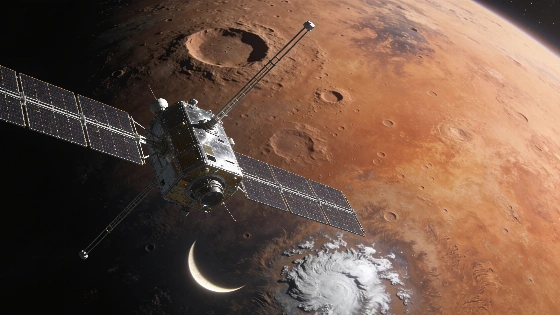
On May 15, 2026, Psyche passed within 4,609 kilometers (2,864 miles) of Mars' surface. This close approach was designed to exploit Mars' gravitational field, providing the spacecraft with a velocity boost of approximately 1,600 kilometers per hour (1,000 miles per hour). The maneuver, known as a gravity assist, is a well-established technique for interplanetary missions, allowing spacecraft to change speed and direction without expending additional propellant. Mission engineers confirmed that Psyche's trajectory after the flyby matches the requirements for its planned arrival at asteroid Psyche in 2029.
During the encounter, Psyche's imaging system captured a time-lapse sequence showing Mars as a thin crescent expanding into a detailed, cratered disk before receding into darkness. The sequence, assembled from images taken over several weeks, documents the spacecraft's changing perspective as it approached and then departed the planet. Notable surface features, including the Huygens crater and the south polar ice cap, were resolved in the images.
Instrument Calibration and Science Operations
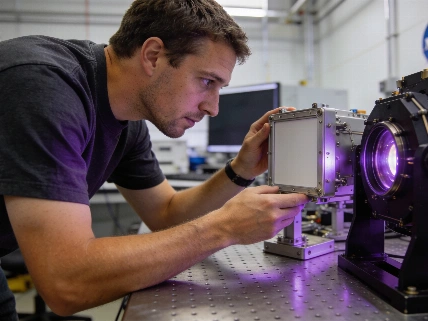
The Mars flyby provided an opportunity to test and calibrate Psyche's suite of scientific instruments against a well-characterized planetary target. The spacecraft's gamma-ray and neutron spectrometer, designed to analyze elemental composition, detected the expected increase in neutron flux as it passed closest to Mars, confirming its operational readiness. The magnetometer recorded the bow shock where the solar wind interacts with Mars' magnetic environment, marking the instrument's first planetary measurement since launch.
Psyche's twin multispectral cameras, responsible for imaging and surface mapping, successfully captured the time-lapse sequence and also detected Mars' two small moons, Phobos and Deimos, from a distance. This capability will be used later in the mission to search for potential moonlets around asteroid Psyche. The successful calibration of all instruments during the flyby ensures that the spacecraft is prepared for its primary science phase upon arrival at its target.
Mission Status and Next Steps
With the Mars gravity assist complete, Psyche is now on a trajectory that will carry it through the asteroid belt over the next three years. The spacecraft will resume sustained thrusting with its solar-electric propulsion system later in 2026, gradually refining its orbit to intercept asteroid Psyche. The mission's primary objective is to investigate the composition, structure, and magnetic properties of the metal-rich asteroid, which is hypothesized to be the exposed core of a protoplanet.
The flyby also provided a valuable rehearsal for future operations, allowing mission teams to validate navigation, instrument performance, and data processing workflows. As NASA continues to expand its exploration of Mars and the asteroid belt, the Psyche mission builds on decades of planetary science, including earlier milestones such as the Viking 1 lander's historic touchdown, which is discussed in the context of Mars exploration in this recent Science Report article.
Scientific Implications and Remaining Questions
While the Mars flyby was not intended to produce new discoveries about the Red Planet, it provided a unique vantage point for observing Mars from a rapidly changing perspective. The data collected serve primarily to validate Psyche's instruments and operational procedures, reducing risk ahead of the main science campaign. The mission's central scientific questions-whether asteroid Psyche is indeed a planetary core and what its composition reveals about early solar system processes-remain to be addressed after arrival.
Uncertainties persist regarding the asteroid's internal structure, surface properties, and potential for hosting small satellites. The mission's success will depend on the continued performance of its instruments and the accuracy of its navigation over the coming years. As with all deep-space missions, unforeseen technical or environmental challenges could affect the timeline or data quality, but the Mars flyby marks a significant step toward the mission's primary science objectives.
Gravity assist maneuvers are a cornerstone of interplanetary mission design. By flying close to a planet, a spacecraft can exchange momentum with the planet's orbital motion, gaining or losing speed and altering its trajectory without using additional fuel. The precise outcome depends on the spacecraft's approach angle, velocity, and the planet's mass and motion. Successful gravity assists require careful planning and navigation, as small errors can lead to significant deviations over interplanetary distances. For Psyche, the Mars flyby was essential to reach its distant asteroid target within the available mission resources.