

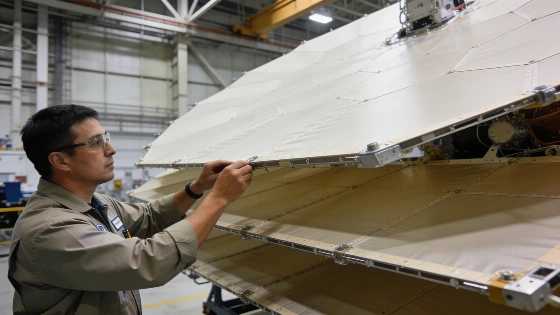
Standing 20 feet tall, the sunshade is designed to keep NASA's NEO Surveyor infrared telescope cool while supplying spacecraft power during searches for asteroids and comets that can be difficult to spot near the Sun
The sunshade being inspected for NASA's Near-Earth Object (NEO) Surveyor mission stands 20 feet (6 meters) tall and is 8 feet (2.4 meters) wide at its base. An image released on Oct. 26, 2026, shows a technician examining the structure. The inspection took place in July at BAE Systems Space & Mission Systems in Boulder, Colorado, after the sunshade was mounted on an assembly ring in a clean room.
Cooling and Power
The sunshade has two jobs: it will help keep the infrared telescope cool and provide the spacecraft with power. Its two flat panels meet at a 23.5-degree angle and carry 864 interconnected solar cells. NASA says the specialized array can produce up to 2 kilowatts of power, making it the spacecraft's only power source and charging its onboard batteries.
The shade is designed to block sunlight from reaching the telescope and keep it cool as it detects infrared emissions from asteroid and comet surfaces heated by the Sun. It also prevents solar glare from entering the telescope's 20-inch-wide (50-centimeter-wide) aperture. NASA describes the sunshade's combined role in its mission update.
Searching Near the Sun
NEO Surveyor will search for near-Earth asteroids and comets, including some of the hardest-to-find objects. Some may appear in the direction of the Sun, where ground-based optical telescopes have a harder time searching. The spacecraft's infrared observations are designed to detect heat emitted by these objects, including targets that can be difficult to observe in visible light. NASA has described the mission as a search for potentially hazardous space rocks that other telescopes may not detect.
Related Instrument Work
The sunshade structure was built by Applied Aerospace in Stockton, California. SolAero Technologies installed the solar cells in January 2026; environmental testing was completed in March at a thermal-vacuum facility in El Segundo, California. The structure was delivered ahead of schedule to BAE Systems in May. After delivery, teams added coarse Sun sensors for spacecraft attitude determination and temperature sensors, then completed functional and performance testing of the solar array before the July inspection. NASA's Jet Propulsion Laboratory also documented the inspection.
NASA's work on instruments for challenging observations also includes an airborne lidar mapping test over Delaware. The NEO Surveyor image is credited to BAE Systems Space & Mission Systems. The mission is set for launch in 2027.







