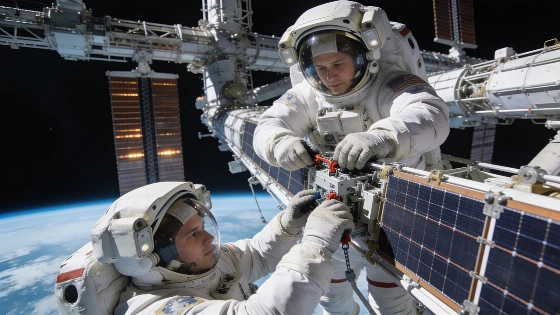
NASA astronauts Jessica Meir and Anil Menon spent 6.5 hours outside the International Space Station installing the final mounting hardware for new roll-out solar arrays, a step toward boosting the station's power supply later this year
NASA astronauts Jessica Meir and Anil Menon have completed a 6.5-hour extravehicular activity (EVA) to install the last set of mounting hardware needed for the International Space Station's (ISS) next-generation solar arrays. The operation, conducted on August 6, 2026, marks a significant milestone in the ongoing effort to sustain and enhance the station's electrical power as its original arrays continue to age.
Final Hardware Installation
During the EVA, Meir and Menon assembled and secured a modification kit on the 3B power channel, located on the starboard S6 truss segment. This kit will support the future deployment of an ISS Roll-Out Solar Array (iROSA), designed to augment the station's existing power system. The astronauts worked from an articulating portable foot restraint, allowing precise positioning as they bolted together triangular brackets and routed power cabling. Once the structure was in place, they covered the new struts with multi-layer insulation to shield them from micrometeoroid impacts and thermal extremes.
Since 2021, six iROSA assemblies have been installed on the ISS, with two more scheduled for delivery and installation later in 2026. The new arrays are positioned forward of the legacy solar panels, increasing the station's total power generation capacity by an estimated 20% to 30% when fully operational. The only remaining channel awaiting iROSA installation is 2A, located on the port side of the truss.
Mission Context and Technical Details
The original ISS solar arrays, launched between 2000 and 2009, were designed for a 15-year operational life and have shown gradual power degradation. The iROSA upgrades are intended to extend the station's ability to support scientific experiments, crew operations, and visiting spacecraft. The modification kits provide the necessary mechanical and electrical interfaces for the new arrays, which are lighter and more compact than their predecessors.
The August 6 spacewalk began at 8:33 a.m. EDT (1233 GMT) and concluded at 3:00 p.m. EDT (1900 GMT), totaling 6 hours and 27 minutes. This EVA was the 96th conducted by U.S. astronauts in support of the ISS and the 281st overall. For Menon, it was a first career spacewalk, while Meir added to her cumulative EVA time, now totaling over 42 hours across six outings. The Expedition 75 crew has two additional U.S. spacewalks scheduled for August, focusing on antenna replacement and further power and data system upgrades.
Operational Challenges and Scientific Impact
Spacewalks to upgrade the ISS power system require careful coordination, as astronauts must work with bulky gloves and limited mobility while exposed to the vacuum of space. The installation of iROSA hardware involves both mechanical assembly and precise cable routing to ensure safe integration with the station's electrical grid. The new arrays are not replacements but augmentations, designed to work in tandem with the aging original panels to maintain and increase available power for science operations.
Maintaining and upgrading the ISS infrastructure is essential for ongoing research in microgravity, including biological, materials science, and Earth observation experiments. The improved power supply will help support new instruments and experiments, as well as future visiting vehicles. The station's long-term viability depends on such upgrades, especially as international partners and commercial providers plan for new missions and eventual transition to private platforms. For context, recent advances in automated laboratory systems aboard the ISS have also reduced crew workload, as described in this report on mini-lab automation.
Looking Ahead for ISS Operations
The completion of the 3B channel hardware installation brings the ISS closer to full iROSA deployment, with the final two arrays expected to arrive later in 2026. Upcoming spacewalks will address additional maintenance tasks, including antenna replacement and preparations for the station's eventual controlled deorbit, currently planned for 2030. The ongoing upgrades reflect both the technical challenges and the collaborative nature of maintaining a complex orbital laboratory over decades of continuous operation.
As the ISS approaches its third decade in orbit, the combination of legacy and new technologies will determine its ability to support science and international cooperation in low Earth orbit. The lessons learned from these upgrades are likely to inform the design and operation of future space stations, whether government-led or commercial.
Spacewalks, or extravehicular activities (EVAs), are among the most technically demanding operations in human spaceflight. Astronauts must rely on specialized suits that provide life support, thermal regulation, and protection from micrometeoroids and radiation. Each EVA is carefully planned to minimize risk and maximize efficiency, with astronauts rehearsing procedures extensively before venturing outside the station. The success of these activities depends on both ground-based mission control and the adaptability of the crew, highlighting the complexity of maintaining and upgrading infrastructure in the harsh environment of space.