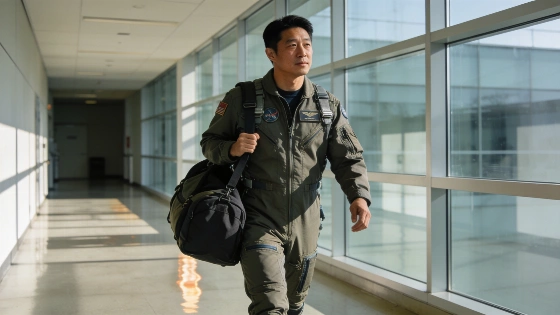
NASA astronaut Jonny Kim, a Harvard-trained physician and Navy SEAL, is leaving the agency after nine years and one mission to the International Space Station to return to active duty in naval aviation training
NASA astronaut Jonny Kim, whose career has spanned medicine, military service, and spaceflight, is leaving the agency after nearly a decade to return to active duty in the U.S. Navy. Kim's departure marks the end of a period in which he contributed to both operational and scientific aspects of human spaceflight, including a long-duration mission aboard the International Space Station (ISS).
From Special Operations to Spaceflight
Selected by NASA in 2017 as part of its 22nd astronaut class, Kim brought an unusual combination of expertise to the astronaut corps. Before joining NASA, he served as a Navy SEAL, completing over 100 combat operations and earning multiple commendations, including the Silver Star and Bronze Star with Combat 'V.' He later earned a medical degree from Harvard University, qualifying as both a physician and a naval aviator. At NASA, Kim completed the agency's rigorous two-year astronaut training and served as a capsule communicator (CAPCOM) at Johnson Space Center, relaying mission-critical information between ground teams and ISS crews.
Mission to the International Space Station
Kim's sole spaceflight assignment came in April 2025, when he launched to the ISS aboard a Russian Soyuz spacecraft alongside cosmonauts Sergey Ryzhikov and Alexey Zubritsky. The crew spent 245 days in orbit, conducting scientific experiments and supporting station operations. During their mission, the trio circled Earth 3,920 times and traveled nearly 104 million miles (167 million kilometers). Kim's medical and operational background informed his work on board, where he contributed to research aimed at advancing space exploration technologies and understanding the effects of long-duration spaceflight on human health.
Return to Military Service
Following his return to Earth in December 2025, Kim has chosen to resume his military career, focusing on naval aviation training. NASA officials have highlighted his impact on the agency, particularly his leadership in astronaut crew operations and his involvement in the Artemis program's development. Kim's decision comes as several other astronauts, including Mike Fincke and Canadian Jeremy Hansen, have also stepped away from active astronaut duty in 2026. The transition underscores the dynamic career paths available to astronauts with multidisciplinary backgrounds.
Broader Context in Space Exploration
Kim's departure from NASA occurs during a period of significant activity in international space missions. For example, Japan's MMX spacecraft is preparing for a sample-return mission to Mars' moon Phobos, aiming to address questions about the origins of Mars' moons and test new sample-return technology. This mission, detailed in a recent Science Report article on Japan's MMX launch preparations, reflects the expanding scope of human and robotic exploration across the Solar System.
Kim's career trajectory illustrates the interplay between military, medical, and scientific expertise in modern space programs. His experience highlights the value of cross-disciplinary training for astronauts tasked with supporting complex missions and advancing the frontiers of human spaceflight.
Understanding the operational and scientific demands of long-duration missions is central to planning future crewed exploration. Astronauts like Kim, who combine technical, medical, and operational skills, play a critical role in bridging the gap between mission safety and scientific return.
Space agencies continue to adapt their training and selection processes to reflect the evolving requirements of exploration beyond low Earth orbit. As international partnerships and mission objectives diversify, the backgrounds of astronauts are likely to remain varied, supporting both the operational resilience and scientific productivity of future crews.
In the context of ongoing and upcoming missions, the departure of experienced astronauts such as Kim signals both the challenges and opportunities facing the next generation of space explorers.
Spaceflight missions, especially those involving the International Space Station, require careful coordination between multiple agencies, rigorous crew training, and robust support systems on the ground. The process of preparing astronauts for long-duration missions involves not only technical instruction but also medical, psychological, and operational readiness. Crew members must be able to respond to emergencies, conduct scientific research, and maintain the health and safety of the team in a physically demanding and isolated environment. The selection and training of astronauts with diverse backgrounds-such as medicine, engineering, and military operations-enhance the ability of missions to adapt to unforeseen challenges and maximize scientific output.