
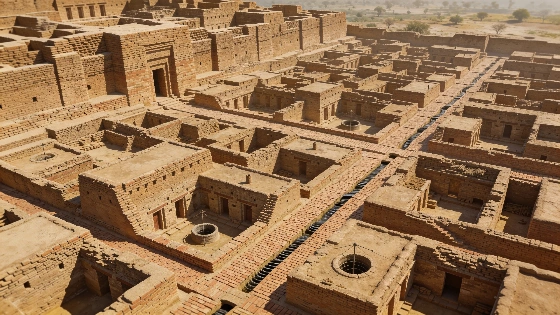
A study of 309 homes at Mohenjo-daro finds that residential inequality fell as the Indus city developed, suggesting that shared infrastructure and collective urban management may have limited wealth gaps
As Mohenjo-daro expanded, the gap between its largest and smallest homes appears to have narrowed rather than widened. A new analysis of residential architecture suggests that urban growth in the Bronze Age Indus city was accompanied by declining inequality.
The finding challenges a common assumption about early cities: that denser settlement and expanding urban systems necessarily produced sharper divisions between wealthy and less wealthy residents. At Mohenjo-daro, the archaeological pattern points toward a more complicated relationship between urbanization and economic difference.
Measuring the homes
Located in present-day Pakistan, Mohenjo-daro was a major center of the Indus Civilization between about 2600 and 1900 BCE. The city is commonly described as having a raised western citadel and a larger lower town containing residential and working areas. Homes were often organized around internal courtyards, while bathing areas connected to drains that carried household wastewater into larger street drainage systems.
Its regular streets, fired-brick buildings, wells, public structures and drainage network indicate coordinated investment in urban infrastructure. They do not, by themselves, prove the existence of a formal administration or a written building code. Likewise, archaeological evidence shows differences in house size, access to amenities and the distribution of valuable objects, but no unambiguous palace or royal tomb has been found that would establish a conventional monarchic class system.
Adam S. Green of the University of York, together with Iqtedar Alam and Cameron Petrie of the University of Cambridge, reconstructed 309 residences from archaeological records produced during early twentieth-century excavations. Using geographic information systems, they mapped surviving layouts and compared residential floor areas. The peer-reviewed study was published in Antiquity; its journal platform is available through the Antiquity journal.
Floor area is an indirect measure. A larger house may have accommodated more people or served activities that required additional space; it does not automatically represent greater wealth. Even so, differences in residential size provide a material basis for comparing inequality when other household records are limited. As in settlement studies published by major journals such as Nature, the interpretation depends on how the archaeological sample was defined and how incomplete evidence is handled.
The numerical pattern
The overall Gini coefficient for Mohenjo-daro was 0.44. For comparison, the reported coefficient was 0.86 at Knossos, 0.75 at Palenque and above 0.6 at both Ur and Ugarit. In the DK-G South district, where the sequence of occupation offers a clearer chronology, the coefficient fell from about 0.39 around 2500 BCE to 0.23 around 2100 BCE.
A Gini coefficient measures how unevenly a resource is distributed: higher values indicate greater inequality and lower values indicate a more even distribution. The comparison does not establish that households at Mohenjo-daro had equal wealth, nor does it make the sites perfectly comparable. It does show that residential differences at Mohenjo-daro were lower than those reported for several other ancient urban centers.
The decline in DK-G South coincided with a stronger alignment between residential buildings and the city's planned street network. That association is important, but it is not proof that street planning caused equality to increase. Both changes may instead reflect broader administrative or social processes that the surviving architecture cannot fully reveal.
The same district provides a second measure of the change. Median house area first fell from approximately 161 square meters to 98 square meters, then rose to about 141 square meters in a later phase. This later increase occurred while the difference between the largest and smallest residences was declining, suggesting that a rise in typical household space did not necessarily restore the earlier level of residential inequality.
Shared systems
The researchers connect the pattern to collective governance and investment in civic infrastructure. Mohenjo-daro contained public buildings, drainage systems, wells and standardized weights and measures. Indus seals were also widely recovered from residential buildings rather than being concentrated in palaces or temples, a distribution consistent with economic activity that was not controlled solely by a single ruling authority.
That interpretation remains provisional. Public infrastructure can support residents without ensuring equal access to land, labor, food or political influence, and seals do not by themselves identify who held power. The buildings offer evidence for how space was organized; they cannot provide a complete map of status or wealth.
The study also found a possible relationship between lower inequality and rising prosperity. In DK-G South, median residential floor area decreased during one phase and later increased to approximately 141 square meters, with the larger median occurring during the occupation phase that showed the lowest recorded inequality. Because the chronological evidence is limited, productivity and inequality cannot yet be linked with confidence.
For readers tracking how archaeologists reconstruct social organization from settlements, the contrast with a recent urban survey is useful: mapped streets and civic structures can reveal planning, but they do not automatically identify the political system behind them. At Mohenjo-daro, the household data add an economic dimension to that architectural evidence without resolving every question about authority.
What the evidence allows
Residential floor area cannot capture differences in movable possessions, access to distant resources, control of production, family size or social rank. The early twentieth-century excavation records also constrain what can be reconstructed, and the chronology is clearer in DK-G South than across the city as a whole. Those limitations matter because a low household-size disparity could coexist with inequalities that left little architectural trace.
The strongest claim supported by the study is therefore specific: residential inequality declined in at least one well-sequenced district as Mohenjo-daro developed, and the city's overall distribution of house sizes was relatively even compared with several other ancient urban sites. The evidence does not show that Mohenjo-daro was egalitarian in every sphere or that collective governance was definitively responsible.
A Gini coefficient is a summary of distribution rather than a direct observation of social life. It is calculated from measured differences within a sample, so its meaning depends on which houses survived, which were documented and how residential spaces are defined. Comparing coefficients across sites also requires caution because excavation histories and settlement layouts differ.
Those qualifications do not weaken the result; they define its value. Mohenjo-daro provides a strong case against treating urbanization as an automatic engine of inequality, while the available architecture still stops short of identifying how wealth, authority and opportunity were distributed beyond the walls of individual homes.
The site's modern condition adds another constraint to future research. Exposed brick ruins are threatened by salt crystallization, moisture, erosion and extreme weather. Conservation priorities therefore emphasize drainage control, monitoring and careful stabilization rather than large-scale reconstruction, since rebuilding could obscure the very spatial evidence archaeologists are trying to measure.
The study's measured decline in residential inequality is more persuasive than any sweeping claim about an equal Bronze Age society. Mohenjo-daro appears to have paired substantial civic organization with relatively even household space, making collective urban management a serious explanation rather than a decorative theory, but not yet a demonstrated cause.