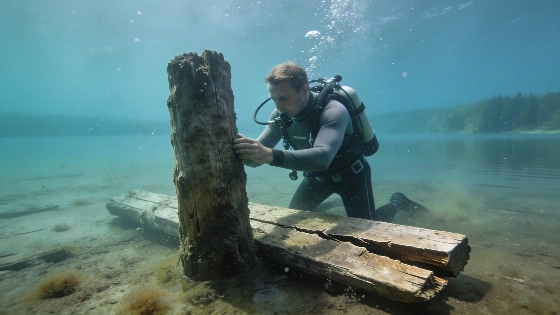
Worked timbers recovered 20 metres below Lake Arendsee date to about 10,500 years ago. Their marks show deliberate woodworking and may indicate construction, but researchers have not yet established whether the remains belonged to huts, platforms, fishing installations or another structure.
Twenty metres beneath Germany's Lake Arendsee lies an archaeological problem that rarely survives on land: worked wood from about 10,500 years ago. A wooden post and split boards bear signs of human manufacture, but the evidence does not yet identify the structures they came from.
The material belongs to the Mesolithic, when people around the lake relied on hunting, gathering and fishing rather than agriculture. If the timbers formed intensively used living spaces or permanent buildings, they would predate the first farming communities and their longhouses in Central Europe by roughly 3,000 years.
Evidence Underwater
Underwater archaeologists from the State Office for Heritage Management and Archaeology of Saxony-Anhalt recovered a wooden post about 1.6 metres long with apparent chopping or felling marks. They also found split boards as long as 1.3 metres. Those features establish deliberate working of the wood; they do not by themselves establish how the pieces were assembled or what activities took place at the site.
The post has been considered a possible load-bearing element, but that interpretation remains a working hypothesis. The timbers could belong to huts, yet they might also represent a platform, a fishing installation or another form of construction with no close modern archaeological parallel in the region. The available evidence is therefore architectural in potential, not yet architectural in proof.
The distinction matters because a single post and several boards cannot establish a building plan. Researchers would need a coherent spatial arrangement, evidence that the pieces were deposited at the same time, and a clearer relationship between the wood and the former shoreline. The current findings confirm human woodworking while leaving the function of the construction open.
Earlier evidence already showed that Mesolithic communities used the shores of Lake Arendsee. The new material adds something that usually disappears: direct evidence for woodworking and possibly architecture. State archaeologist Harald Meller has described the discovery as opening a new perspective on the Mesolithic, because Central German structures from this period have more often been inferred from soil discolorations than from surviving wooden elements.
A Preserved Shoreline
Lake Arendsee's geology helps explain why the wood survived. The lake floor has gradually subsided through geological processes associated with an underlying salt dome. As the basin sank, parts of the ancient shoreline and its archaeological material were preserved beneath sediment instead of being erased by shoreline changes and the exposure that commonly destroys organic remains.
That setting is not simply a storage vault for ancient objects. Waterlogged environments can preserve organic material exceptionally well, but interpretation still depends on the position of each object and its relationship to the submerged landscape. A worked post found near a board is evidence of association; it is not automatic proof that both were used in the same building.
The preservation contrast is unusually sharp. On dry land, wood from the Mesolithic is rare, while stone tools and animal bones are much more likely to remain. At Arendsee, the lake has retained construction material that could reveal activities otherwise visible only through indirect traces. The find therefore expands the evidence base without eliminating the uncertainties that accompany underwater archaeology.
Mapping the Ancient Lake
The site was discovered in spring 2026. Archaeologists then recovered additional samples and individual objects to assess its age and extent before working with the Fraunhofer IOSB-AST in Ilmenau on a second investigation. The wider underwater research programme in the Arendsee area has been running for several years.
A remotely operated vehicle equipped with high-resolution sonar mapped the submerged terrain and documented the contours of the former shoreline. Researchers recorded the positions of individual finds so they can look for concentrations that may indicate archaeological sites and target future underwater work more precisely.
The method changes the scale of the investigation. Divers can recover selected objects, but sonar provides a map of the setting in which those objects were found. That context may help distinguish a construction area from scattered material moved by later geological or lake processes, although the available reports do not yet describe a final site plan.
Lake Arendsee has already produced archaeological evidence from later periods, including Neolithic fish weirs, a High Medieval flat-bottomed cargo vessel and a Late Medieval dugout canoe. The Mesolithic timbers extend the lake's archaeological record much further back and give underwater researchers a rare opportunity to connect organic objects with an ancient shoreline.
The combination of remote sensing, spatial recording and direct study of preserved wood follows a broader interdisciplinary approach familiar from major archaeological projects and from research reported in Nature's scientific literature. It does not replace excavation or dating; instead, it helps investigators decide where additional observations can most effectively test competing interpretations.
What the Wood Cannot Establish
The discoveries do not yet demonstrate that Mesolithic residents lived permanently at the lake or that they occupied built houses year-round. Neither do they establish a new settlement type. Those claims require a clearer arrangement of posts and boards, stronger evidence of repeated or intensive use, and a secure understanding of how the material entered the submerged deposits.
Even so, the find has real evidential weight. It moves the discussion from whether Mesolithic people could work wood to which kinds of structures they actually built in this landscape. The physical evidence is preliminary but unusually direct, and future underwater mapping may determine whether the timbers form a coherent construction or an assemblage of separate objects.
The broader pattern fits a growing archaeological lesson: hunter-gatherer societies cannot be understood only through stone tools and animal bones. As an earlier ice find also shows, unusual preservation can expose organic technologies that normally vanish from the record. At Arendsee, however, the central issue is not a dramatic claim about permanent settlement but the careful identification of what these pieces were made to do.
Comparative work by organisations such as the Max Planck Society has repeatedly shown why archaeological interpretation must separate the presence of a technology from claims about social organisation. The same caution applies here: worked timber demonstrates technical skill and resource investment, but it does not by itself reveal whether the builders were sedentary, seasonally mobile or using the structure for a specialised task.
Waterlogging slows the microbial processes that normally destroy wood, while subsidence can seal an ancient shoreline beneath sediment and water. That preservation protects information but does not remove the need for archaeological context: the depth, position and associations of each timber still determine what can be inferred. For now, the strongest conclusion is that Mesolithic people around Lake Arendsee deliberately shaped substantial wood and may have used it in construction. Until the submerged pattern is mapped and interpreted, calling the remains huts would go beyond the evidence; calling them a rare window onto Stone Age building practice is justified.