NASA's MAVEN orbiter has provided evidence that localized auroras on Mars are powered by a process similar to Earth's Dungey cycle, offering new insight into Martian atmospheric loss and magnetic field interactions
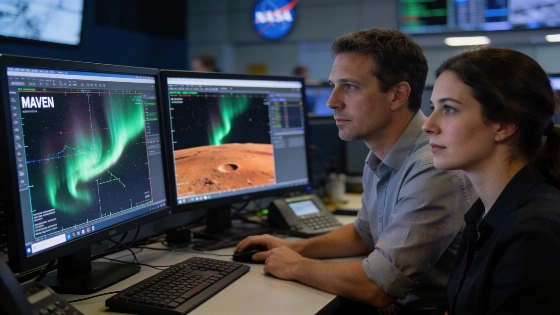
New analysis of data from NASA's MAVEN spacecraft has identified a physical process on Mars that closely parallels the mechanism behind auroras on Earth. The findings, published in Nature Communications, indicate that certain Martian auroras are generated by a miniature version of the Dungey cycle-a process that circulates and accelerates charged particles within a planet's magnetic environment. This result clarifies how electrons are energized above regions of Mars with strong crustal magnetic fields, despite the planet lacking a global magnetic shield like Earth's.
Localized Auroras and the Dungey Cycle
On Earth, auroras are produced when solar wind particles are funneled by the planet's global magnetic field toward the poles, where they interact with the upper atmosphere. This process is governed by the Dungey cycle, in which magnetic reconnection between the solar wind and Earth's magnetosphere injects energy and mass, driving plasma circulation and accelerating electrons. Mars, by contrast, lost its global magnetic field billions of years ago, but retains isolated patches of strong crustal magnetism. The new study demonstrates that over these regions, a scaled-down Dungey-like cycle operates, enabling localized auroras to form in a manner analogous to terrestrial auroras.
The MAVEN mission, which began orbiting Mars in 2014, observed these auroras using a suite of instruments, including the Magnetometer, Solar Wind Electron Analyzer, and STATIC (Suprathermal and Thermal Ion Composition) instrument. By combining measurements of magnetic field configuration, electron currents, and plasma flows, researchers reconstructed the sequence of events leading to auroral emission above magnetized crustal areas.
Mission Data and Scientific Implications
MAVEN's science operations continued until December 2025, when the spacecraft lost contact with Earth. Although the mission was declared concluded in June 2026, its extensive dataset remains a resource for planetary scientists. The new analysis draws on high-resolution measurements collected during the mission's operational phase, revealing that the Dungey-like cycle at Mars is confined to small spatial scales and is shaped by the patchy distribution of crustal magnetic fields. This mechanism explains how electrons are accelerated to energies sufficient to produce visible auroras, despite the absence of a global magnetosphere.
These findings have broader implications for understanding atmospheric loss on Mars. The interaction between solar wind and localized magnetic fields not only drives auroral activity but also contributes to the ongoing escape of atmospheric particles into space. The study's results help clarify the physical processes that have shaped Mars' atmosphere over billions of years, and may inform future mission planning and instrument design.
Comparative Planetology and Remaining Questions
The discovery that a Dungey-like cycle can operate on both planetary and regional scales highlights the diversity of magnetic environments in the solar system. While Earth's global field produces large-scale auroras, Mars demonstrates that similar physics can emerge in a fragmented magnetic landscape. This insight may be relevant for interpreting auroral phenomena on other bodies with partial or remnant magnetism, such as Mercury or some moons.
Despite the progress, important questions remain. The efficiency of particle acceleration, the variability of auroral intensity, and the long-term impact on atmospheric escape rates are not yet fully constrained. Further analysis of MAVEN's dataset, as well as future missions equipped to probe Martian magnetism and plasma dynamics, will be needed to refine these models. For context, NASA's ongoing interest in Martian atmospheric processes is reflected in its broader exploration strategy, as seen in missions discussed in related coverage such as the agency's preparations for aerial exploration of the Martian skies following the legacy of Viking 1.
The MAVEN mission was managed by NASA's Goddard Space Flight Center, with science operations led by the Laboratory for Atmospheric and Space Physics at the University of Colorado Boulder. Lockheed Martin Space constructed the spacecraft and oversaw mission operations, while NASA's Jet Propulsion Laboratory provided navigation and communications support.
Understanding Magnetic Reconnection
Magnetic reconnection is a fundamental process in plasma physics, occurring when magnetic field lines from different domains are forced together and rearrange, releasing stored magnetic energy. On Earth, this process is central to the Dungey cycle, driving the circulation of plasma within the magnetosphere and powering auroral displays. At Mars, reconnection occurs above crustal magnetic anomalies, enabling localized acceleration of charged particles. The efficiency and spatial extent of reconnection depend on the strength and geometry of the magnetic fields involved. Understanding these dynamics is essential for interpreting auroral observations and for modeling the long-term evolution of planetary atmospheres exposed to solar wind.