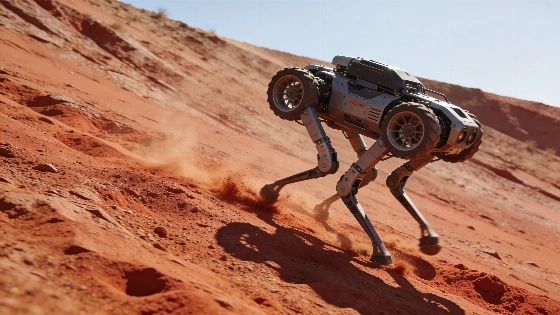
DEEP Robotics has released new footage of its Lynx wheel legged robot navigating loose sand and steep slopes in a desert environment, demonstrating the platform's hybrid mobility and environmental resilience for hazardous industrial tasks
DEEP Robotics has put its Lynx wheel legged robot to the test in a red desert, releasing footage that shows the machine traversing loose sand, steep inclines, and uneven ground-conditions that routinely defeat conventional wheeled robots. The demonstration, conducted with the Lynx M20 series, is intended to showcase the platform's ability to maintain mobility where standard industrial robots would stall or require human intervention.
Unlike traditional quadrupeds or wheeled machines, the Lynx combines both wheels and articulated legs, switching between rolling and stepping as terrain demands. In the released video, the robot is seen rolling efficiently across compacted surfaces, then shifting to legged locomotion to negotiate unstable sand and abrupt elevation changes. This hybrid approach is designed to maximize speed and energy efficiency on suitable ground while retaining the ability to clear obstacles and adapt to unpredictable environments.
Environmental Stress Testing
DEEP Robotics reports that the Lynx M20 series is engineered for industrial inspection, emergency response, and exploration in hazardous or inaccessible areas. The company claims the robot can operate in temperatures up to 55°C, with the desert test intended to demonstrate resilience to dust, heat, and mechanical stress. In addition to desert trials, the Lynx has reportedly been tested in subzero conditions down to -30°C and shown crossing icy waterways up to 80 centimeters deep, suggesting a focus on broad operational range rather than laboratory-only performance.
Measured against other recent hybrid mobility platforms, such as those described in earlier breakdown, the Lynx's wheel legged configuration is positioned as a commercial product rather than a research prototype. DEEP Robotics lists a starting price of $17,999 for industrial customers, with the system marketed for tasks where human entry would pose safety risks-such as power facility inspection, firefighting, and search and rescue.
Evidence and Limitations
The evidence for Lynx's capabilities comes primarily from company-released demonstration footage rather than independent field trials or peer-reviewed studies. The video shows the robot maintaining stability and forward progress across shifting sand and steep slopes, but does not disclose the number of trials, failure rates, or the extent of human supervision during testing. There is no published data on battery life, sensor suite, or the robot's ability to recover from falls or mechanical faults in the field. The company's claim of operation in extreme temperatures and across water obstacles remains developer-reported, with no independent verification or systematic evaluation available.
While the hybrid wheel legged design offers clear theoretical advantages for variable terrain, the absence of transparent performance metrics or third-party testing means that reliability, safety, and maintenance requirements in real industrial deployments remain unproven. The demonstration does not address how the robot handles unexpected obstacles, communication loss, or the need for remote human intervention-factors that routinely limit the autonomy of field robots in hazardous environments.
Deployment and Industry Context
The Lynx M20 series is marketed as the world's first industrial grade wheel legged robot for hazardous terrain, but the field remains crowded with competing designs and ongoing technical challenges. Previous attempts to commercialize hybrid mobility robots have often stalled at the transition from controlled demonstrations to sustained field use, where dust, weather, and mechanical wear expose limitations not visible in curated footage. The Lynx's commercial availability and stated price point suggest a push toward real world deployment, but the lack of independent operational data makes it difficult to assess whether the system can deliver on its promise of reducing human risk in dangerous environments.
For industrial buyers, the key questions remain: how often does the robot require human rescue or reset, what is the mean time between failures, and how does the system perform when environmental conditions exceed those shown in promotional videos? Until these metrics are disclosed and independently validated, the Lynx remains a promising but unproven tool in the ongoing effort to automate hazardous fieldwork.
DEEP Robotics' desert demonstration is a calculated move to position the Lynx as a practical solution for industrial inspection and emergency response, but the absence of transparent performance data and independent evaluation leaves critical questions unanswered. The robotics industry has seen many hybrid mobility prototypes, but few have achieved reliable, low maintenance operation in the unpredictable conditions that define real world hazardous sites. Without systematic evidence of repeatable performance, the Lynx's field readiness remains a claim rather than a demonstrated fact.
Hybrid wheel legged robots like the Lynx are designed to combine the speed and efficiency of wheels with the adaptability of legs, allowing a single platform to traverse both smooth and highly irregular terrain. This approach aims to reduce the need for multiple specialized machines or frequent human intervention in environments where ground conditions can change rapidly. However, the complexity of integrating two mobility systems increases the engineering challenge, requiring robust control algorithms, sensor fusion, and mechanical reliability to avoid new failure modes. The success of such platforms in industrial settings will depend not only on their ability to move across obstacles, but also on their resilience to environmental stress, ease of maintenance, and the transparency of their operational limitations.