
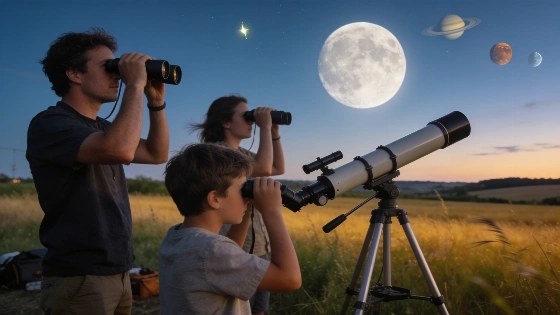
The full Buck Moon rises on July 29, accompanied by a rare alignment of Venus, Saturn, Mars, and Mercury. Observers can witness this planetary parade with the naked eye or optical instruments as twilight fades
This July, skywatchers are presented with a coordinated display as the full Buck Moon rises in tandem with a compact procession of bright planets. The event offers a rare opportunity to observe the Moon and four major planets-Venus, Saturn, Mars, and Mercury-arcing across the evening and predawn sky, each visible to the unaided eye under favorable conditions.
Full Moon Timing and Visual Effects
The Buck Moon reaches its full phase at 10:36 a.m. EDT (14:36 UTC) on July 29, when the lunar disk appears fully illuminated from Earth's perspective. The name "Buck Moon" reflects the period when young male deer begin to grow new antlers, while other traditional names include the Berry Moon and Thunder Moon, as recorded by various Indigenous cultures. At moonrise, the lunar disk may appear unusually large and tinged with yellow or orange due to atmospheric scattering and the well-known Moon Illusion, which exaggerates its apparent size near the horizon.
During this phase, sunlight strikes the Moon nearly head-on, minimizing shadows and making surface features such as craters less prominent. However, the dark basaltic plains known as lunar maria remain visible, marking regions where ancient volcanic activity once resurfaced the Moon. Observers using binoculars or telescopes may notice bright streaks radiating from younger impact craters-these are ejecta rays, formed by material thrown outward during collisions. Over time, most rays fade due to space weathering, leaving only the freshest impacts with visible patterns.
Planetary Parade Across the Sky
As twilight deepens, Venus emerges low in the western sky, shining as the brightest evening object apart from the Moon. Later in the night, Saturn, Mars, and Mercury rise sequentially in the east, forming a gentle arc that follows the Moon's path. This alignment is not a true conjunction but a favorable geometric arrangement, allowing all four planets to be seen in a single night without optical aid, provided skies are clear and horizons are unobstructed.
Venus's brilliance is due to its highly reflective cloud cover and proximity to Earth, while Saturn's pale yellow hue and Mars's reddish tint are both visible to attentive observers. Mercury, often elusive due to its proximity to the Sun, appears briefly before sunrise, completing the planetary sequence. The best viewing times vary by location, but the hours around moonrise and predawn offer the clearest views of the full lineup.
Observing and Imaging the Event
For those interested in capturing the event, a stable tripod and a camera with manual exposure controls can help record both the Moon and the planetary arc. Binoculars with large objective lenses, such as 15x70 models, provide enhanced contrast along the lunar terminator and reveal subtle details in the maria and crater rays. Telescopes can further resolve planetary disks and, in the case of Saturn, its ring system.
Astrophotographers seeking to document the predawn alignment may benefit from guides on planetary imaging and lunar photography. For context on how meteor showers and planetary alignments can coincide, readers may find it useful to explore how the Perseid meteor shower traces its origins to cometary debris in the solar system, as discussed in this related article.
Physical and Cultural Significance
The Buck Moon's appearance and the accompanying planetary parade are shaped by the relative positions of Earth, the Moon, and the inner planets. Such alignments are governed by orbital mechanics and occur irregularly, making each event unique in its timing and visibility. The cultural names for July's full moon reflect centuries of observation and seasonal change, while the planetary arrangement offers a reminder of the dynamic architecture of the solar system.
Although the event is visually striking, it does not indicate any unusual gravitational or physical interaction among the planets or the Moon. Instead, it highlights the interplay of orbital periods and viewing geometry that occasionally brings multiple bright objects into the same night sky.
Understanding how planetary alignments and lunar phases are observed requires familiarity with basic astronomical concepts. The apparent brightness and position of each planet depend on its distance from Earth, phase angle, and atmospheric conditions. The Moon's changing appearance is a result of its orbit around Earth, with full phase occurring when the Sun, Earth, and Moon are aligned. Observational astronomy relies on both naked-eye viewing and optical instruments to distinguish subtle features, while atmospheric effects such as scattering and refraction can alter the perceived color and size of celestial objects near the horizon.