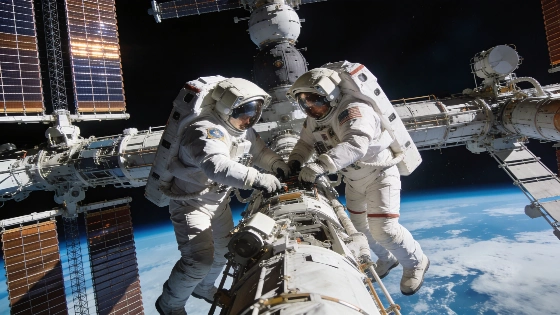
ESA astronaut Sophie Adenot and NASA astronaut Anil Menon spent over six hours outside the International Space Station on August 18, 2026, removing a malfunctioning antenna during a technically demanding extravehicular activity
On August 18, 2026, two astronauts aboard the International Space Station (ISS) conducted a complex extravehicular activity (EVA) to address a critical communications issue. ESA astronaut Sophie Adenot and NASA astronaut Anil Menon spent more than six hours outside the station, working to remove a failed antenna that had compromised one of the ISS's primary links to ground control.
Spacewalk Objectives and Execution
The main goal of the EVA was to detach a malfunctioning "Space-to-Ground" antenna from the station's exterior. This antenna, which had been experiencing technical problems for several months, is essential for transmitting operational data and mission-critical information between the ISS and Mission Control on Earth. Adenot and Menon were assigned to remove the faulty unit and, if time permitted, install a replacement to restore full redundancy to the station's communications system.
During the 6-hour, 23-minute spacewalk, the astronauts successfully removed the failed antenna. However, due to the complexity of the task and the time required to safely maneuver and secure equipment in microgravity, they were unable to complete the installation of the new antenna before the scheduled end of the EVA. The replacement will be attempted during a future spacewalk.
Technical and Operational Challenges
Conducting repairs on the ISS exterior presents significant technical and physical challenges. Astronauts must operate in the vacuum of space, tethered to the station, while managing bulky suits and specialized tools. The removal of the antenna required careful coordination to avoid damaging sensitive systems and to ensure the safety of both crew members. The EVA also marked a milestone for Sophie Adenot, who became the first French woman to participate in a spacewalk, as previously highlighted in Science Report's coverage of her historic assignment.
The failed antenna had been replaced temporarily in function by a backup unit, but this solution was not intended for long-term use. The need for a permanent fix underscores the importance of redundancy in space station systems, where communication failures can have serious operational consequences.
Implications for ISS Operations
Reliable communication between the ISS and ground teams is essential for mission safety, scientific operations, and crew well-being. The "Space-to-Ground" antenna system enables real-time data transfer, voice communication, and the relay of critical instructions. While the temporary backup has maintained basic connectivity, restoring full capability remains a priority for mission planners.
The partial completion of the repair highlights both the complexity of extravehicular maintenance and the limits imposed by time, safety protocols, and the physical demands of working in orbit. The next scheduled EVA will focus on installing the new antenna and verifying its performance, ensuring the ISS continues to meet its operational requirements.
Spacewalks, or extravehicular activities, are among the most demanding tasks astronauts perform. Each EVA requires extensive planning, specialized training, and real-time coordination between the crew and ground control. Astronauts rely on pressurized suits that provide life support and protection from radiation, micrometeoroids, and extreme temperatures. The duration of a spacewalk is limited by suit consumables and crew fatigue, making time management and task prioritization critical to mission success.