

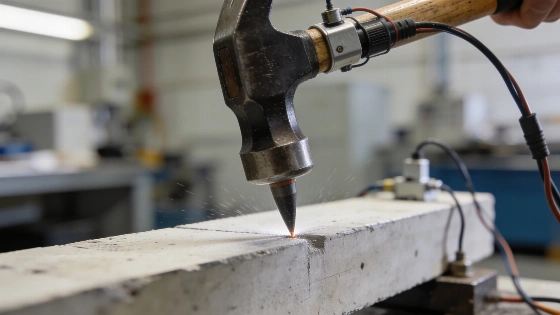
NASA's technical bulletin explains why measured hammer inputs with ripples or separated contacts can still support structural tests when bandwidth, signal quality and objective coverage are adequate
A hammer can lose contact with a structure and strike it again while the structure is still vibrating. That force history can remain useful for testing if the force and response are measured accurately. Instrumented hammer tests use the measured impact and structural response to identify natural frequencies, damping and frequency-response behavior.
Measure the Full Input
NASA's guidance says a test does not need to produce an idealized single half-sine pulse. Crest ripples and intervals between contacts change the excitation, but do not automatically invalidate the record. The measured force-time history is the test input; the shape of the pulse alone is not a substitute for recording it.
Hammer-tip properties and contact duration affect the force waveform and the frequencies available to excite a structure. Laboratory impact-testing procedures compare tips and record both waveforms and power spectra. The resulting response also depends on the test article's mass, geometry, stiffness and boundary conditions.
For an exact model and test article given the same force and initial conditions, uniqueness requires identical responses for each bounded measured force history. An approximate model can show different errors when inputs excite different parts of its frequency response or drive it into a different nonlinear state.
Read the Spectrum
A finite half-sine pulse is broadband, but its spectrum is not flat. For pulse duration T, the characteristic frequency is fo = 1/(2T), and the ideal pulse has spectral zeros at odd multiples beginning at 3fo, followed by 5fo, 7fo and so on. The pulse's appearance alone cannot establish whether it adequately excites the structure.
Ripples in the force crest can add spectral content and fill half-sine notches. The timing between separated contacts creates deterministic interference. NASA advises checking the unnormalized measured spectrum alongside the response signal-to-noise ratio; spectra normalized to their own DC values show relative content, not the absolute force available at each frequency.
In modal testing, the measured response spectrum is used to identify resonant frequencies, while damping can be estimated from the decay of the time response. Laboratory guidance on cantilever-beam impact testing describes these frequency- and time-domain measurements.
Match the Test Objective
Assess the complete force measurement for adequate bandwidth, calibration, dynamic range and time synchronization. Response sensors also need sufficient bandwidth and signal-to-noise ratio, and their signals must not be clipped or saturated.
The excitation must cover the frequencies and amplitudes required by the objective. If nonlinear response is part of that objective, the test must cover the relevant nonlinear range as well. Reject or repeat a test only when an identified measurement, excitation or coverage deficiency warrants it.
A spectrum describes how a force history is distributed across frequencies. Normalizing it to the DC value makes relative spectral shapes easier to compare, while concealing differences in absolute force. The unnormalized measured spectrum retains that force information.
Repeated impacts are also used in field inspection. A 2026 study in Sensors describes a digital-hammering method that typically applies about three impacts at one location within a few seconds and repeats impacts when environmental noise is elevated. Its method identifies candidate frequency peaks above a threshold of 0.3 to distinguish them from background noise. The study of digital hammering inspection relates measured natural frequency to the inspected object's mass, geometry and stiffness, as well as its boundary constraints.







