Intel plans to pair Classiq's quantum algorithm synthesis software with its silicon spin-qubit hardware. The agreement sets out a full-stack ambition but supplies no performance results for an integrated system
Intel's silicon spin-qubit effort dates to 2015. On October 26, 2026, Intel announced a definitive agreement to acquire Tel Aviv-based quantum-computing software company Classiq Technologies Ltd. Intel described the plan as combining Classiq's quantum-algorithm synthesis platform with its silicon spin-qubit manufacturing and software capabilities to build a full-stack quantum-computing business. The companies have signed a definitive agreement reported by Israeli media at approximately $2.3 billion; Globes also reported an effective value of about $2.2 billion after accounting for Classiq's cash on hand. Intel CEO Lip-Bu Tan said the combination would change Intel's Quantum Computing Group into a full-stack business. The announcement gives no performance data showing how Classiq's software would run on Intel hardware.
The distinction matters. A software acquisition can bring tools and expertise under one corporate roof; it does not, by itself, demonstrate a faster processor, a larger useful computation or a working end-to-end quantum system. Intel's announcement describes the intended combination of software, hardware and manufacturing rather than reporting a completed integrated system.
The integration gap
Quantum circuits must be translated into operations that a particular processor can execute. Classiq develops software that helps customers create quantum code for different hardware platforms; Reuters reported that users can test and run that code across hardware types. The platform automates part of the work by synthesizing algorithms from higher-level descriptions. The intended benefit is to let developers work without needing detailed knowledge of each underlying device.
That is a impressive software challenge, but it is separate from the physical limits of a processor. A circuit that can be generated still has to run on hardware with controllable qubits, reliable operations and adequate measurement. Intel's announcement reports no qubit count, gate fidelity, error rate or benchmark for a combined Intel-Classiq system.
Classiq's approach is compared in the supplied material with electronic design automation and computer-aided design tools used in conventional chip development. The comparison concerns abstraction and design workflows; it does not establish that quantum circuits can be engineered with the same maturity or predictability as classical chips.
What the software adds
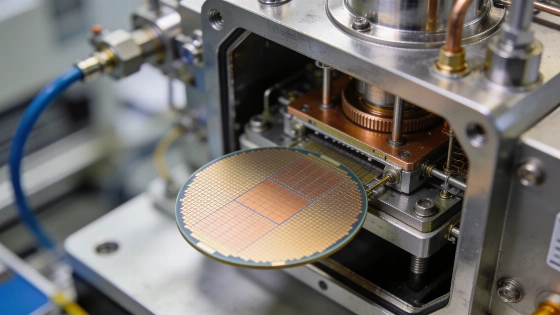
Intel has been developing silicon spin-qubit chips alongside cryogenic control electronics. In this approach, information is encoded in the spin of electrons confined in silicon devices. Intel's stated plan combines Classiq's automated algorithm synthesis with its silicon spin-qubit technology and semiconductor-manufacturing expertise. The company says quantum-processing units could complement a compute portfolio that includes basic processing units, graphics-processing units and application-specific integrated circuits. The source describes the hardware as designed for ability to grow, but provides no fabrication yield, operating conditions or processor results with which to assess that claim.
Software abstraction could make hardware easier to access for researchers and enterprise developers. It cannot remove the engineering requirements of controlling and measuring qubits, nor does it establish that an algorithm will retain useful performance when mapped to a physical processor. The material provided does not report a test of Classiq-generated circuits on Intel's silicon spin-qubit hardware.
Intel says Classiq's platform will retain its hardware- and modality-agnostic approach after the transaction closes. ChosunBiz reported that Intel intends to preserve the platform's multi-hardware environment and continue supporting integrations with other quantum-computing platforms. That is a stated plan for maintaining an open software environment, rather than evidence that every integration will continue unchanged or that performance will be equivalent across different hardware.
Classiq's reported customers include BMW and AT&T. Reuters reported that the company had raised more than $200 million and employed about 130 people. Those company details accompany the planned acquisition, which Intel says will add Classiq's software capabilities to its quantum hardware and manufacturing work.
Israel's quantum sector
The deal also places an Israeli quantum software company within a sector that the accompanying overview describes as expanding across hardware, control systems, sensing and software. Its estimates put Israel at fourth globally for private quantum venture investment, with about 9% of worldwide funding, or roughly 15% when the United States is excluded. The overview counts growth from five active quantum companies in 2019 to more than 20 commercial enterprises today, with total capital between $650 million and $1 billion.
Entrée Capital is described as managing $1.5 billion in assets and holding nine quantum investments across several areas. The overview identifies late-stage financing and reliance on specialized overseas suppliers as constraints for hardware companies. Software activity ranges from proposed projects to acquisitions: a planned quantum software project for catalyst modeling, for example, was described as a conditional prototype effort rather than a demonstrated simulation.
These figures provide industry context, not evidence that the acquisition will improve processor performance. The overview also points to hybrid quantum-classical workflows as a focus for 2026-2029, particularly in high-performance computing centers. It does not report that such deployments have already delivered practical gains.
Agreement still pending
The transaction remains subject to regulatory approvals and other customary closing conditions and is expected to close in the first half of 2027. Intel and Classiq are to operate independently until then. Intel's October 26 announcement described the deal's full-stack aim; Israeli business reporting put the headline value at $2.3 billion. The technical outcome of integrating the companies' work remains to be established.
Algorithm synthesis organizes a computational problem into a sequence of operations that a quantum processor can attempt to perform. The resulting circuit is still limited by the hardware's errors and by the number of operations it can execute reliably. Software can help translate a task into a circuit, but measured performance on a specified processor is needed to show what that circuit achieves.