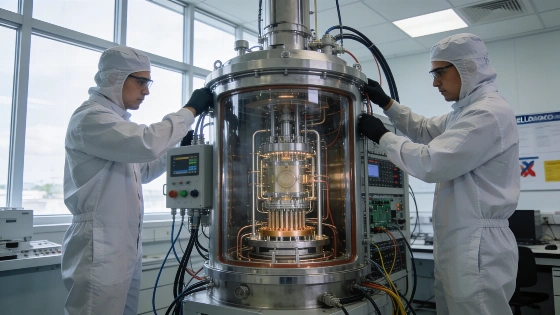
IQM Quantum Computers will supply its IQM Spark superconducting quantum system to Brazil's Eldorado Research Institute, marking the first time a private research institution in South America has purchased and installed a quantum computer on site.
The Eldorado Research Institute in Brazil has agreed to purchase an on-premises superconducting quantum computer from IQM Quantum Computers. The system is scheduled for delivery to Eldorado's Campinas headquarters in early 2027 and will be the first quantum computer bought by a private research institute in Brazil. Eldorado plans to make the system available to a network of universities, startups, and industry partners in fields such as automotive, energy, oil and gas, fintech, agribusiness, and healthcare. The project is expected to support joint work with academic institutions like the State University of Campinas (Unicamp) and connect with international research centers including MIT and CERN.
The installation will use the IQM Spark system, a superconducting quantum processor designed for on-site use. Eldorado will also have remote cloud access to IQM's 54-qubit quantum processor in Europe. This hybrid setup allows researchers to work directly with local hardware while also running larger-scale algorithms on the remote system. The approach reflects a broader move in quantum computing to combine hands-on access with scalable remote resources. Similar models have been used in projects at Stanford and described in recent Nature publications, which point to the value of flexible access for developing and testing quantum algorithms.
IQM Quantum Computers, based in Espoo, Finland, reported a commercial backlog of €102 million as of August 2026, with 26 full-stack systems sold and 17 delivered worldwide. The company focuses on superconducting qubit technology, aiming to improve coherence times, gate fidelity, and system integration. The IQM Spark system at Eldorado will be located in Brazil's main technology cluster, near Unicamp, and will support research and development of quantum algorithms for specific industries. The system is intended to enable hybrid workflows that combine high-performance computing, artificial intelligence, and quantum processing, with applications in oil and gas, agribusiness, and energy. These efforts are similar to work at NASA's Quantum Artificial Intelligence Laboratory, which studies quantum-classical integration for complex optimization and simulation problems.
This agreement is IQM's first hardware deployment in South America and expands the region's access to quantum computing infrastructure. By providing on-site access to a superconducting quantum processor, Eldorado aims to build local expertise and develop quantum algorithms for regional industry needs. The hybrid model, which combines local hardware with remote access to a 54-qubit processor in Europe, is meant to bridge the gap between small-scale lab experiments and larger algorithm testing. As quantum hardware becomes more available outside traditional research centers, a key challenge will be integrating these systems with classical high-performance computing and AI to deliver real scientific and industrial results. Recent field trials in Europe have shown the importance of operational integration and collaboration between institutions for moving quantum computing beyond isolated prototypes.
Superconducting quantum computers work by controlling quantum states in circuits cooled to millikelvin temperatures, where electrical resistance disappears and quantum coherence can be maintained for short periods. Each qubit is usually a superconducting circuit element, such as a transmon, operated with microwave pulses. The number of qubits, their connections, and the accuracy of quantum gates and measurements determine the system's capabilities. Current devices are limited by noise, decoherence, and error rates, but hybrid deployment models-combining local and remote quantum resources-give research institutions a way to build skills, test algorithms, and prepare for future advances in quantum hardware and error correction. Ongoing research in journals like Science and PNAS continues to refine error mitigation and explore scalable designs, reflecting the global push to develop quantum technology.