A surplus Denso VS-050 industrial robot arm has been adapted into a programmable badminton training machine, delivering repeatable shuttlecock serves for solo practice and testing the limits of industrial robotics in recreational sport settings
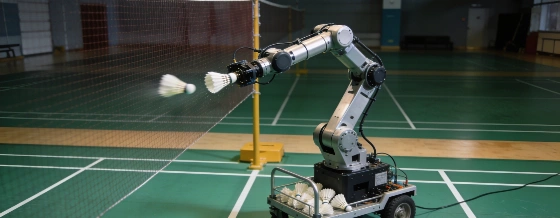
An industrial robot arm originally designed for manufacturing has been re-engineered to serve as an automated badminton training partner, offering programmable shuttlecock launches for solo practice. The project, led by badminton enthusiast Travis Mitchell, centers on a Denso VS-050 six-axis robotic arm, which was adapted over six months to deliver consistent, repeatable shots across a standard court. The system combines the robot's precise movement with a custom-built launching mechanism, aiming to provide a reliable alternative to human feeding during training sessions.
The modified Denso VS-050 arm is equipped with a wrist-mounted assembly that integrates a shuttlecock magazine, pneumatic actuators, and a pair of high-speed spinning wheels. The launcher uses two 400-watt AC servo motors to accelerate shuttlecocks, while pneumatic cylinders manage the grip and feeding process. The entire mechanism is mounted on an aluminum frame attached to the robot's wrist, allowing for flexible positioning and shot variation. According to developer reports, the system can store up to 120 shuttlecocks in a motorized carousel, with a time-of-flight sensor ensuring correct loading before each serve. The robot's software supports up to 127 programmed positions, enabling a range of shot trajectories and court placements.
Developing a reliable launching mechanism required extensive material testing. The high-speed wheels, which must rotate at up to 6,000 rpm, were prototyped using EVA foam, gum rubber, silicone, and 3D-printed components. Most materials either failed to provide sufficient grip or deformed at speed. The final design uses a 3D-printed hub with a narrow silicone strip, balancing grip, weight, and rotational stability. The system's feeding and launching process was refined to minimize shuttlecock damage and misfires, with the pneumatic actuators calibrated for consistent handling.
In practical terms, the completed machine is mounted on a height-adjustable base and transported via a wheeled cart that houses the compressor and electronics. The setup operates from a 240-volt supply and was initially tested in a workshop before being deployed on a badminton court. During field trials, the robot demonstrated the ability to serve shuttlecocks repeatedly without human intervention, though the system's reliability and shot consistency remain dependent on careful calibration and maintenance. The project highlights the potential for surplus industrial robotics to be adapted for recreational or training purposes, but also underscores the engineering challenges involved in repurposing hardware for tasks outside its original design parameters.
While this demonstration focuses on shuttlecock launching, other recent projects have explored the adaptation of industrial and bio-inspired robots for sports and movement tasks. For example, research into six-legged robots that learn adaptive walking from insect movement data has shown how robotics can be tailored for complex, dynamic environments, as discussed in this analysis of adaptive locomotion in legged robots. Both cases illustrate the growing interest in extending robotics beyond traditional industrial roles, but also reveal the technical and safety limitations that must be addressed before such systems can be widely adopted in new domains.
Repurposing industrial robots for novel applications often exposes the gap between laboratory automation and real-world autonomy. While automated systems can deliver repeatable actions under controlled conditions, their performance in less predictable environments depends on robust sensing, error recovery, and human oversight. In this context, the distinction between automation-predefined, repeatable operation-and autonomy-independent adaptation to new situations-remains critical. Understanding these boundaries is essential for evaluating the reliability, safety, and practical value of robotics in both industrial and recreational settings.