Donald Trump plans an AI Force and a new AI czar while rejecting calls to slow the industry, as data centers push electricity systems toward a major expansion by 2030
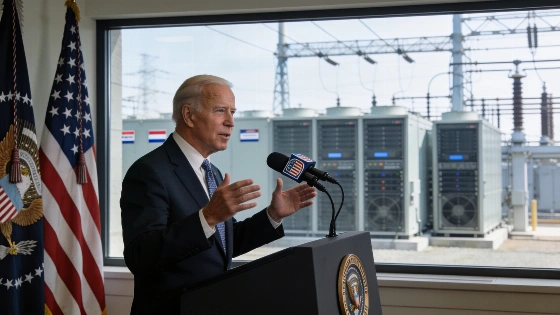
Washington is preparing to organize its AI push around speed rather than restraint. President Donald Trump says he plans to create an "AI Force" and appoint an AI czar as the United States competes with China to expand increasingly powerful systems. Reuters reported on September 19 that Trump disclosed neither a launch date nor the proposed body's structure or powers.
The proposal is still undefined. Trump compared the planned organization with the Space Force created during his first administration, but no operating model has been provided. It is also unknown whether the AI Force would be civilian or military, and no candidate has been named for the AI czar position. The announcement is therefore a political direction rather than an established institution with a legal mandate.
It would also represent a reset of White House AI coordination. Venture investor David Sacks previously held the AI czar role before leaving it for an external advisory position. That background makes the latest announcement less a description of an existing agency than a proposal to recreate centralized oversight around a new strategic priority.
The immediate constraint may be less philosophical than physical. Large AI data centers require substantial electricity for computation, networking and cooling, placing new demands on grids, utilities and communities. The International Energy Agency estimates that global data center electricity use will rise from about 485 TWh in 2025 to approximately 945-950 TWh by 2030, nearly doubling in less than five years. The scale of the forecast is summarized in an IEA energy assessment.
AI-focused facilities could expand faster than the wider data-center sector, with electricity use potentially tripling over the same period. In the United States, data centers currently account for roughly 4.4% of national electricity consumption in the cited estimate; by 2030, the projected range is about 9-17%. The range reflects uncertainty in deployment, efficiency, grid connections and the mix of computing workloads, but even its lower end would make transmission capacity and generation planning central to AI policy.
The IEA also projects that data centers could account for almost half of the increase in US electricity demand through 2030. That forecast gives the administration's acceleration strategy a concrete infrastructure problem: faster model development requires more computing capacity, while the electricity needed to operate that capacity must be secured, transmitted and paid for. Semiconductor efficiency can reduce energy per computation, but efficiency gains do not automatically offset growth in total demand when the number of chips and workloads expands rapidly.
Trump has already acknowledged the political risk of shifting those costs onto households. His proposed "ratepayer protection pledge" would ask major technology companies to cover the electricity expenses linked to their data center expansion. The White House has also planned discussions with Amazon, Google, Meta, Microsoft, xAI, Oracle and OpenAI about voluntary commitments to secure or generate power through dedicated agreements or on-site generation.
Those arrangements could include long-term power contracts, new generation capacity or privately financed infrastructure, but voluntary commitments are not the same as binding rules. They leave open questions about how costs will be audited, how local grid reliability will be protected and what happens when a company's demand exceeds its contracted supply.
Trump has rejected calls for a pause or moratorium on AI development, arguing that slowing the US industry could give China a competitive advantage. He has also rejected the argument that more capable AI could create an existential threat. His stated position is that the federal government should not hinder the industry and that harmful applications can be addressed through existing criminal and civil justice systems. He has compared AI with earlier technological transformations including the Industrial Revolution and the internet and has suggested that its eventual economic effect could equal as much as 25% of US GDP.
That approach treats AI risk primarily as a question of unlawful use after harm occurs. It offers no detail on specialized testing, technical standards, model evaluations or new oversight for systems whose failures may arise before a conventional criminal or civil case is possible. The announcement therefore describes an institutional preference rather than a completed safety framework.
Scientific and engineering institutions such as NASA, CERN and MIT typically separate a system's intended capability from its demonstrated performance under defined conditions. The same discipline is relevant to AI policy: a model should be assessed against specified tasks, datasets, error rates, security conditions and human-review procedures rather than judged only by its scale or economic promise.
Former White House AI and crypto czar David Sacks has also argued that fears about AI threatening humanity are overstated while acknowledging that some caution is necessary. The narrower and more immediate concerns are easier to identify: data center power demand is measurable, harmful applications can already be addressed through law and increasingly capable models create pressure for institutions to define responsibility before deployment.
That distinction matters because claims about AI's future economic value are not evidence that a particular model is reliable, safe or useful in a specific setting. The proposed AI Force is an administrative and strategic concept, not a tested AI system. No model, benchmark, deployment plan or performance measurement was supplied with the announcement. As in peer-reviewed work published in journals such as Nature, conclusions about performance require a stated method and reproducible evidence, not only a projection of future benefits.
The China comparison gives the proposal its strategic urgency, but competition does not substitute for evaluation. A government can accelerate research funding, infrastructure and deployment while still requiring evidence about failure modes, data quality, security and human oversight. Without those details, the phrase "AI development" covers everything from research computing to public-sector automation without identifying which risks will be managed.
That gap is familiar in technical policy. Concerns about how AI could disrupt verification and knowledge transfer have also appeared in earlier mathematics warnings, where the central issue was not whether software could produce an answer but whether institutions could reliably check and use it. The same distinction applies to government-backed AI: faster output is not the same as dependable capability.
A credible test plan would need to specify who evaluates models, which benchmarks are mandatory, how independent audits are funded and what thresholds trigger restrictions or redesign. It would also need to distinguish laboratory performance from behavior after deployment, where data drift, adversarial inputs, automation bias and unclear chains of responsibility can change the risk profile.
The administration's position is therefore coherent but incomplete. It places national momentum and economic expansion ahead of calls to slow the industry, while recognizing that electricity costs could become a public issue. Yet a force and a czar will matter only if their responsibilities include more than coordination and acceleration. On the evidence available, Trump has announced a direction, not a functioning system of AI governance; the United States is preparing to scale the technology before it has explained how that scale will be tested or controlled.
Model training is the phase in which an AI system adjusts its internal parameters using data and computational resources. Inference is the later phase in which the trained system generates an output from a new input. More training and larger data centers can increase capability, but neither fact establishes accuracy in every environment or meaningful human control. For this proposal, the missing test is not whether the United States can build more computing capacity but whether institutions can measure the consequences of using it.