IBM has pledged $50 million in quantum processor access over five years to support the U.S. Department of Energy's Genesis Mission, enabling national lab and academic researchers to run experiments on utility-scale superconducting quantum hardware
IBM has announced a five-year, $50 million commitment to provide quantum computing access for researchers participating in the U.S. Department of Energy's Genesis Mission. The initiative is designed to support the development and testing of quantum algorithms and workflows by granting direct access to IBM's latest superconducting quantum processors. According to IBM, the program will enable scientists at DOE national laboratories and partner academic institutions to run experiments on utility-scale quantum hardware, with the goal of accelerating research into quantum algorithm discovery and practical applications.
The compute resources offered under this commitment include access to IBM's 156-qubit Quantum Heron and 120-qubit Quantum Nighthawk processors. These devices are based on superconducting qubit technology and are engineered for high-throughput circuit execution. IBM reports that the Nighthawk systems can execute up to 100,000 quantum circuits per second and deliver more than 5,000 quantum operations (QuOps), though actual performance will depend on calibration, circuit complexity, and noise. The company will also provide technical integration support to connect its quantum systems with classical high-performance computing (HPC) clusters and AI supercomputing infrastructure at DOE facilities, including Oak Ridge, Lawrence Berkeley, and Los Alamos National Laboratories, as well as National Quantum Information Science Research Centers.
Agentic AI and Inverted Quantum Workflows
As part of its selection for a Phase I Genesis Mission project, IBM is piloting an "inverted workflow" approach to quantum application discovery. Instead of starting with a specific scientific or engineering problem and attempting to map it onto quantum hardware, the workflow begins with mathematically validated quantum algorithms. An AI assistant, described as "agentic," screens scientific literature to identify physical or chemical systems whose mathematical structure matches the available quantum algorithms. Human researchers then define benchmark criteria, while the AI agent automates large-scale literature searches to propose candidate applications that may not be easily identified through manual review.
This approach builds on previous collaborations between IBM, Oak Ridge National Laboratory, and Cleveland Clinic, where AI-driven screening, classical GPU supercomputing, and quantum processors were combined to simulate complex materials such as molten salts for fusion energy research. The Genesis Mission project aims to formalize and scale this workflow, using AI to accelerate the identification of quantum-relevant problems and to benchmark quantum algorithms against real-world scientific challenges.
Technical and Engineering Considerations
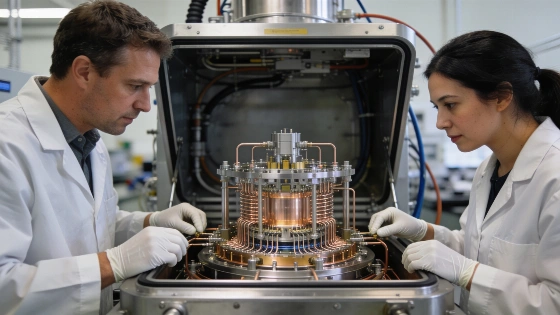
The utility-scale quantum processors offered through this program operate at cryogenic temperatures and require precise calibration to maintain qubit coherence and gate fidelity. While IBM's reported throughput figures for the Nighthawk processor-up to 100,000 circuits per second and over 5,000 QuOps-represent significant engineering progress, these numbers reflect best-case scenarios under controlled conditions. Actual performance for user experiments will depend on circuit depth, error rates, and the effectiveness of error mitigation strategies. The integration of quantum processors with classical HPC and AI systems is intended to support hybrid workflows, but the practical utility of such integration remains an active area of research.
IBM's commitment is structured as compute access rather than direct funding, and the company has not released detailed allocation criteria or usage quotas for participating researchers. The Genesis Mission's focus on agentic AI-driven quantum algorithm discovery reflects a broader trend toward automating the search for quantum advantage, but it remains to be seen whether this approach will yield applications that outperform classical methods on problems of scientific or industrial relevance. Independent benchmarking and peer-reviewed publication of results will be essential for evaluating the impact of this initiative.
Research Status and Remaining Challenges
At present, the Genesis Mission's quantum computing track is in its initial phase, with IBM serving as a lead performer on the agentic AI workflow project. The company's quantum hardware is accessible via cloud-based interfaces, and technical integration with DOE supercomputing resources is ongoing. No claims of quantum advantage or fault-tolerant computation have been made in connection with this program. The primary objective is to enable researchers to explore the capabilities and limitations of current utility-scale quantum processors in realistic scientific workflows, with a focus on algorithm discovery, benchmarking, and hybrid quantum-classical computation.
Key engineering challenges remain, including maintaining high gate fidelity and coherence across large numbers of physical qubits, scaling error mitigation and correction techniques, and ensuring reproducibility of results across different devices and calibration cycles. The Genesis Mission's collaborative structure is intended to foster cross-institutional research and accelerate progress, but the gap between laboratory demonstrations and practical quantum utility remains substantial. As with all quantum computing initiatives, transparent reporting of experimental conditions, error rates, and classical baselines will be critical for assessing scientific progress.
Understanding the distinction between physical and logical qubits is central to interpreting progress in quantum computing. A physical qubit is a controllable quantum system-such as a superconducting circuit-that can be prepared, manipulated, and measured. However, physical qubits are subject to errors from noise, decoherence, and imperfect control. Logical qubits encode information across multiple physical qubits using error-correcting codes, allowing errors to be detected and, in principle, corrected. Achieving practical quantum computation will require not only increasing the number of high-quality physical qubits but also demonstrating that logical qubits can reliably outperform their physical counterparts in real algorithms. Current utility-scale processors, including those offered in the Genesis Mission, operate at the level of physical qubits with error mitigation, but full fault-tolerant logical qubits remain a major engineering challenge.