Hyundai Motor Group has tested its MobED autonomous robot aboard a moving cargo vessel, evaluating its ability to perform inspections in hazardous ship environments without human entry
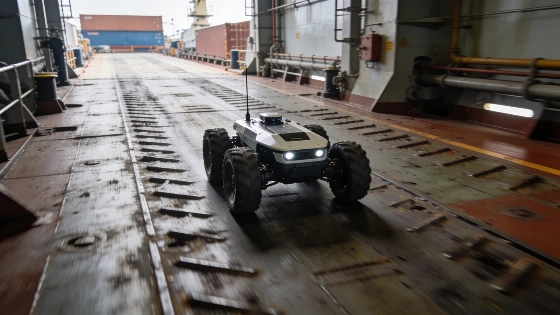
Hyundai Motor Group has conducted a field demonstration of its MobED (Mobile Eccentric Droid) robot aboard the multipurpose vessel HYUNDAI DUBAI, aiming to assess whether a land-designed autonomous platform can reliably operate in the challenging environment of a moving ship. The test, carried out in partnership with Korean Register, HMM, HMM Ocean Service, and Goseong Engineering in Changwon, South Korea, focused on the robot's ability to navigate cargo holds and other hazardous spaces that may be unsafe or inaccessible for human crew members.
How Hyundai's MobED Robot Works
The MobED robot is a compact, four-wheeled mobile platform developed by Hyundai's Robotics Lab. It uses a proprietary Drive and Lift (DnL) system, allowing each wheel to adjust independently for stability on uneven surfaces, steep ramps, and thresholds. The robot is available in two versions: MobED Basic, which is remotely operated and intended for research and development, and MobED Pro, which combines LiDAR and camera sensors with AI-based navigation for autonomous operation in complex environments. The Pro model also features a "follow-me" mode for accompanying users while transporting equipment.
Testing Autonomous Navigation Aboard a Moving Ship
During the demonstration, MobED was tasked with a series of navigation challenges inside the ship's cargo spaces, including straight and curved driving, low- and high-speed movement, and route learning. The robot's independently controlled wheels enabled it to maintain stability despite the vessel's motion and vibration. In wider cargo areas, MobED operated autonomously, while in narrow passageways, operators switched to remote control due to spatial constraints. The platform can be equipped with inspection tools, cameras, or delivery modules, supporting a range of onboard tasks without requiring modifications to existing ship infrastructure.
Payload, Speed, and Limits of the Demonstration
According to Hyundai, the MobED Basic model can carry up to 47 kilograms, while the Pro version supports payloads up to 57 kilograms and reaches speeds of 10 km/h. The demonstration did not report systematic failure rates or long-duration reliability, and the robot's performance was evaluated in a single vessel and operational context. Human intervention remained necessary in confined spaces, and the system's ability to handle unexpected obstacles or emergencies was not independently assessed. The demonstration forms part of broader efforts to deploy robots for hazardous inspections, a trend also seen in other robotics research such as the development of humanoid systems for physically demanding tasks, as discussed in Science Report's coverage of ergonomic lifting robots.
Potential Uses Beyond Maritime Inspection
MobED's design supports a variety of attachments, including inspection equipment, delivery boxes, and digital displays, making it adaptable for last-mile logistics, facility inspections, and mobile guidance services. However, the current evidence is limited to a controlled demonstration, and the system's readiness for routine deployment in diverse maritime environments remains unproven. No independent verification of the robot's safety, reliability, or integration with ship operations has been reported.
Autonomous Robots Still Depend on Human Oversight
Understanding robot autonomy requires distinguishing between automated and autonomous operation. Automated robots follow predefined instructions or remote commands, while autonomous robots make decisions based on sensor input and environmental conditions, often using AI-based navigation. In practice, most field robots-including MobED-operate with a mix of autonomy and human oversight, especially in unpredictable or hazardous settings. The degree of autonomy is shaped by technical limitations, safety requirements, and the complexity of the environment, making human intervention a critical factor in real-world deployment.