A hydrogen-fueled vehicle has achieved a new land speed record, reaching an average of 406 km/h during controlled runs at the Bonneville Salt Flats, demonstrating the potential of hydrogen combustion engines for high-performance applications
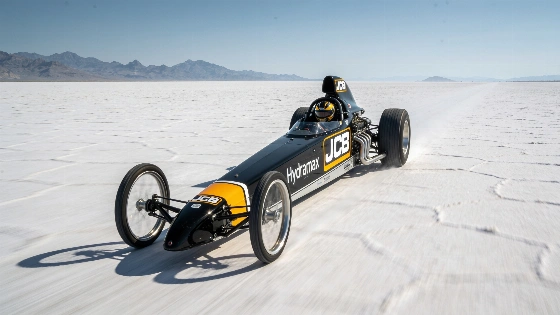
A hydrogen-powered car has surpassed previous speed records for its class, reaching an average velocity of 406.3 kilometers per hour (252.6 mph) during two officially timed runs at the Bonneville Salt Flats in Utah. The JCB Hydromax, piloted by retired Royal Air Force Wing Commander Andy Green, demonstrated the highest verified speed ever recorded for a vehicle using a hydrogen internal combustion engine.
Record-Setting Performance
The test took place on August 11, with the Hydromax completing two runs in opposite directions to account for wind and surface conditions. The vehicle achieved 400.6 km/h (248.9 mph) on its first pass and 412.1 km/h (256.2 mph) on the return, yielding an official average of 406.3 km/h (252.6 mph). This result exceeds the previous hydrogen-powered land speed record of 303 mph (488 km/h), marking a significant advance in the performance envelope for hydrogen combustion technology.
Green, who previously set the overall land speed record in 1997 by breaking the sound barrier in a jet-powered car, has a history of pushing the limits of vehicle propulsion. The Hydromax's achievement demonstrates that hydrogen engines, while not matching the absolute speeds of jet or rocket propulsion, can deliver reliable high-speed performance under controlled test conditions.
Hydrogen Engine Technology
The JCB Hydromax is powered by two hydrogen-fueled internal combustion engines, each typically rated at 74 horsepower in their standard industrial configuration. For the record attempt, the engines were adapted for high-speed operation and integrated into a streamlined chassis designed for stability on the salt flats. Unlike conventional gasoline or diesel engines, hydrogen combustion produces water vapor as its primary emission, eliminating direct carbon dioxide output.
Hydrogen has long been used as a propellant in rocket engines, including NASA's Space Launch System (SLS), which relies on liquid hydrogen and liquid oxygen to power its RS-25 engines. However, the Hydromax's configuration is distinct from rocket propulsion, as it uses atmospheric oxygen and operates at much lower speeds. The vehicle's preparation involved rigorous safety protocols, including countdowns and checklists similar to those used in aerospace operations.
Scientific and Engineering Context
The record run highlights the adaptability of hydrogen combustion engines for applications beyond their traditional industrial roles. While the Hydromax was engineered specifically for the land speed attempt, its success suggests that hydrogen-fueled engines could play a role in future high-performance or specialized transport systems. The demonstration also provides a benchmark for evaluating the efficiency, reliability, and emissions profile of hydrogen combustion compared to other propulsion technologies.
Hydrogen-powered vehicles remain a small segment of the broader alternative energy landscape, with most research and commercial development focused on fuel cells rather than combustion. Nevertheless, the Hydromax's achievement offers a data point for ongoing debates about the practicality and scalability of hydrogen as a transport fuel. For comparison, recent studies of energetic outflows in astrophysical systems, such as those described in research on black hole-driven turbulence, illustrate how advances in propulsion and energy transfer are relevant across both terrestrial and cosmic contexts.
Limitations and Future Prospects
Despite the technical success, hydrogen combustion engines face significant challenges for widespread adoption, including fuel storage, infrastructure, and overall energy efficiency. The Hydromax's engines, originally designed for construction equipment, were heavily modified for the speed record and are not representative of commercial automotive technology. The demonstration does not address the economic or environmental costs associated with hydrogen production, which remains a critical factor in assessing the sustainability of hydrogen-powered transport.
Further research will be needed to determine whether hydrogen combustion can compete with fuel cell or battery-electric systems in terms of efficiency, emissions, and scalability. The record run at Bonneville provides a high-profile example of what is technically possible, but it does not resolve the broader questions about hydrogen's role in future mobility.
Understanding the significance of a land speed record requires context about how such measurements are conducted. Official records are typically established through two timed runs in opposite directions over a measured course, with the average speed used to account for environmental variables such as wind and surface conditions. This method ensures that the result reflects the vehicle's true performance rather than transient advantages. In the case of hydrogen-powered vehicles, the record also serves as a benchmark for evaluating the practical limits of alternative propulsion technologies under controlled conditions.