Researchers in South Korea have directly demonstrated two-photon interference between a quantum dot and a warm cesium atomic vapor, achieving photon indistinguishability across distinct quantum hardware without active filtering or frequency conversion
Researchers at Pusan National University and the Ulsan National Institute of Science and Technology (UNIST) have experimentally demonstrated direct two-photon interference between two fundamentally different quantum light sources: a semiconductor quantum dot and a warm cesium atomic vapor ensemble. The result, published in Light: Science & Applications, establishes a key benchmark for hybrid quantum networking by showing that photons from dissimilar hardware platforms can interfere without requiring active spectral or temporal modification.
Hybrid Quantum Interconnects
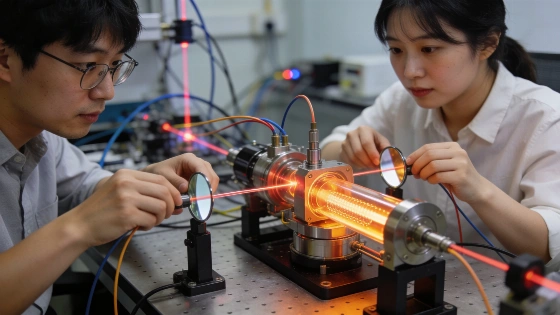
The experiment paired a self-assembled indium arsenide/gallium arsenide (InAs/GaAs) quantum dot, cooled to 12.5 K, with a warm cesium (Cs) vapor cell. Quantum dots are known for their ability to emit single photons on demand at high rates, but they lack intrinsic quantum memory capabilities. In contrast, atomic vapor cells offer stable frequency standards and efficient quantum storage, but typically emit photons at lower rates. By combining these two systems, the researchers aimed to bridge the gap between fast photonic sources and long-lived quantum memories, a central challenge for scalable quantum networks.
Experimental Conditions and Measurement
To achieve spectral overlap, the emission wavelength of the quantum dot was tuned to 917.48 nm, closely matching the 917 nm heralded photons generated by continuous-wave excitation of the cesium atoms. The measured spectral overlap between the two independent sources reached 0.88, indicating a high degree of indistinguishability. The team then performed a Hong-Ou-Mandel (HOM) interference experiment, in which photons from the two sources were directed into a beam splitter. When two indistinguishable photons enter a beam splitter simultaneously, quantum interference causes them to exit together in the same output mode, a signature of nonclassical behavior. After correcting for detector timing resolution, the experiment achieved an interference visibility of 0.65 ± 0.14 under continuous-wave excitation, demonstrating that photons from these distinct sources can interfere directly without external filtering, frequency conversion, or temporal reshaping.
Benchmarking Hybrid Quantum Links
This result marks the first direct two-photon interference benchmark between an atomic ensemble and a solid-state quantum dot without introducing additional optical loss from filtering or conversion stages. The demonstration provides experimental evidence that high-rate solid-state photon sources can be interfaced with atomic quantum memory nodes using a shared atomic frequency standard. Such hybrid links are essential for building quantum repeaters and distributed quantum computing networks that combine the strengths of different quantum hardware platforms. The work complements ongoing efforts to integrate diverse quantum systems, such as the deployment of trapped-ion and photonic nodes in regional quantum networks, as seen in projects like the EPB Quantum Network's integration of trapped-ion computers with photonic infrastructure.
Limitations and Next Steps
While the experiment demonstrates photon indistinguishability and interference between two independent sources, several engineering challenges remain before such hybrid links can be deployed in practical quantum networks. The reported visibility, while significant, is limited by factors including detector timing resolution, spectral mismatch, and residual distinguishability between the sources. Further improvements in photon collection efficiency, spectral tuning, and noise reduction will be required to approach the performance needed for fault-tolerant quantum communication. The experiment was conducted under controlled laboratory conditions, and scaling the approach to longer distances or more complex network architectures will require additional advances in device integration and system engineering.
Two-photon interference is a fundamental quantum phenomenon in which two indistinguishable photons entering a beam splitter simultaneously will always exit together in the same output port, rather than randomly splitting. This effect, known as the Hong-Ou-Mandel (HOM) dip, is a direct signature of quantum interference and is widely used to benchmark the indistinguishability of single-photon sources. Achieving high-visibility HOM interference between photons from different physical systems is a critical requirement for hybrid quantum networks, as it enables the transfer of quantum information between heterogeneous nodes. The ability to demonstrate this effect without active filtering or frequency conversion reduces optical loss and complexity, making it a key step toward scalable quantum interconnects.