

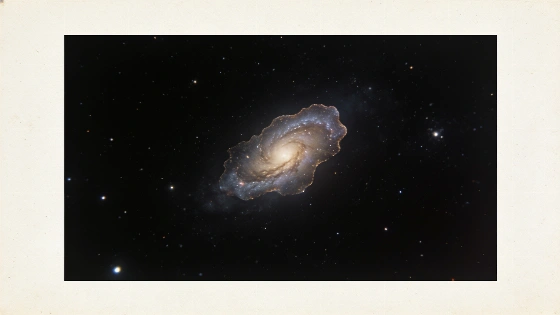
Hubble observations of 37 nearby dwarf galaxies showed far less oxygen than researchers expected. The result suggests these small galaxies retain only a fraction of the oxygen their stars produce, leaving the shortfall unexplained
Released on Nov. 2, 2026, a Hubble image of NGC 4449 features one of the nearby dwarf galaxies researchers examined in a study of missing oxygen. The findings, reported by the Galaxies Losing Oxygen via Winds (GLOW) project, come from a census of 37 gas-rich dwarf galaxies about 19.5 million to 22 million light-years from Earth.
The reported shortfall
Researchers used archival observations from NASA's Hubble Space Telescope to study the galaxies, whose stellar masses range from approximately 3 million to 3 billion times the mass of the Sun. They found that the galaxies retain between 4% and 25% of the oxygen their stars are estimated to have produced, with an average of about 11%. Some systems have therefore lost as much as 96% of their expected oxygen.
The study, "GLOW. II. A Census of Oxygen in Low-mass Galaxies," was published in The Astrophysical Journal under the leadership of GLOW principal investigator Kristen B. W. McQuinn. The census compares the galaxies' present-day oxygen inventories with estimates of the oxygen produced over their star-formation histories.
Hubble's optical images resolved individual stars, helping the team reconstruct when stars formed and estimate their oxygen production. Researchers combined that analysis with infrared and radio observations from NASA's retired Spitzer Space Telescope, the Very Large Array and the Australian Telescope Compact Array. Oxygen can occupy different ionization states, so the inventory also considers gas beyond the galaxies' visible stellar bodies.
When oxygen in surrounding halos is included, the estimated share accounted for rises to roughly 5%-35% of what the stars produced. That halo estimate is distinct from the oxygen retained within each galaxy itself.
Small galaxies
Dwarf galaxies range from a few thousand to hundreds of millions of stars. A separate N159 report covered metallicity in a star-forming region, while this study focuses on oxygen retained by nearby dwarf galaxies.
Oxygen is produced predominantly by massive stars and dispersed into surrounding space through stellar winds and supernova explosions. Because dwarf galaxies have relatively shallow gravitational wells, energetic outflows can carry newly made elements away more readily than in more massive galaxies. NASA's study announcement describes massive-star energy and supernova-driven winds as more effective at driving oxygen out than current models predict.
McQuinn said oxygen is one of the primary elements formed by stars and a practical tracer for studying stellar enrichment. GLOW co-investigator Grace Telford, an assistant professor of physics and astronomy at the University of Utah, said the oxygen must have been inside the galaxies at some point because their stars produced it; she said it must therefore have been ejected.
What remains unclear
The findings identify a substantial oxygen deficit, while the precise outflow history and the final destination of the missing oxygen remain open questions. The study does not establish one definitive mechanism for every galaxy or determine exactly how much oxygen has escaped beyond the galaxies' halos. Its results provide a benchmark for galaxy-evolution models, which must account for the low oxygen-retention fractions and the oxygen that may remain in surrounding halos.
The paper, "GLOW. II. A Census of Oxygen in Low-mass Galaxies," appears in The Astrophysical Journal with DOI 10.3847/1538-4357/ae93a6.







