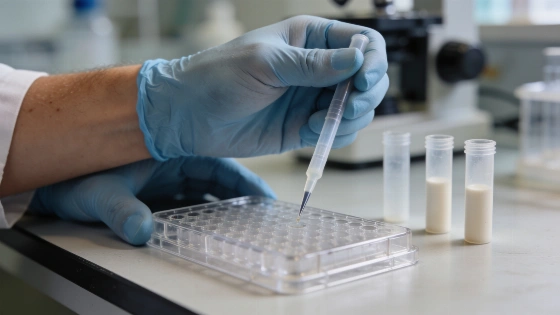
Google researchers narrowed structural calculations to the part of a target where a designed protein should attach. The method accelerated predictions 8.6 times in tests, while laboratory results remain far from evidence of a cancer treatment.
The strongest experimentally tested designs bound fibroblast activation protein alpha (FAP) with single-digit nanomolar affinity. FAP is associated with solid tumors, but the engineered proteins have not been shown to treat cancer. Google Research presented this work as early-stage discovery, not clinical treatment, in a publication dated October 16, 2026, authored by Pooja Rao, Petar Sirkovic and Annalisa Pawlosky.
Google researchers used a faster structure-prediction method to help design the candidate binders. Called "surgical epitope excision," it focuses calculations on the local region where a designed protein is expected to attach instead of processing the entire target. Google reported an 8.6-fold speed increase without sacrificing structural accuracy in its tests. The approach shortens the structure being folded; the computational cost of that modeling scales quadratically with target length.
This is a computational efficiency result, not evidence of clinical benefit. The researchers first designed candidates on computers, then screened them in laboratory experiments using yeast surface display and fluorescence-activated cell sorting. These methods let researchers examine many protein variants and identify those that bind to a target. The measured affinity indicates tight molecular binding; it does not establish that a candidate can safely reach tumors in the body or affect cancer.
The comparison also included a human working with an AI agent. With equal computing resources, the scientist using the agent achieved nearly twice the predicted hit rate of a scientist working alone. That result concerns predicted design hits, not a demonstrated improvement in treatment outcomes.
Google described the protein work as one of three separate research projects on AI agents for biological research. Another project tested DNA aptamers: short strands of DNA that fold into shapes capable of binding specific proteins. Researchers repeatedly designed candidates and tested them in the lab; sequencing results then informed later designs. They ran three rounds against myoglobin and alpha-thrombin, and each round took seven to 10 days.
In the alpha-thrombin experiment, the first round produced no binders. Researchers traced the result to fixed primer regions that disrupted folding in about 48 percent of the sequences. After redesigning the candidates, the second round reached a 26.0 percent hit rate; the third reached 42.1 percent, with 98.5 percent specificity for the target. By the third round of the myoglobin experiment, the on-target hit rate was 33.5 percent and specificity was 72.4 percent. The myoglobin result was reported as a ninefold increase over the starting level. These figures describe laboratory screens, not therapeutic effects.
A separate project introduced VERID, a digital laboratory model that tracks experimental materials, including equipment and liquid volumes. Agents can use it to simulate procedures and check for possible errors before sending commands to lab robots. In a dye-mixing experiment, repeated robotic tests and camera feedback helped an agent improve reconstruction accuracy by more than fivefold. This result has not been shown to transfer to biological experiments.
The demonstrations are distinct, and Google says it plans to combine its robotic control structure with molecular discovery workflows. The company says human oversight and biosecurity screening will remain part of that work. A related example of robotics infrastructure is discussed in earlier robotics coverage; it is a separate effort, not evidence that Google's biological systems are deployed.
Protein structure prediction estimates the three-dimensional shape a sequence of amino acids may form. For a designed binder, the relevant question is whether its predicted shape can fit the target's local binding region. Narrowing computation to that region can reduce processing time, while laboratory screening tests whether candidates bind under experimental conditions. Neither step by itself establishes safety or effectiveness as a cancer treatment.