A periodic gold nanostructure produced different plasmon responses to left- and right-circularly polarized light. The proposed mechanism relies on the focused beam and grating geometry rather than built-in structural asymmetry.
A tightly focused beam on a symmetric gold grating produced opposite momentum shifts for left- and right-circularly polarized light. The resulting plasmon modes split information from the light's polarization, creating an optical analogue of Rashba spin splitting without relying on structural inversion asymmetry.
A spin effect without asymmetry
The conventional Rashba effect arises when a material lacks inversion symmetry. In that setting, an effective electric field couples a particle's spin to its momentum, so particles in different spin states can move in different directions. Researchers use the effect to manipulate electron spins without a magnetic field.
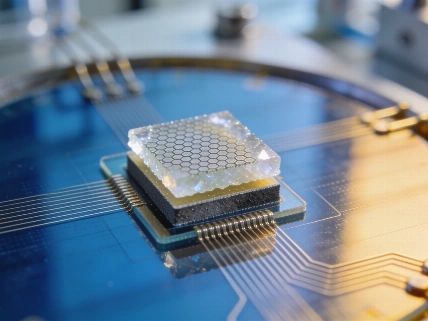
Here the relevant system was a periodic gold nanostructure, or plasmonic crystal. Surface plasmons are collective waves of oscillating electrons at a metal surface, coupled to light. The experiment tested whether a similar spin-dependent split could appear in a structurally symmetric optical system. In this case, the “spin” label refers to light polarization, not electron spin, and the result is not a demonstration of Rashba splitting of electrons in gold.
How the grating shapes light
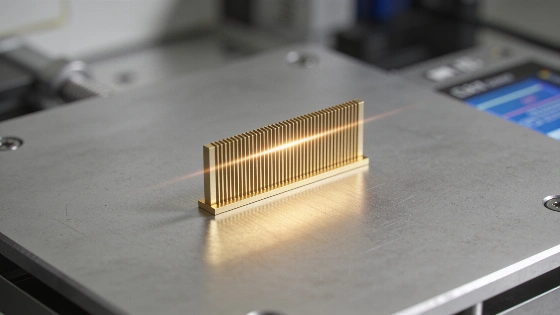
The gold grating has lines running in one direction, making it optically anisotropic: components of the field polarized along the lines interact with the structure differently from components polarized across them. When a beam is tightly focused, its polarization varies across the illuminated field rather than remaining identical at every point.
As the spatially varying field interacts with the grating, linear birefringence and linear dichroism act together. Their combination produces a gradient in geometric phase. This gradient shifts the momentum of left- and right-circularly polarized light in opposite directions, splitting the plasmon modes. The mechanism is described as a geometric effect of linear birefringence and linear dichroism; the grating itself does not need to break inversion symmetry.
What the experiment shows
The researchers illuminated the crystal with polarized light and compared the resulting plasmon modes for left- and right-circular polarization. They observed opposite momentum shifts for the two polarizations. The researchers link the split to focused light interacting with the anisotropic grating, rather than to an inversion-breaking structure.
The result points to a way of producing spin-dependent optical behavior with symmetric metasurfaces, without designing structural asymmetry specifically to create this response. It is an experimental demonstration of a physical mechanism, not a report of a practical optical device or a system-level performance test.
Evidence and limits
The finding concerns the polarization-dependent momentum response of plasmon modes. It does not establish that the optical effect and electronic Rashba splitting share an identical microscopic mechanism: in the plasmonic system, circular polarization plays the role of the spin label, while the grating's anisotropy and the focused beam shape the optical response.
This differs from other spin-based photonics: an earlier spin-wave chip result coupled propagating magnons to a superconducting resonator, whereas this experiment uses optical polarization to shape plasmon modes. The research is described in the 2026 paper "Rashba-like spin splitting in inversion symmetric plasmonic metasurface," by Sujit Rajak et al., published in Reports on Progress in Physics 89, 070501.
In a Rashba system, spin and momentum are coupled, so changing the spin state changes the allowed motion. The plasmonic result reproduces a related spin-dependent pattern in light: circular polarization labels the two opposite shifts. The analogy concerns that polarization-dependent response, not identical particles or an identical microscopic mechanism.