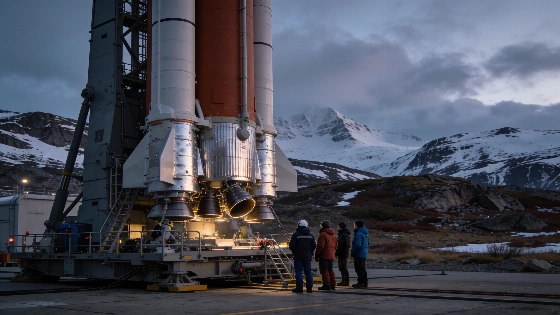
Isar Aerospace's Spectrum rocket has become the first vehicle to reach orbit from a Western European launch site, following a successful mission from Andøya Space Center in Norway that deployed multiple payloads
Europe's commercial launch ambitions took a decisive step forward as Isar Aerospace's Spectrum rocket reached orbit from Norway, marking the first time a Western European launch vehicle has achieved this milestone from European soil. The mission, conducted from Andøya Space Center on September 5, 2026, signals a new operational capability for the continent's private space sector.
Mission Details and Technical Milestones
The Spectrum rocket, a two-stage vehicle standing 28 meters tall, lifted off at 22:12 local time. After a flight lasting just over seven minutes, the upper stage entered an initial elliptical orbit with a perigee of 180 kilometers and an apogee of 500 kilometers. The mission's primary objective was to demonstrate reliable orbital insertion and successful payload deployment, both of which were confirmed by Isar Aerospace approximately two hours after launch.
This second flight, named "Onward and Upward," carried five cubesats and a non-deployable scientific experiment. The upper stage executed a circularization burn before releasing its payloads, completing the sequence required for full mission success. Spectrum is designed to deliver up to 1,000 kilograms to low Earth orbit, positioning it as a workhorse for small and medium satellite launches in the region.
Engineering Challenges and Recovery
The path to this achievement was marked by technical setbacks. Spectrum's first launch attempt in March 2025 ended in failure less than a minute after liftoff due to an unintended vent valve opening and loss of attitude control during a roll maneuver. Isar Aerospace conducted a detailed investigation, identifying the root causes and implementing engineering corrections within two months.
Subsequent launch attempts faced further delays, including a pressurization valve issue, adverse weather, a maritime incursion, and a leak in a composite overwrapped pressure vessel. The June 2026 attempt was scrubbed after off-nominal fluid system behavior was detected. Each incident prompted additional diagnostics and modifications, culminating in the successful September launch.
Implications for European Launch Capability
Spectrum's success establishes a new operational precedent for Western Europe, which has historically relied on launch sites outside the continent or on Russian territory for orbital missions. While Russia's Plesetsk Cosmodrome has supported orbital launches for decades, no Western European site had previously hosted a successful orbital insertion. Isar Aerospace's manufacturing facility near Munich is reportedly capable of producing over 30 rockets per year, suggesting the company aims to scale up launch cadence and support a growing market for satellite deployment.
The mission's outcome also highlights the increasing role of private companies in European space access, paralleling developments in other regions. For context, a recent report covered China's Pallas-1 rocket reaching orbit, reflecting a broader trend of commercial providers advancing technical milestones once dominated by state agencies.
Remaining Questions and Next Steps
While the successful launch and payload deployment mark a significant technical achievement, Spectrum's long-term reliability and operational cadence remain to be demonstrated. The mission did not carry high-value or operational payloads, and the transition from demonstration flights to routine commercial service will require sustained performance and regulatory oversight. The company's ability to maintain quality control as production scales will be critical for establishing trust with satellite operators and institutional customers.
Europe's entry into the orbital launch market with a domestically launched vehicle is a notable development, but the field remains competitive and technically demanding. The next phase for Isar Aerospace will be to translate this milestone into a consistent launch record, supporting both commercial and scientific missions.
Orbital insertion is a critical phase in any launch, involving precise timing and velocity to ensure the payload enters a stable path around Earth. Achieving this requires coordinated engine burns, guidance corrections, and real-time monitoring of vehicle health. Even minor anomalies can result in mission failure, as seen in previous attempts. The transition from initial elliptical orbit to a circularized trajectory is essential for most satellite operations, and successful deployment depends on both vehicle performance and ground-based tracking. As more private providers enter the launch market, the technical and regulatory standards for orbital insertion will continue to shape the reliability and accessibility of space missions.