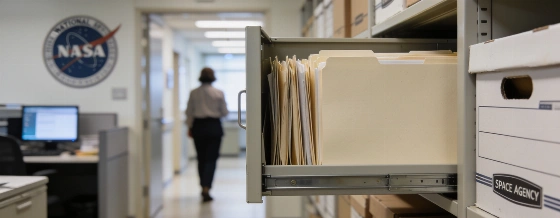
NASA's Widely Attended Gatherings archive brings together event determinations from 2020 through 2026, covering launches, awards dinners, policy meetings and industry receptions while showing why administrative records must be distinguished from scientific evidence.
NASA's Widely Attended Gatherings archive is not a mission-results database or a scientific-discovery log. It is a public record of event determinations that traces where agency representatives were scheduled to appear across the space sector from 2020 through 2026.
The collection is built from linked PDF documents rather than narrative reports. The entries identify events such as the 2026 NAHF Enshrinement Ceremony, An Evening with the Stars EWTS 9.16.26, the Roman Space Telescope Event 8.28.26, the 41st Space Symposium and the 2025 76th International Astronautical Congress_IAC 9.29.25.
That format matters. A WAG determination records an event classification and its associated documentation; it does not by itself establish what was said, who attended, whether an agreement followed or whether a scientific result was produced. In federal ethics practice, the relevant question is generally the official status of an event and whether participation is permissible, rather than the scientific or commercial content implied by its title.
The surrounding ethics framework is also procedural. Under 5 CFR 2641.105 guidance, agency ethics officials and the Office of Government Ethics may advise employees on post-government employment restrictions and 18 U.S.C. 207. Advice may be oral or written, and good-faith reliance can be considered by the Department of Justice even though it does not create automatic immunity. The rule also makes clear that such communications do not create a personal attorney-client privilege for the employee. These limits help explain why an administrative archive should be read as documentation of an institutional determination, not as a confidential legal opinion or scientific finding.
The 2026 entries show NASA's public-facing network spanning government, universities, professional associations, launch companies and nonprofit groups. The list includes the Maryland Space Business Roundtable, Virginia Aerospace Business Association (VASBA) Gala, University of Maryland Acres 7.14.26, Smithsonian National Air and Space Museum_Blue Origin 7.14.26, Northrop Grumman Event 6.17.26 and SpaceX Networking Reception 3.24.26.
Earlier records carry the same mixture of scientific, commercial and civic settings. The archive names the Nancy Grace Roman Space Telescope Mission through the Roman Space Telescope Event 8.28.26, while other entries reference Artemis II, the International Space Station, the James Webb Space Telescope and launch events involving Blue Origin, Rocket Lab, Axiom Space and SpaceX. Those names show the range of subjects around NASA's public-engagement work, not a single research program.
The chronology also exposes recurring meeting points. Maryland Space Business Roundtable entries appear repeatedly in 2026, 2025, 2024, 2023, 2022 and 2020. Space Policy Institute events recur across several years, as do Space Symposium gatherings, Goddard Memorial Dinner events and National Space Club Florida Committee luncheons.
NASA's continuing public calendar gives this archive a contemporary institutional context. On September 17, 2026, NASA Science communications included announcements concerning StarBurst, a SpaceX resupply launch and other current agency activities. Such notices are operational and public-facing; they should not be confused with the separate ethics determinations preserved in WAG files.
The archive is arranged under annual headings, but the dating is not perfectly uniform. The 2026 section runs from January entries such as 2026 Amentum Artemis II Rollout Reception through September events including NAHF Enshrinement Ceremony 9.24.26. The 2025 section includes events from January through December, while the 2024 section includes both launch-related gatherings and professional receptions.
The 2023 section contains records extending from Artemis I Splashdown 01.17.23 to the 2023 Astrobotic PM1 PreLaunch Reception. The 2022 and 2021 sections preserve older migrated files, and the 2020 section includes entries dated in late 2019, including Boeing Orbital Flight Test Launch Events 12.20.19 and Wright Memorial Dinner 12.13.19. A reader should therefore treat the year labels as archive organization rather than assume that every listed date belongs to the heading above it.
The documents also contain signs of administrative history. Some filenames use abbreviations, some repeat events, and some preserve typographical errors such as "KSC Gateway VIP Rception 6.14.22" and "Aarianespace Reception 3.23.22." These imperfections do not erase the records' value, but they reinforce the need to inspect each document rather than derive a precise attendance or activity count from the index alone.
For journalists and researchers, the archive can establish that NASA's Office of the General Counsel maintains determinations connected to a wide range of public events. It can also help locate primary administrative documents tied to launches, awards, receptions, conferences and space-policy gatherings. The archive's practical value is its breadth and persistence: it preserves a paper trail across commercial spaceflight, scientific institutions and government-facing events.
The archive cannot establish the scientific performance of the missions named in the filenames. A Roman Space Telescope event is not a Roman Space Telescope observation, and a launch reception is not evidence of launch success. Likewise, the presence of a company or organization in an event title does not document a contract, endorsement or technical partnership.
That distinction is essential when the archive is read alongside science coverage. A related instrument report can describe hardware and its scientific purpose, but a WAG entry should be read for what it is: an administrative record of a widely attended gathering determination.
Scientific claims require a different evidentiary chain. Instrument measurements, calibrated datasets, mission operations records and peer-reviewed analyses in journals such as Nature are designed to support conclusions about performance or discovery. Organizations including NASA, ESA and MIT may appear in those research records, but their presence at an event does not substitute for experimental methods, uncertainty estimates, independent review or published results.
The broader culture of responsible research reinforces the same principle. The National Academies' 2026 release of a new edition of its widely used guide to responsible research illustrates why transparent procedures, institutional accountability and careful documentation matter across scientific and governmental settings. The guide is not a NASA WAG record, but it provides useful context for reading event archives as part of a wider accountability system.
The archive is strongest as a map of institutional access. It shows NASA operating at the intersection of research, mission development, industry, education and public affairs without pretending that a calendar entry is a measurement. Its real editorial lesson is simple: follow the linked document for the event record and seek mission data or published research for claims about science.
In that sense the collection is useful precisely because its limits are visible. It documents the settings in which NASA engages the space community, while leaving scientific conclusions to instruments, datasets and accountable technical publications.