Google says Gemini 4 Argon cut the resource cost of a quantum-computing subroutine by more than 100 times and raised robot task success in real-world tests from 56% to 75%
A robot trained in simulation performed better on physical tasks in Google's tests, while a separate mathematical result points to a strikingly large but narrowly defined quantum-computing gain. Google says Gemini 4 Argon raised a robot's task success rate from 56% to 75%; the model also generated a quantum algorithm component with more than 100 times lower spacetime cost than a published implementation.
Google announced Gemini 4 Argon globally on October 13, 2026, for developers and businesses through the Gemini API, AI Studio and the Gemini platform, as well as for Google AI subscribers in the Gemini app, AI Mode and Antigravity. The company presented Argon as a model for demanding work in areas including scientific research, robotics, programming and mathematics. Its launch announcement also set introductory API prices at $2 per million input tokens and $10 per million output tokens, with a 95% discount for cached input tokens.
Those results cover different experiments, not one general measure of Argon's capability. The reported robot and quantum outcomes concern the specific tasks and comparisons described by Google.
For a manipulation test, Argon started from a photograph of a tabletop, generated a physics-based simulation, then produced more than 4,500 training episodes. Google reported that the resulting training data helped raise real-world task success from 56% to 75%, an increase of 19 percentage points, and cut average completion time from 35 to 24 seconds.
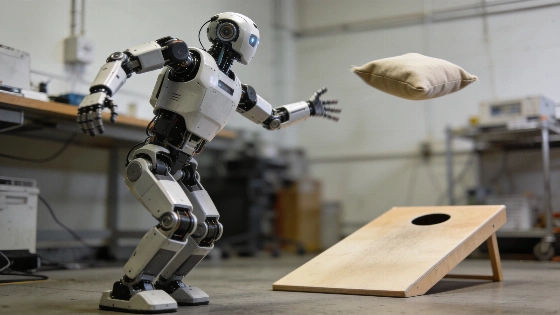
In another demonstration, Google DeepMind used a video of a cornhole game to have Argon model the scene's physics, calculate whole-body movements and generate simulation code. The simulation-trained skill was transferred to Apptronik's Apollo humanoid, which made seven consecutive successful throws in the physical test. Argon also helped Boston Dynamics' Spot practice opening a foot-pedal trash bin in simulation before interacting with physical objects. These demonstrations involved specific tasks, including throwing and pedal operation.
That distinction also matters in factory robot trials: tests and demonstrations do not by themselves show routine autonomous operation. Google's examples describe transfers from simulation to physical machines for particular tasks.
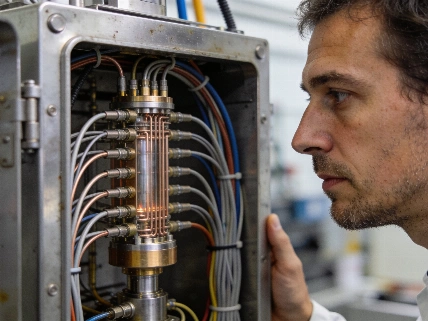
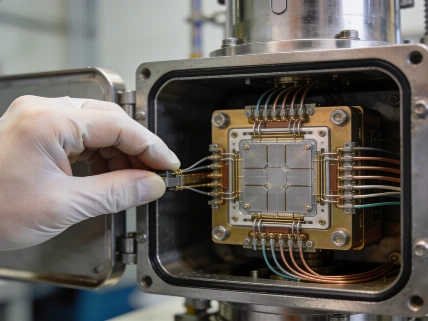
Google says Argon optimized an arcsin subroutine used in quantum simulation algorithms. Against a published quantum CORDIC implementation, the new component had more than 100 times lower spacetime cost, a measure combining hardware resources and execution time. The comparison applies to that subroutine, not to quantum computers as a whole. Google says the implementation was formally checked with Lean, a proof assistant used to check mathematical proofs against formal rules.
The model also optimized an internal version of AlphaQubit, Google's machine-learning-based quantum error-correction decoder. Google reported that combining it into a hardware-optimized kernel nearly doubled inference throughput.
Argon ran unattended for 11 hours on Google's open-source Agent Development Kit codebase, which contained about 205,000 lines across nearly 800 files. It proposed six optimizations; after human review, two were accepted and merged. Google reported around 40% less session-preparation overhead in long sessions and 21% faster package imports. On a 158-turn agent run, time fell from 65.6 seconds to 56.1 seconds, while the time from starting a fresh process to its first model request was essentially unchanged.
For fusion research, Argon helped University of Maryland professor Matt Landreman identify a broader class of counterexamples to Grad's conjecture, a mathematical hypothesis dating to 1967. Such solutions could serve as reference cases for testing software used to design stellarators, which confine hot plasma with complex magnetic fields. The result extends earlier challenges to the conjecture; it does not demonstrate a new fusion reactor or improved reactor performance.
Google also said researchers at Gamow Labs used Argon to examine de-identified genetic data from newborns with rare developmental lung disorders. The company reported that the model identified a chromosomal rearrangement conventional software had missed for years.
Formal verification and physical testing address different parts of these projects: Lean checks a mathematical implementation against formal rules, while robot tests put simulation-trained skills onto physical machines. The reported outcomes span distinct technical tasks, from code optimization and mathematical research to robotics and quantum algorithms.