The Spanish quantum company says its €19.6 million Series A first close will expand chip fabrication and deployment of fluxonium-based systems, but the announcement provides no benchmark or qubit-performance figures
Qilimanjaro Quantum Tech announced on October 14, 2026, the first close of a €19.6 million ($21.9 million) Series A round to expand manufacturing and deployment of its quantum platforms. Indra Group invested €10 million through its IndraMind unit, while Spain's Sociedad Española para la Transformación Tecnológica (SETT), a public technology investment body under the Ministry for Digital Transformation and Public Administration, contributed €9.6 million. The amounts represent roughly 51% and 49% of the first close, respectively.
Indra's investment was made through a convertible instrument, as reported by Cinco Días. SETT had previously invested €1 million in Qilimanjaro. The Series A remains open: the company expects to complete it in the fourth quarter of 2026 with Avançsa and other existing investors, Forbes España reported.
The financing marks a funding milestone, not a reported advance in processor performance: the announcement gives no qubit count, coherence measurement, error rate, or benchmark.
Funding the hardware
The company says the capital will support chip fabrication and commercial deployment of full-stack systems, as well as industrialization, new generations of chips, and expanded production and deployment capacity. Indra's investment through IndraMind brings a defense-industry participant into the funding round. The company's stated areas of interest include quantum computing applied to artificial intelligence and robotics, alongside defense and security applications.
That distinction matters. Investment can provide resources for engineering and production, but it does not by itself establish that a quantum processor performs a useful task better than a classical computer. An earlier hardware report focused on IBM's approach to exposing error-control workflows; Qilimanjaro's announcement instead centers on financing and system deployment.
Fluxonium and multimodal computing
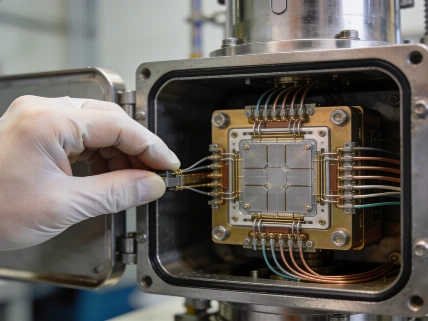
Qilimanjaro, based in Catalonia, builds around fluxonium, a type of superconducting qubit, rather than relying solely on transmons, another widely used superconducting architecture. The company describes fluxonium qubits as having longer coherence times and greater natural resilience to flux noise. The funding announcement supplies no measured values or test conditions for either property, so it does not allow a comparison of the company's devices with transmon processors.
Nor does "multimodal" specify a single processor design. Qilimanjaro says its approach combines analog and digital quantum processing units (QPUs) with classical high-performance computing (HPC). The stated target areas are optimization, simulation, and defense-related artificial intelligence workloads. No particular task, hardware run, classical baseline, or performance result is identified.
Deployment is not a benchmark
The company says its hybrid deployment model is already operating in production environments. It points to an analog quantum system at the Barcelona Supercomputing Center and to the launch of its multimodal Quantum Data Center in Barcelona. These details establish the deployments claimed in the announcement; they do not show how the systems perform or whether users have obtained a measurable advantage over classical computing.
The release provides no information on the number of qubits, gate or readout fidelity, coherence times under operating conditions, system availability, or the tasks run at either site. It also does not say whether the reported deployments are independently evaluated. Without those details, production presence should not be confused with demonstrated commercial utility or a validated quantum advantage.
What remains unreported
The next technical questions are concrete: how reliably can Qilimanjaro fabricate its chips, how do its fluxonium devices perform across a system rather than in selected examples, and what workloads can the combined quantum and classical infrastructure complete? The announcement offers no data to answer them. It reports a financing close and named deployments, not experimental results or a comparison against conventional HPC.
Coherence time describes how long a qubit's quantum state retains phase relationships needed for controlled operations before environmental interactions degrade them. A longer coherence time can help, but it does not alone determine processor capability: gate accuracy, readout, connectivity, calibration, and the workload all matter. Because the announcement gives no corresponding measurements, its stated fluxonium advantages remain a rationale for the architecture rather than a quantified performance result.