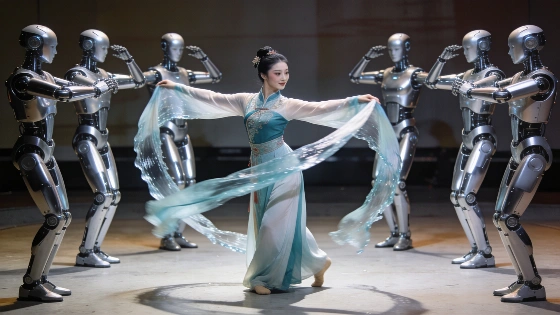
Eight Unitree G1 humanoid robots joined Sichuan dancer Wu Yufei for a synchronized water-sleeve routine in the Season 21 finale of America's Got Talent, demonstrating carefully programmed coordination rather than independent machine improvisation.
Eight humanoid robots entered the Season 21 finale of America's Got Talent alongside 27-year-old Sichuan dancer Wu Yufei and performed a synchronized shuixiu, or water-sleeve, routine. The long sleeves associated with traditional Chinese theater gave Unitree Robotics' machines an unusual assignment: not simply walking or balancing, but reproducing a tightly timed cultural performance in front of a mass television audience.
The act was presented under the name Homies, with Wu performing beside eight Unitree G1 robots. The group reached the finale after its June audition, where Sofia Vergara awarded the act a Live Golden Buzzer, sending it directly to the next stage. In the live finale, however, the robot performance did not win the season; Nene Royal was announced as the winner.
Its appeal was not evidence that the machines can dance independently. It was a controlled demonstration of how precisely a repeated sequence can be distributed across multiple humanoid platforms. The routine combined dance with martial-arts movements and acrobatics, linking a traditional Chinese performance vocabulary to contemporary robotic control.
Reports describing the act outline a pipeline familiar in advanced robotics. Human movement is captured in detail, simulated on computers and converted into motion data before engineers adjust the sequence for physical machines. In practice, this can involve mapping human joint trajectories onto a different robot body, checking collisions and balance in simulation, and tuning timing and actuator commands before hardware trials.
The robots then repeat the programmed actions with mechanical consistency. That consistency is useful on a stage where eight performers must move together, but it is not the same as improvisation, perception or independent artistic judgment. The distinction resembles the difference between replaying a validated trajectory and generating a new one in response to an unforeseen event.
Modern humanoid control typically combines state estimation, feedback loops and trajectory planning. Sensor fusion uses measurements from systems such as inertial units, joint encoders and cameras to estimate posture and motion, while a controller converts that estimate into commands for motors. A rehearsed dance can simplify the perception problem because the timing, location and intended movements are largely known in advance.
Dance nevertheless exposes an important engineering trade-off. A human can adapt to a small change in music, timing or balance, while a humanoid robot generally depends on movement sequences and control parameters prepared in advance. The machines can execute a rehearsed routine repeatedly, yet the demonstration does not establish how they would respond to an unexpected interruption or a change outside the choreography.
Wu's months of training with the robots reportedly made the group feel more like a team than a collection of machines. He also noted that the robots learned choreography quickly, while people were better at adapting to unexpected changes during a performance. That observation captures the human side of the collaboration, but it should not obscure where the coordination comes from: the dancer, the engineers and the programmed control system remain central to the result.
Research in robot learning, including work discussed in Nature Machine Intelligence, often distinguishes between learning or optimizing a motion in simulation and reliably transferring it to physical hardware. Small differences in friction, actuator response, body geometry and contact with the floor can make a simulated movement fail on a real robot. Engineers therefore test, retune and constrain motions before public demonstrations.
The television appearance was not the robots' first display of coordinated movement. Wu and the eight G1 machines appeared during the June audition with a routine combining dance, martial-arts movements and synchronized backflips. The act advanced after receiving the Live Golden Buzzer from Sofia Vergara and later returned for the September 22 finale.
That sequence matters because it shows a progression in presentation rather than a measured expansion of autonomy. The audition emphasized athletic movement and timing. The finale used shuixiu and its flowing sleeves to make the machines' coordination legible to viewers who may not normally watch a robotics demonstration. The stage provides a clear test of repeatability, but it remains a curated environment with a known routine and a human performer directing the expressive center of the act.
Unitree's chief marketing officer Wang Qixin described Homies as the first Chinese team to reach the America's Got Talent finale. The claim is part of the act's public significance, while the technical evidence remains narrower: eight humanoids completed a prepared performance with a human dancer.
The reported performance involved one human dancer, eight Unitree G1 humanoid robots and a 27-year-old performer from Sichuan. The group first appeared in the June audition and returned for the September 22 finale after advancing through the competition. Those figures establish the scale and timeline of the demonstration, but the available reports provide no success rate, number of rehearsals, failure count, intervention log or independent test of the robots' performance.
That missing information limits what can be inferred. A televised routine can demonstrate that a sequence was made to work under the conditions of the show. It cannot establish how often the robots would fail, how much resetting was required, whether an operator intervened during the performance or how the system would behave in an unfamiliar space. No p-values, confidence intervals or controlled comparison with human dancers are reported, so the appearance should not be treated as a formal experiment.
The broader platform has been shown performing walking, balancing, martial arts and backflips. Unitree robots also appeared alongside human dancers at China's annual Spring Festival Gala, helping bring humanoid machines into commercial events and public entertainment. These appearances put balance, motion control and multi-robot synchronization in front of large audiences, but they do not replace formal evaluation of reliability, safety or useful work.
That distinction is important as the public encounters more humanoid robots through performances. A related robot report about a controlled sprint makes the same point from another direction: a striking physical feat is evidence about a particular task under particular conditions, not a general measure of machine capability.
Entertainment gives robotics companies a powerful demonstration environment. Audiences can immediately see whether machines stay upright, keep time and coordinate with a person. Repetition is an asset rather than a weakness when the goal is a clean routine, and a group of identical robots can reproduce the same motion without the small timing differences that complicate human group choreography.
But the stage also hides the hardest parts of deployment. The input sequence is known, the action is short and the objective is visually obvious. The performance says little about perception in clutter, manipulation, recovery from faults, safe interaction with untrained people or operation over long periods. It also does not show whether the robots are autonomous, remotely supervised or simply executing a prearranged control program.
Work at institutions such as MIT has shown why physical robots require more than a visually successful trajectory: controllers must handle uncertainty, contact changes and disturbances while respecting the limits of motors and structure. Those requirements are especially important for humanoids, whose narrow support base and many degrees of freedom make balance a continuous control problem rather than a one-time pose calculation.
That is why the America's Got Talent appearance should be judged as a robotics demonstration rather than a milestone in machine intelligence. It shows that humanoid platforms can be choreographed into a visually demanding group routine and that traditional performance can provide a compelling public test of synchronization. It does not show that the robots understand the dance, improvise with the musician or operate without human preparation.
The most defensible reading is also the most useful one: Unitree has moved its humanoids from isolated technical displays into mainstream entertainment without removing the engineering limits that make such displays possible. The water-sleeve finale is impressive because the machines can repeat complex movement in formation, but its real lesson is that reliable robotics still depends on carefully bounded tasks, extensive preparation and human control.
Sensor fusion means combining data from multiple sensors to estimate the robot's position and surroundings, while motion control turns that estimate into commands for its actuators. A dance routine can reduce the perception problem because the required movements and timing are known in advance. That is different from open-ended autonomy, where a robot must detect unexpected changes, choose an action and recover safely. The distinction is central here: the performance demonstrates programmed coordination, not general-purpose independence.
The same caution applies to claims about intelligence. NASA's autonomous systems research, CERN's complex instrument control and robotic work reported across journals such as Nature all distinguish a system's performance on a defined task from broad, human-like understanding. The Unitree act belongs in that narrower category: a technically demanding, highly rehearsed demonstration whose strongest evidence concerns synchronization, repeatability and presentation.