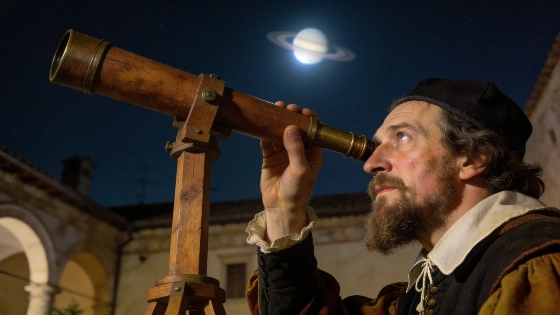
In July 1610, Galileo Galilei used a newly invented telescope to observe Saturn, recording features that would later be identified as the planet's rings-a finding that reshaped our understanding of planetary systems
More than four centuries ago, Galileo Galilei turned a primitive telescope toward Saturn and recorded a sight that would puzzle astronomers for decades: the planet appeared to have unusual appendages, unlike anything seen before in the night sky. This early telescopic observation, made in July 1610, marked the first recorded detection of Saturn's ring system, though its true nature would not be understood until much later.
Galileo's Early Observations
Galileo's telescope, built just two years after the instrument's invention, offered only modest magnification and limited optical clarity by modern standards. When he observed Saturn, Galileo noted what he described as "ears" or "handles" on either side of the planet. He speculated that these might be large moons or physical extensions of Saturn itself, as the telescope's resolution was insufficient to reveal the rings as distinct structures. The true explanation would remain elusive until 1659, when Christiaan Huygens, using a more advanced telescope, correctly identified the features as a broad, flat ring encircling the planet.
Galileo's observations were part of a broader wave of discoveries enabled by the telescope, including his identification of Jupiter's four largest moons-now known as the Galilean moons. These findings demonstrated the power of telescopic astronomy to reveal new planetary phenomena and challenged prevailing models of the solar system.
Interpreting the Rings
For decades after Galileo's initial report, astronomers debated the nature of Saturn's appendages. The limitations of early telescopes led to competing theories, including the possibility of multiple large satellites or transient features. Only with improved optics and repeated observations did the consensus emerge that Saturn was surrounded by a ring system, composed of countless small particles orbiting in a thin, flat plane.
Modern studies have shown that Saturn's rings are primarily made of water ice, with particle sizes ranging from micrometers to meters. The rings are shaped and maintained by gravitational interactions with Saturn's moons, including so-called "shepherd moons" that confine ring material into sharply defined bands. Distinctive features within the rings, such as gaps and clumps, continue to be active areas of research, with some structures-nicknamed "kittens"-still not fully explained.
From Early Telescopes to Spacecraft
Saturn's rings have been observed by a succession of increasingly sophisticated instruments. In the late 20th and early 21st centuries, spacecraft such as Pioneer 11, Voyager 1, Voyager 2, and Cassini provided high-resolution images and in situ measurements, revealing the rings' complex structure and composition. Cassini, which orbited Saturn from 2004 to 2017, made repeated passes through the ring plane and ultimately ended its mission with a controlled descent into the planet's atmosphere.
These missions have enabled detailed studies of ring dynamics, particle composition, and the interactions between rings and moons. Observations at different wavelengths, including visible, infrared, and radio, have revealed variations in ring particle size and composition, as well as evidence for ongoing processes that may alter the rings over time. The study of Saturn's rings has also informed our understanding of disk systems elsewhere in the universe, including protoplanetary disks around young stars.
Scientific Legacy and Broader Impact
Galileo's initial observation of Saturn's rings was a turning point in planetary astronomy, demonstrating that planets could possess complex, previously unimagined structures. The discovery paved the way for the identification of ring systems around other giant planets, including Jupiter and Uranus, and contributed to the development of models for planetary system formation and evolution. The ability to resolve such features has depended on advances in both ground-based and space-based instrumentation.
Today, Saturn's rings remain a focus of active research, with questions about their age, origin, and long-term stability still under investigation. The legacy of Galileo's observation is evident in the ongoing effort to interpret new data from planetary missions and telescopic surveys. For readers interested in how modern spacecraft continue to expand our view of the solar system, a recent mission imaged Earth and the Moon in both visible and thermal infrared light, as described in this report on NASA's ESCAPADE spacecraft.
Understanding how astronomers interpret planetary features depends on the resolving power of their instruments. Angular resolution-the ability of a telescope to distinguish small details-determines whether features like Saturn's rings appear as distinct structures or blurred extensions. Early telescopes, limited by small apertures and optical imperfections, could not separate the rings from the planet's disk, leading to ambiguous observations. Improvements in lens quality, mirror size, and detector sensitivity have since enabled astronomers to resolve fine details in planetary systems, both within our solar system and around distant stars. The history of Saturn's rings illustrates how advances in instrumentation drive progress in planetary science.