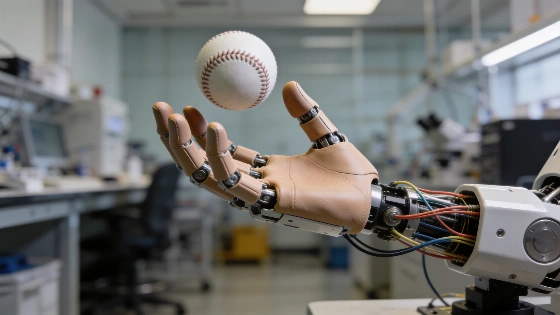
Foundation Robotics has demonstrated a tendon-driven robotic hand that can catch a baseball in mid-air, highlighting advances in mechanical design, adaptive grasping, and sensor integration for industrial humanoid robots
Foundation Robotics, a US-based robotics developer, has released a demonstration of its latest robotic hand prototype performing a controlled catch of a baseball thrown in mid-flight. The test, conducted under laboratory conditions, is intended to showcase progress in robotic dexterity and adaptive manipulation, with the company emphasizing the system's ability to handle fast, dynamic tasks that have historically challenged automated grippers.
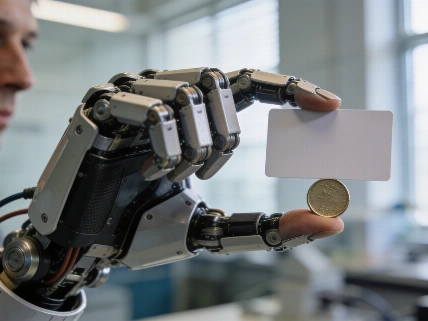
The new hand is built around a tendon-driven architecture, with motors relocated from the fingers to the forearm. This design reduces the weight and bulk of the fingers, allowing for slimmer, lighter appendages that can still generate the force required for rapid, precise movements. Flexible tendons route from the forearm through engineered pathways to each finger joint, enabling coordinated flexion and extension. The fingers can move independently and adjust their shape, forming a cupped grip for spherical objects like baseballs or a pinch grip for smaller items, without the need for specialized end-effectors.
Sensor Fusion and State Estimation
Unlike many robotic hands that rely exclusively on physical joint sensors, Foundation's prototype uses a hybrid approach. The control software estimates finger positions in real time by combining motor rotation data with a geometric model of the tendon system. This software-based estimation allows the hand to maintain awareness of its configuration even if individual sensors fail. For additional accuracy and redundancy, each joint is equipped with tunnel magnetoresistance (TMR) sensors, which measure joint angles with sub-degree precision. These sensors refine the software's estimates and provide backup in environments where sensor reliability is a concern.
Minimizing friction in the tendon routing is a key engineering challenge. Low-friction pathways ensure that motor commands translate accurately into finger motion, maintaining synchronization between intended and actual positions. This precision is critical for tasks like catching a baseball, where the fingers must close quickly and absorb impact without losing grip or bouncing the object away. According to Foundation Robotics, the demonstration was carefully planned, with the throw trajectory and timing controlled to match the hand's capabilities. The company has not disclosed the number of trials or the overall success rate, and independent verification of repeatable performance is not yet available.
Industrial Context and Limitations
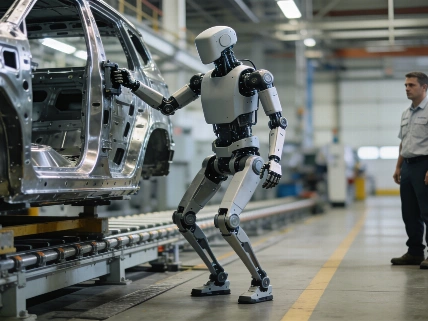
The robotic hand is designed for integration with Foundation's Phantom humanoid robots, which are intended for industrial environments. Unlike earlier gripper-style hands, the new prototype features independently actuated fingers, anatomically inspired joints, and adaptive grasping capabilities. These advances are aimed at expanding the range of tools, components, and irregular objects that humanoid robots can manipulate in real-world settings. However, the demonstration remains a controlled laboratory test, and the system's reliability, safety, and performance in unstructured industrial environments have not been established.
Foundation Robotics' approach reflects a broader trend in robotics research, where tendon-driven hands and advanced control algorithms are being developed to close the gap between human and robotic dexterity. Similar efforts have been reported by other research groups, including work on predictive motion planning and dynamic manipulation. For example, recent advances in full-body humanoid control, such as those described in Google DeepMind's Gemini Robotics project, highlight the growing focus on coordinated, high-speed tasks in robotics. Despite these advances, most demonstrations remain limited to controlled settings, and the transition to robust, unsupervised operation in complex environments is an ongoing challenge.
In the reported demonstration, the robotic hand's ability to catch a baseball depends on precise motion planning, accurate state estimation, and reliable actuation. The company has not released detailed performance metrics, such as the number of successful catches per attempt, latency between object detection and grasp, or the range of object sizes and shapes handled. Without systematic evaluation and independent testing, it is not possible to assess the system's general reliability or suitability for safety-critical applications.
Robotic manipulation remains a central challenge for industrial automation, particularly in environments where objects vary in size, shape, and orientation. While tendon-driven hands and adaptive control algorithms represent significant engineering progress, the evidence for robust, general-purpose manipulation outside the laboratory is still limited. Ongoing research will need to address failure modes, safety risks, and the requirements for meaningful human oversight before such systems can be widely deployed in industrial or public settings.
Understanding tendon-driven robotic hands requires familiarity with the principles of robot perception and actuation. In these systems, motors generate force that is transmitted through flexible tendons to finger joints, mimicking the function of muscles and tendons in the human hand. Accurate state estimation-combining sensor data and software models-is essential for reliable operation, especially when physical sensors may fail or drift over time. This approach allows for redundancy and fault tolerance, but also introduces complexity in calibration and control. As robotic hands become more dexterous, the challenge shifts from basic actuation to precise, adaptive manipulation in unpredictable environments, where safety, reliability, and human oversight remain critical concerns.